Can I Use a 50V Capacitor Instead of a 25V?
Yes, you can use a 50V capacitor instead of a 25V one, as long as the capacitance in microfarads is the same. The voltage rating is a maximum, not an operating point, so a 50V capacitor in a circuit that ran a 25V part still only sees the circuit’s actual voltage. It just carries twice the headroom. If anything, that makes it the safer choice against voltage spikes. The one real trade-off is physical size, covered below.

Last updated: August 13, 2026 — tightened the guidance, removed a bad external link, added the size math and an FAQ.
Why It Works
A capacitor’s voltage rating is the maximum voltage it can hold before its dielectric fails. Using a part with a higher rating raises the safety ceiling without changing anything the circuit relies on. The capacitance sets the electrical behavior; the voltage rating just sets the limit. So a 50V cap and a 25V cap of the same µF behave identically in the circuit, right up until you exceed 25V, where the 50V part keeps going and the 25V part would be in trouble.
That headroom is the whole appeal. Run a capacitor close to its rated voltage and spikes, ripple, and heat all shorten its life. Double the rating and you buy margin. When I am repairing a board and only have 50V parts on the shelf, I reach for them without a second thought as long as the µF is right.
The Real Trade-Off: Physical Size
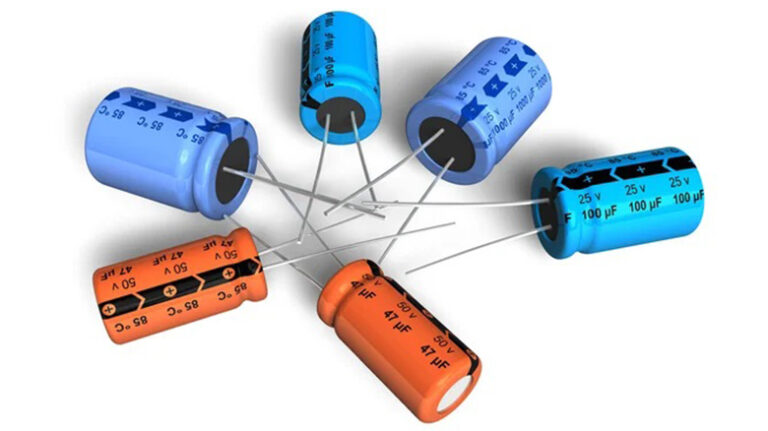
Higher voltage ratings cost space. To hold more voltage, an electrolytic needs a thicker oxide layer and thicker foil, so the case grows. As a rough rule for electrolytics, doubling the voltage rating can roughly quadruple the volume for the same capacitance. A 50V part is often noticeably bigger than the 25V equivalent.
That matters in two ways:
- Fit. Confirm the taller or wider part clears its neighbors and any cover, and that the leads match the board. If space is tight, check standard lead spacing for capacitors.
- Don’t overshoot. Designers keep circuits compact, so jumping to a far higher rating than you need wastes board space for no benefit. A 50V-for-25V swap is sensible; a 250V-for-25V swap is just bulk.
When I Use a 50V Capacitor Instead of a 25V
Most of my swaps up to 50V happen for practical reasons, not theory. Here is when I reach for the higher-rated part on purpose:
- The circuit has occasional voltage spikes and you want margin.
- 50V is what you have on hand, and 25V would need ordering. Same µF, so it drops in.
- The part runs hot, and extra voltage headroom helps it survive.
For the neighboring case one step down, see can I use a 25V capacitor instead of a 35V, and for the general rule, what happens if you use the wrong size capacitor.
Frequently Asked Questions
Is it OK to replace a capacitor with a higher voltage rating?
Yes, this is the standard safe upgrade. Keep the capacitance the same and confirm the larger part physically fits.
Can I use a 50V capacitor in a 12V circuit?
Yes. The higher rating gives extra margin against spikes. The capacitor only ever sees 12V, well inside its limit.
Does a 50V capacitor store more energy than a 25V one?
Not on its own. Stored energy depends on capacitance and the actual applied voltage, not the rating. Same µF at the same circuit voltage stores the same energy.
Do I need to match the µF exactly?
Match it closely. Capacitance drives behavior, so keep it the same in timing and tuned circuits; filters tolerate small differences.
Is there any downside to going higher in voltage?
Mainly size and sometimes cost. Electrically it is fine; a much larger case can be a mechanical problem on a dense board, which is why I don’t jump further up the rating ladder than the circuit needs.
My Rule of Thumb
When I decide whether to use a 50V capacitor instead of a 25V, I ask two things: does the µF match, and will the bigger can fit? If both are yes, I do it without hesitation, because the extra headroom is genuinely useful and costs me nothing electrically. What I don’t do is chase ratings for their own sake. I have watched people put a 100V or 250V cap in a low-voltage logic supply “to be safe” and end up fighting a part that won’t sit on the board. Match the µF, go up one sensible step in voltage, and move on.
Bottom Line
A 50V capacitor is a safe stand-in for a 25V one when the capacitance matches. You gain spike margin and lose nothing electrically. Watch physical size, since higher-voltage electrolytics are bigger, keep the polarity correct, and don’t jump to a far higher rating than the circuit needs.