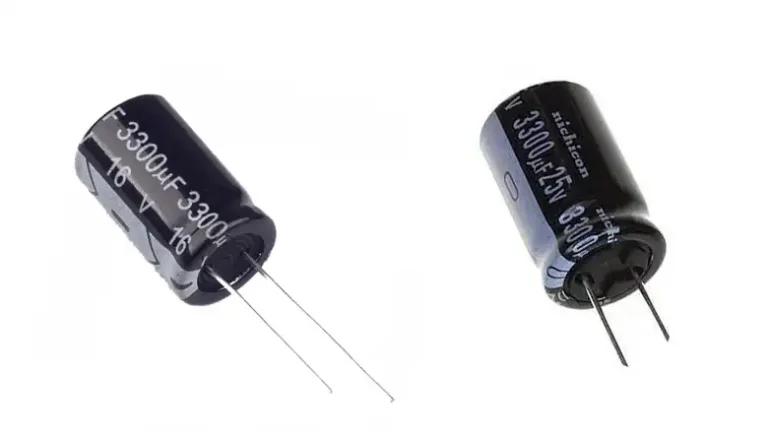
What Is the Peak Voltage Across the 4.0μF Capacitor? Answered
The peak voltage across the 4.0μF capacitor equals 1.414 times its RMS value. That is the whole answer. When a handheld meter shows 120 V RMS sitting on that cap, the crest actually climbs to roughly 170 V, and the size of the component, be it four microfarads or forty, never shifts that ratio one bit. Size changes something else entirely. It governs how hard current has to push to build the swing, and that quiet detail is where beginners keep stumbling.
Last updated: August 13, 2026. Rewrote the page as a worked example, added the reactance formula, a spec table, a fresh FAQ, and links to related guides.
How to Find the Peak Voltage Across the 4.0μF Capacitor
Begin with whatever figure your meter hands you. A budget multimeter set to AC reports RMS. Never the crest. So you translate it.
- Note the RMS reading on the component. Assume 120 V.
- Scale that number by the square root of two, close to 1.41 times.
- Whatever pops out is your crest. 120 multiplied by 1.414 lands at 169.7 V, near enough to 170.
Finished. A crest is simply the RMS figure stretched up by about 1.41 times, since a sinusoid rises exactly that far above its averaged level at the top of every swing. Nothing about the four-microfarad rating alters it. The same trick works on any cap fed a clean sine wave.
Now the twist newcomers miss. Inside an alternating circuit the potential and the flow through a capacitor march ninety degrees apart. Flow peaks while the potential slips through zero. The potential tops out exactly when flow has faded to nothing. I keep a hand-drawn sketch of that lag pinned beside my soldering station, because once it lodges in your head the rest of the arithmetic stops feeling like guesswork.
Working the 4.0μF Example End to End
Let me walk a complete case the way I run it on the bench. Picture a four-microfarad part wired straight across a 120 V RMS, 60 Hz outlet.
Crest first. Multiply 120 by 1.414 and you get about 170 V. Easy. I have run this exact sum hundreds of times, and it never changes.
Current is trickier, and here the rating finally earns its keep. A capacitor opposes alternating flow through something called reactance, tagged Xc. Its formula reads Xc = 1 / (2πfC). Feed in the terms: two, times pi, times sixty, times 0.0000040 farads. The math settles near 663 ohms. Draw becomes 120 divided by 663, roughly 0.18 A, and the crest of that draw is 0.18 stretched by 1.414, close to 0.26 A.
Look what happened. The four-microfarad figure left the crest untouched. It merely fixed the reactance, which in turn fixed the flow. Drop in a forty-microfarad cap instead and reactance shrinks tenfold, so ten times the draw rushes in, yet the crest still shadows the wall supply precisely as before.
| Quantity | Symbol | Value in this example |
|---|---|---|
| Capacitance | C | 4.0μF |
| Source (RMS) | V | 120 V |
| Peak voltage | Vpk | ~170 V |
| Reactance at 60 Hz | Xc | ~663 Ω |
| Peak current | Ipk | ~0.26 A |
Why the Peak Voltage Across the 4.0μF Capacitor Matters
Because the crest bruises the part, not the tidy RMS average. Slap a cap marked “160 V” onto a 120 V RMS line and it already lives on a knife edge, since the genuine top reaches 170. I have watched that exact mistake bite. Somebody eyeballs the 120, grabs a 160 V part, and it pops on the bench weeks later.
The root mean square value is a smoothed average of a waving signal. The crest is the raw ceiling. A datasheet quotes a maximum working figure, and you always size against that ceiling with breathing room stacked on top. My habit: choose a rating at least half again above the expected top. Facing a 170 V crest, that pushes me toward a 250 V part or better.
Overshoot the limit and the insulating layer between the plates surrenders. Charge leaps the gap. Heat builds. An electrolytic can hiss and rupture in under two seconds. The rating you settle on behaves like a wall, not a polite hint.
Two smaller gremlins also tug on the real number:
- Tolerance. A part stamped 4.0μF might drift twenty percent either way. That barely budges the crest, though it nudges the draw and any filter corner frequency. Whether that wobble truly matters hinges on the job in front of you.
- Aging. Wet electrolytics slowly dry and wander across years of service, tweaking reactance and ripple. Plastic film types hardly flinch.
How Charge and Voltage Tie Together
The potential on a capacitor answers to the charge parked on its plates. The link is Q = C × V, which rearranges to V = Q / C. Shove extra charge aboard and the potential rises. Bleed charge away and it sinks.
Stored energy trails a second rule, Energy = 0.5 × C × V². Spot the square. Double the potential and you quadruple the hoarded energy, which explains why a charged high-tension cap stays lethal long after the plug leaves the socket. Need the breakdown across a whole string of caps in series? That is a separate sum, laid out in the potential difference across each capacitor.
Two facts worth burning into memory:
- A capacitor refuses steady DC. It merely hoards charge on facing plates.
- Its potential cannot leap in an instant, because a leap would demand endless current for a frozen moment.
A Quick Bench Method
When I need the crest in a hurry and own nothing but a meter, this is the shortcut I lean on.
- Grab the RMS reading across the cap on the AC range.
- Triple-check nothing, just multiply by 1.414, or slap on forty percent for a rough field guess.
- Weigh that crest against the printed ceiling.
- If the crest lands within thirty percent of the rating, reach for a higher-voltage part. Trust me on that margin. I have paid for skipping it.
Own a working oscilloscope? Ditch the arithmetic. Clip a probe on the cap and read the top straight off the glowing trace. A scope hands you the crest directly. No conversion. No fuss.
Frequently Asked Questions
What is the peak voltage across the 4.0μF capacitor if the RMS is 120 V?
About 170 V. Take 120 and multiply by 1.414, which lands at 169.7 V. The four-microfarad rating plays no part in this figure, only in the current.
Does a bigger capacitor give a higher peak voltage?
No. The crest tracks the source, never the capacitance. A fatter cap simply pulls more current at the identical crest, because its reactance runs lower.
How do I convert RMS to peak voltage?
Multiply the RMS reading by the square root of two, near 1.414. For a fast field guess, tack roughly forty percent onto the RMS number and move on.
Why does the current peak when the voltage is zero?
Current in a capacitor leads the potential by ninety degrees. Flow is fiercest while the potential shifts quickest, which happens as it slices through zero. At the very top the change rate is nil, so nothing flows.
What voltage rating should I pick for a 120 V RMS line?
Size against the 170 V crest, not the 120 V average. I want at least half again on top, so a 250 V part is the comfortable pick.
Can the voltage across a capacitor change instantly?
No. A true instant jump would call for infinite current, which physics forbids. The potential always ramps, quick or slow, yet never in zero time.
Related Reading
Bottom Line
The peak voltage across the 4.0μF capacitor is 1.414 times the RMS reading, so 120 V RMS translates to a crest near 170 V. Capacitance rules the current through reactance, never the crest itself. Pick a rating that clears the crest with real margin, and whenever a scope is within reach, read the top off the screen instead of trusting bare RMS math.