What Happens if You Use the Wrong Size Capacitor? Is It Safe?
What happens when you use the wrong size capacitor depends entirely on which spec is wrong. “Size” means three different things on a capacitor, and they carry very different risks: the voltage rating, the capacitance in microfarads (µF), and the physical case size. Get the voltage rating too low and the part can bulge, leak, or burst. Get the µF wrong and you usually get a performance problem, not a bang, except in motors, where the wrong µF cooks the windings. Physical size almost never matters electrically. Sort out which one you are actually asking about before you swap anything.
Last updated: August 13, 2026 — rebuilt around the three meanings of “size,” added a decision guide and safety table.
First, Which “Size” Are You Changing?
Run through this before you decide anything:
- Is the voltage rating lower than the original? Stop. This is the one genuinely dangerous mistake. Skip to the voltage section.
- Is the voltage rating higher, everything else equal? Almost always fine. Higher voltage rating is free safety margin.
- Is the capacitance (µF) different? The answer depends on the circuit. A motor, a power-supply filter, and a timing circuit each react differently. See the µF section.
- Is only the physical case bigger or smaller? Electrically irrelevant in most circuits, with one exception (low-ESR switching supplies) covered below.
Wrong Voltage Rating: The Only Real Safety Issue
The voltage rating is the maximum voltage the capacitor can hold across its terminals without its dielectric breaking down. This is where “wrong size” becomes a safety question.
Too low is dangerous. Put 20 V across a capacitor rated for 16 V and the dielectric is over-stressed. It heats up. Pressure builds. Eventually the electrolytic vents through its scored top, or it bursts. I once watched an under-rated 10 V cap in a 12 V rail balloon within minutes on the bench. Don’t do this. Not even “just to test.”
Higher is safe and often smart. A 50 V capacitor in a 12 V circuit only ever sees 12 V. That is well inside its limit. Designers frequently pick a rating at least 1.5 to 2 times the working voltage to survive spikes. If you want the full reasoning, see can I use a 50V capacitor instead of a 25V and replacing a 16V capacitor with a 25V.
Wrong Capacitance (µF): It Depends on the Circuit
This is where most people ask “what size” and where the answer branches hard. Match the row to your circuit:
| Circuit type | Wrong µF too low | Wrong µF too high | Match tolerance |
|---|---|---|---|
| Motor run capacitor | Weak torque, motor hums, overheats, short life | Uneven magnetic field, overheating, short life | Tight (±5–10%) — replace exact |
| Motor start capacitor | Motor struggles or fails to start | Usually tolerable | ±20% or use a range-rated part |
| Power-supply filter / smoothing | More ripple, possible hum/instability | Usually fine, sometimes better; watch inrush | Loose — bigger is generally safe |
| Timing / oscillator (RC) | Frequency shifts, timing off | Frequency shifts the other way | Exact — µF sets the frequency |
| Tuned filter / crossover | Cutoff frequency moves | Cutoff frequency moves | Exact |
| Coupling / decoupling | Weak low-frequency passage | Usually fine | Loose |
Motors are the strict case
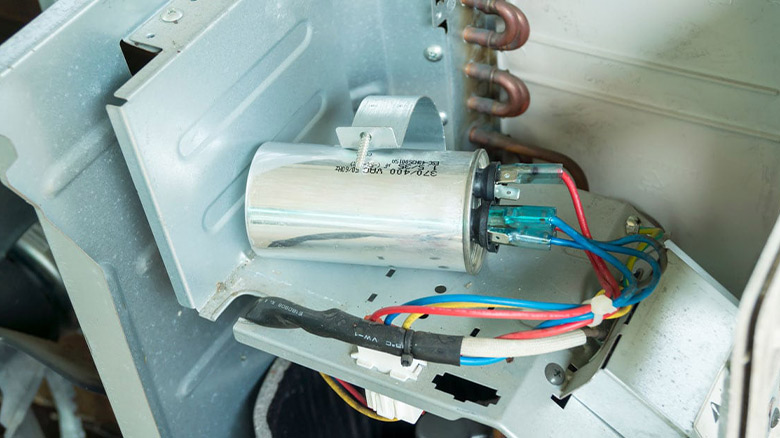
In a single-phase motor, the run capacitor sets up the phase shift that creates a rotating magnetic field. The wrong µF distorts that field, the rotor hesitates through the weak spots, and the motor gets noisy, draws more current, and overheats. Both too-high and too-low µF shorten winding life. Motor makers test specific motor-and-capacitor pairs, so I always replace a run capacitor with its exact µF value rather than “close enough.” A start capacitor is more forgiving because it only acts for a moment during spin-up.
Power supplies are the forgiving case
In a filter or smoothing role, the capacitor’s job is to hold charge and flatten ripple, and because more capacitance simply stores more energy between the peaks of the rectified waveform, nudging the value upward usually leaves you with cleaner DC rather than a problem. Bigger is often better here. Up to a point. The one caution is inrush: a much larger capacitor gulps a bigger surge of current at the instant you switch on, and that unglamorous detail is what stresses a rectifier or pops a fuse when someone gets carried away and fits ten times the original value.
Timing and tuned circuits are exact
If the capacitor sits in an RC oscillator, a 555 timer, or a filter, its µF is part of a frequency equation. Change it and you change the frequency. As one reader put it, small deviations “add up” — a slightly-off timing capacitor throws the whole interval out. In these circuits, match the value.
Can You Go Up in µF? By How Much?
For motor start capacitors, you can generally go up to about 20% higher µF, and the replacement’s voltage rating must equal or exceed the original. For a run capacitor, match it. For a filter capacitor, a bump such as swapping a 5 µF for a 7.5 µF is often fine, since raising capacitance lowers capacitive reactance and lets the cap pass more current, but confirm the surrounding circuit can handle it. When in doubt about tolerance in precision circuits, read does capacitance tolerance matter.
Does the Physical Size Matter?
Usually no. If capacitance, voltage rating, and ESR match, a physically smaller or larger electrolytic capacitor behaves the same electrically. Two real exceptions:
- Low-ESR switching supplies. Here the capacitor’s equivalent series resistance and inductance matter. A physically different part may have different ESR and misbehave, so match the low-ESR spec, not just the µF.
- High-frequency bypass. Small chip capacitors have lower parasitic inductance (ESL) and respond better at high frequency, while large capacitors handle bulk energy and DC. That is why boards use both.
Frequently Asked Questions
Is it safe to use the wrong size capacitor?
It is safe only if the wrong dimension is a higher voltage rating or a loose-tolerance filter value. A voltage rating below the circuit’s working voltage is not safe and can make an electrolytic capacitor burst.
What happens if a capacitor is too big (too high µF)?
In a filter, usually nothing bad, sometimes better ripple performance, though inrush current rises. In a motor, too-high µF distorts the magnetic field and overheats the windings.
What happens if a capacitor is too small (too low µF)?
Filters get more ripple, timing circuits drift off frequency, and motors lose torque and run hot. How much it matters depends on the circuit, per the table above.
Can I replace a capacitor with a higher voltage but same µF?
Yes. Same capacitance with a higher voltage rating is the standard safe upgrade. Only the voltage headroom changes.
Can I use a 7.5 µF capacitor instead of a 5 µF?
In a filter or non-critical role, usually yes. In a motor run position or a timing circuit, no, match the rated value.
What I Check Before Any Capacitor Swap
Here is my own bench routine, and I would recommend you make it yours. First I read the µF off the old part, because that is the number I refuse to guess at. Then I confirm the voltage rating on my replacement is equal or higher, never lower. If it is a motor run capacitor, I stop looking for substitutes and order the exact value. If it is a filter cap, I let myself go up a little on µF but keep an eye on inrush. Last, I dry-fit the part to be sure it clears its neighbors. Do that in order and you will not get caught out.
Don’t overthink the physical case. When people tell me a repair “still runs hot,” it is almost never the capacitor’s dimensions. It is a wrong µF in a motor. Or a marginal voltage rating that finally gave up. Size of the can is rarely the villain.
Related Reading
- can i use 25v capacitor instead of 35v
- can i use a 63v capacitor instead of 25v
- does size matter in capacitor
- standard lead spacing for capacitors
Bottom Line
“Wrong size” is really three questions. Wrong voltage rating (too low) is the dangerous one and can burst the part, so never drop below the circuit’s working voltage. Wrong µF is a performance question whose severity depends on the circuit: strict for motors and timing, forgiving for power-supply filters. Physical case size rarely matters unless you are in a low-ESR switching supply. Identify which spec you are changing, match it to the table, and you will know both whether it works and whether it is safe.