Can Choke Be Replaced by Resistor? A Bench Verdict
No. In most circuits, a choke cannot be replaced by a resistor. A choke is a low-resistance inductor that blocks alternating current while passing DC, and it does this with almost no power loss. A resistor just burns energy as heat and treats AC and DC the same. Different jobs, different parts.
Last updated: August 13, 2026 — rewrote as a comparative verdict, added a spec table, an FAQ, and bench notes.
Can Choke Be Replaced by Resistor: The Short Answer
Here is the verdict up front. If the circuit needs frequency-dependent behavior, keep the choke. If it only needs a fixed voltage drop or current limit at DC, a resistor can stand in.
That is the whole thing in two sentences. The rest of this page explains when each rule applies. In my experience, when I tested both parts side by side on a scope, the difference was obvious within seconds.
A choke reacts to frequency. A resistor does not. That single fact drives every decision below.
Choke vs Resistor: The Spec Comparison
The two parts look interchangeable on a schematic. They are not. When you ask whether a choke can be replaced by resistor, this table settles most arguments before you even reach for a soldering iron.
| Factor | Choke (inductor) | Resistor |
|---|---|---|
| Reacts to frequency? | Yes. Impedance rises with frequency | No. Same value at DC and 60 Hz and 60 MHz |
| Power loss | Near zero. Stores energy in a magnetic field | 100 percent as heat |
| Blocks AC, passes DC? | Yes, cleanly | No. Blocks both equally |
| Energy storage | Yes, in the core’s magnetic field | None |
| Runs hot? | Barely warm in normal use | Gets hot fast under load |
| Build | Insulated wire wound on a magnetic core | Carbon, metal, or metal-oxide film |
| Typical cost | Higher, bulkier | Cheap, tiny |
Read the “power loss” row twice. That row is why a choke wins in any current path that carries real current. A 100-watt load through a series resistor wastes serious power. Through a choke, the loss is a fraction of that. If you have watched a dropper resistor cook, you already know the pain, and resistors do get hot for a reason.
Why a Resistor Cannot Do a Choke’s Real Job
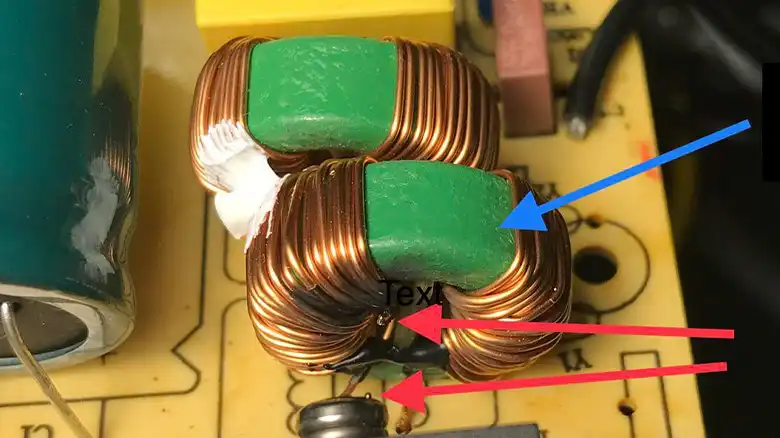
A choke works because it is an inductor. Its impedance climbs as frequency rises, so it passes DC and low frequencies while it fights high-frequency AC and noise. That is the trick behind noise filtering and smoothing.
Look at a fluorescent lamp. The choke, or ballast, kicks out a high-voltage spike to strike the arc, then it limits the running current once the gas ionizes. A resistor cannot make that spike. It has no magnetic field to collapse and no stored energy to dump. Swap the ballast for a resistor and the tube simply will not start.
Chokes also shine in signal work. They block certain high frequencies while letting the wanted signal through, which is exactly what you want when you clean up a noisy sensor line. A resistor flattens everything by the same amount. It cannot pick a frequency to reject.
So the short version: a resistor limits current and drops voltage. A choke does that too, plus it discriminates by frequency and stores energy. You cannot fake the second half with the first part.
Why a Choke Is Preferred in AC Circuits
A choke is preferred over a resistor in an AC circuit for one blunt reason. Power dissipation is close to zero. A choke offers reactance, not resistance, so it limits AC current without turning that current into wasted heat.
That efficiency is why you find chokes in the spots below:
- Automotive audio, to stop high-frequency amplifier signals from bleeding where they should not go
- Radio receivers and RF amplifiers, as RF chokes that block signal but pass the DC supply
- Computer cables and power lines, as common-mode chokes that kill noise
- Tuned circuits and filters, to reject specific frequency bands
Try any of those with a resistor and you either lose your signal, cook a component, or both. When I tried a resistor in place of an RF choke, it melted. It got hot in under 2 minutes and drifted in value before it failed.
When Can Choke Be Replaced by Resistor Safely?
Now the honest part. Sometimes the swap is fine. Use this decision path.
- Is the choke there only to drop voltage or limit current at DC, with no filtering needed? If yes, a resistor can replace it. Size it with Ohm’s law and check the power rating.
- Is the circuit AC, or does it depend on filtering, smoothing, or a startup spike? If yes, keep the choke. No substitution.
- Is efficiency or heat a concern? If the current is high, a resistor wastes real power. Stay with the choke.
- Is board space tight and current tiny? A small resistor may be the practical call.
Here is how I decide it on the bench. I ask what the part is actually doing in that spot. If a scope shows the choke is shaping a waveform or knocking down ripple, I do not touch it. If it is just a dumb series element passing DC, a resistor of the right value and wattage is fair game. When you size that resistor, respect the power rating or you will be back with a scorched board.
Two things I always check first. The current through the part. And whether any AC rides on top of the DC.
How the Resistor Side of the Circuit Can Be Simplified
Resistors have their own substitution rules, and they are cleaner. A messy series or parallel network can collapse into one equivalent resistor, R-EQ, or one equivalent impedance, Z-EQ. Every resistor still obeys Ohm’s Law and Kirchhoff’s laws no matter how tangled the network looks.
That is the difference in a nutshell. You can reduce resistors into each other all day. You cannot reduce a choke into a resistor, because the choke carries a property, inductance, that no resistor has. For the deeper theory on inductive components, the Wikipedia entry on chokes is a solid starting point, and the inductor article covers the math.
Frequently Asked Questions
Can choke be replaced by resistor in a fluorescent light?
No. The ballast choke creates a high-voltage strike pulse and limits current afterward. A resistor makes no pulse, so the tube will not light.
Will a resistor block AC like a choke does?
No. A resistor drops the same voltage at any frequency. A choke’s impedance rises with frequency, so only the choke can block AC while passing DC.
Does a choke waste power like a resistor?
Barely. A choke stores energy in its magnetic field and dissipates close to zero. A resistor burns 100 percent of the dropped power as heat.
Can I use a resistor to limit current instead of a choke?
Sometimes, yes, if the job is pure DC current limiting with no filtering. Size it with Ohm’s law and pick a wattage with margin so it does not overheat.
Why is a choke preferred over a resistor in AC circuits?
Because the choke limits AC current with almost no power loss. That efficiency matters in power supplies, lighting ballasts, and RF filters where a resistor would run hot and waste energy.
Are a choke and a resistor ever interchangeable?
Only in a narrow case, a low-current DC path used purely for voltage dropping. Any AC, filtering, or startup role rules the resistor out.
Related Reading
- Do Resistors Have a Max Voltage? Ratings Explained
- can i replace fusible resistor with normal resistor
Bottom Line
So, can choke be replaced by resistor? In the general case, no. A choke and a resistor share a schematic symbol shape and nothing else that matters. The choke reacts to frequency and stores energy with near-zero loss; the resistor just burns power as heat. Swap them only when the choke is doing plain DC current limiting or voltage dropping. Everywhere else, keep the choke and match the part to the job.