Do LED Resistors Get Hot? Why They Heat and How to Fix It
Do LED resistors get hot? Yes. They do. The diode itself stays fairly cool, but the current-limiting resistor beside it burns off leftover voltage as thermal energy, and that behaviour is completely normal for the circuit. How warm the little cylinder gets comes down to two things: how much current runs through it, and the power rating you originally chose. A tiny 1/8 watt part pushed hard will feel scorching. A well-sized 1/2 watt sibling barely climbs above ambient.
Last updated: August 13, 2026 — rewrote for clarity, added a safe-temperature table, a bench heat-management checklist, and an FAQ.
Do LED Resistors Get Hot in a Normal Circuit?
Short answer. Yes. A little. The ballast is doing a job. That job makes heat.
Here is the mechanism, in plain shop language. An indicator diode emits photons through electroluminescence. Electrons cross a p-n junction inside the chip and drop energy as visible light rather than motion. The die itself is efficient, so it barely warms up. The ballast is the part that sweats. It sits in series to throttle current, and every volt it wastes turns into thermal energy at the resistive body. This is nothing exotic. Plain Joule heating, the same physics that warms a kettle element or an old incandescent filament.
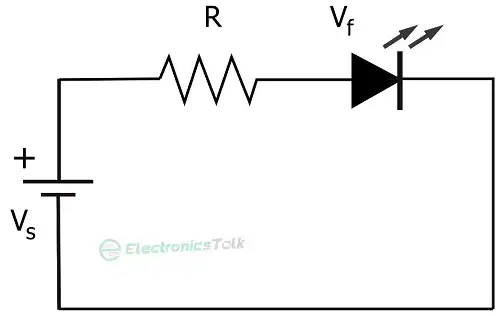
Figure 1: A circuit diagram with an LED and a resistor.
Let the current be I and the voltage across the resistor be V. With resistance R, the power the resistor throws off is:
P = VI = I²R
Read that formula aloud. Everything clicks. Push more amps and the wattage rises with the square of it. Double the current, quadruple the burn. That is why a ballast which ran chilly on 10 mA can scald at 40 mA. So do LED resistors get hot in a normal build? Only mildly. Provided the current stays where you set it, and the ambient enclosure is not baking the board.
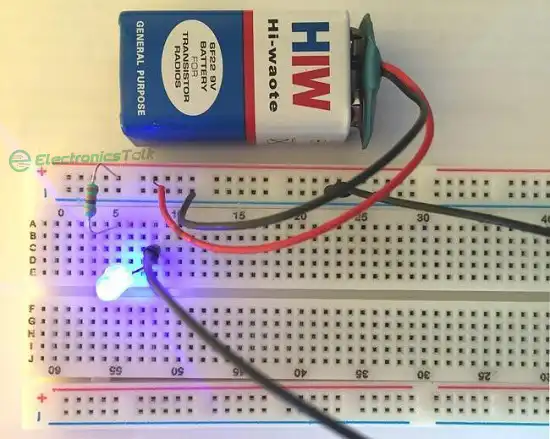
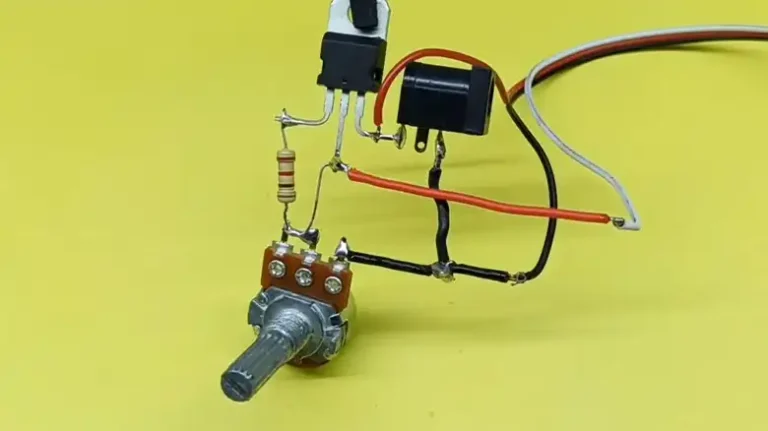
Figure 2: The same circuit built on a breadboard.
A quick worked case. Suppose you drive a red diode off a 5V rail. The junction drops roughly 2V, so the ballast eats the remaining 3V. At 20 mA that pans out to 0.06 watts. A standard 220 ohm resistor is enough for that LED, and a 0.25 watt through-hole part handles the load without complaint. You’ll feel a whisper of warmth at most.
How Hot Is Too Hot for the Resistor?
Every ballast carries a rated ceiling. Manufacturers call it the “maximum operating temperature.” Cross it. The measured value drifts, the paint blisters, the coating cooks, and the part can fail open with a sad little pop. Below is a rough field guide I keep taped inside my bench drawer.
| Resistor type | Comfortable surface temp | Get worried above |
|---|---|---|
| Carbon film / metal film | up to about 70°C | 125°C |
| High-power / wirewound | up to about 100°C | 155°C |
| SMD (0805, 1206) | up to about 70°C | 125°C |
For the average through-hole carbon or metal film chip, keep the body below 125°C (257°F). Specialised surface-mount resistors tolerate more punishment, often 155°C (311°F) or higher. Always trust the datasheet over any chart, mine included. Numbers on paper beat guesswork every single time.
Here is a fast touch-test I’ve used since college. Warm? Fine. Hot but holdable for three seconds? Caution flag. Too hot to touch at all means your current, your wattage, or your ventilation is wrong somewhere upstream.
- Warm and steady: leave it alone.
- Too hot to hold for 3 seconds: recheck your math.
- Discoloured body or a faint smell: cut the power now.
- The measured value creeping up: you have already cooked it, and resistor values do drift when they run hot.
How I Keep a Resistor Cool on the Bench
When I wire an indicator rig or a status panel, I plan for thermal load before I ever plug it in. Here is my routine. It has saved me more roasted parts than any single trick I know.
- Size the wattage first. I pick a resistor rated for at least double the power it will dissipate. Rated 1 watt, used at 0.5 watt. That headroom is cheap insurance.
- Reach for a higher value where the design allows. More ohms means less current, and less current means far less heat.
- Split the load. Two resistors in series or parallel share the burden, so no single part carries it all.
- Give it air. A resistor buried under a rat’s nest of wires bakes. Leave a gap.
- Bolt on a heatsink or thermal pad for power resistors. This is only worth it above a watt or so, but it drops the temperature fast.
- Derate on purpose. I run bench resistors at roughly 60 percent of their rating, and I derate power parts to 50% when they live in a sealed box.
- Sense the temperature if the circuit is critical. A cheap thermistor can trip a shutdown before anything melts.
Follow that habit and a decent ballast lasts well over 10 years, sometimes closer to 20 if the enclosure stays cool. Skip it. You’ll be desoldering scorched carbon inside a month, guaranteed. In my experience the wattage mistake is the one hobbyists make most often, so don’t guess it, calculate it. A right-sized part cools in under 2 minutes after you kill the power. A tiny SMD pad, maybe 3mm long, has almost no thermal mass and heats or cools almost instantly, which cuts both ways depending on what you’re monitoring.
If your ballast still runs hot after all that, the culprit is usually upstream. A potentiometer can overheat for exactly the same current-limiting reason, and diodes run into their own heat limits too. Heat is rarely a lone-component story on a real board.
Frequently Asked Questions
Do LED resistors get hot enough to burn you?
In a typical small-signal LED circuit, no. A 0.25 watt part dropping a couple of volts at 20 mA barely gets warm. In high-current or poorly sized builds, though, a resistor can reach 100°C and give you a real burn.
Is it the LED or the resistor that heats up?
Mostly the resistor. The LED converts most of its energy to light and stays cool. The series resistor is where the wasted voltage becomes heat, so that is the part your finger notices first.
What resistor wattage should I use for an LED?
Work out the power with P = I²R, then pick a resistor rated for at least double that. For a standard 20 mA indicator LED, a 0.25 watt resistor is almost always plenty.
Can a hot resistor damage my LED?
Indirectly, yes. A resistor pushed past its rating can drift in value and let more current through, and that extra current is what kills the LED. Keep the resistor cool and the LED stays safe.
How hot is a 220 ohm resistor on a 5V supply?
With a 2V LED it drops 3V at about 14 mA, so it dissipates roughly 0.04 watts. On a 0.25 watt part that is barely noticeable, only a slight warmth.
Related Reading
Bottom Line
So, do LED resistors get hot? Yes. And that is exactly what they are meant to do. The ballast turns leftover voltage into thermal energy so your diode does not fry, and in a properly sized circuit it never climbs past a gentle warmth you’d barely notice on your fingertip. Match the wattage. Keep the current in check. Give the body a little breathing space. Heat stops being a worry the moment you respect the maths. Get the sizing wrong, though, and the ballast will tell you loudly, usually with a smell you won’t forget.