Can a Potentiometer Overheat? Causes and Quick Fixes
Can a potentiometer overheat? Yes. A potentiometer is a variable resistor, and like any resistor, it turns current into heat. It gets too hot when the power it dissipates climbs past its rating, when current runs too high through the wiper track, or when it sits in a sealed box with no airflow. Most volume and trim pots never even get warm. The ones that cook are almost always carrying load current they were never built to carry.
Last updated: August 13, 2026 — rewrote as a diagnosis-first guide, added a power-math worked example, a troubleshooting decision path, and an FAQ.
Can a Potentiometer Overheat From Normal Use?
Short answer: rarely. A pot doing its actual job, setting a reference voltage or trimming a signal, moves almost no current. Think microamps. There is nothing to heat.
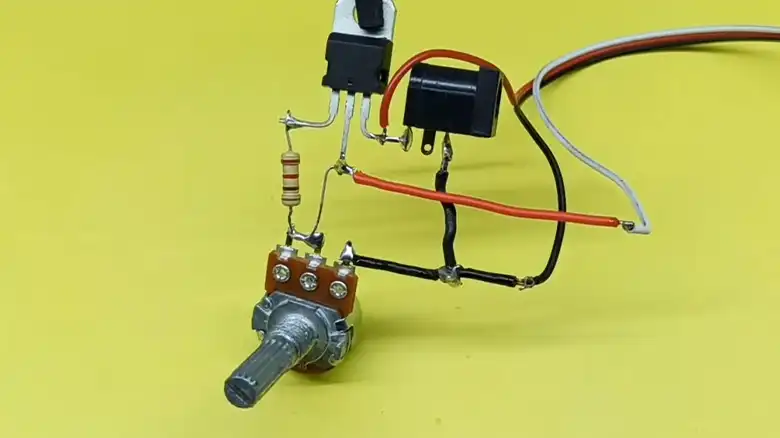
Heat shows up when the pot becomes a load, not a divider. Wire it as a rheostat in series with a motor, an LED string, or a heater, and suddenly the whole load current flows through part of that thin resistive track. That is when a potentiometer can overheat. I have seen it happen in seconds.
Here is the number that matters. A common 9 mm panel pot is rated for around 0.05 W to 0.2 W. A trimmer might handle 0.1 W. Push 0.5 W through it and you are two to ten times over budget. It will get hot, drift, then char.
The Real Reasons a Potentiometer Overheats
I have killed more than a few pots on the bench, and almost every time it traced back to one of these:
- Power over the rating. Every pot has a maximum dissipation printed in the datasheet. Cross it and the track cannot shed heat fast enough.
- Too much current through the wiper. The wiper contact is tiny. Run 100 mA through a sliver of carbon track and that spot heats first.
- No airflow. Seal a pot inside a plastic enclosure with no vents and even a modest load builds up. Heat has nowhere to go.
- Nonstop duty. Run it flat out for 30 minutes with no break and the temperature just keeps climbing.
- Wrong wiring. Connect a pot across a supply with no series limit and you have built a short through a resistor that was never meant to take it.
Note one thing people get backwards. When a pot fails, it usually goes open, not shorted. An open circuit carries no current, so it makes no heat on its own. If a dead pot is still getting warm, something upstream is wrong, not the pot.
A Quick Power-Rating Check
Want to know if your pot is safe before you power up? Do the math first. It takes ten seconds.
- Find the worst-case voltage across the part of the track that carries current.
- Find the current through it, in amps.
- Multiply. That is your dissipation in watts (P = V x I).
- Compare it to the rating on the datasheet.
- If your number is anywhere near the rating, resize or move the load off the pot.
Worked example. Say you drop 2 V across a pot section and pull 100 mA through it. That is 2 x 0.1 = 0.2 W. A 0.05 W trimmer is done. It cooks. Every time. A chunky 2 W wirewound pot shrugs it off. Same circuit. Same current. Wildly different fate. Sizing is everything, and I learned that the smoky way.
Troubleshooting a Hot Potentiometer
Follow the branches. Do not guess.
- Is the pot warm but the circuit works? You are close to the rating. Reduce current or fit a series resistor to share the drop. This is the same reasoning behind using a fixed resistor instead of a pot once you know the setting you want.
- Is it hot only at one rotation point? The wiper is concentrating current on a worn spot. Replace it. A worn track will not recover.
- Is it hot even with the wiper backed off? Check your wiring. You have likely got the ends connected straight across the supply.
- Does it stay hot after you cut the load? Then the pot is not the source. Look at whatever it feeds.
If your pot passes current as its normal job, treat it like any power part. Resistors in the same seat run warm too, and the reasons overlap with what makes LED current-limiting resistors heat up. Heat is heat. The physics does not care what you call the component.
How I Keep Pots Cool on the Bench
When I know a design will push real current through a pot, I plan for it up front. My routine:
- Spec the pot at double the worst-case power. Headroom is cheap.
- Move the heavy current off the wiper. Use the pot to set a value, then let a transistor or a fixed resistor carry the load.
- For a rheostat that must carry load, jump to a wirewound rated 1 W, 2 W, or more.
- Add airflow or a small heatsink if the datasheet suggests it.
- Give it a duty cycle. Let it rest instead of running 100% nonstop.
Trust me, the cheapest fix is picking the right part on day one. Swapping a charred pot at 11 p.m. because you saved 40 cents is a bad trade. I have made that trade. I do not recommend it.
One more habit. A pot is really two resistors sharing a wiper, so its behavior drifts with heat and age the same way any resistor does. If precision matters, read up on how resistor values shift over time and design in some margin. A pot that runs at 80% of its rating for years will not hold its curve like a cool one will.
Frequently Asked Questions
Can a potentiometer overheat if it is not under a heavy load?
Yes. Poor ventilation, bad wiring, or continuous operation can heat a pot even at modest load. Load is only one of several causes, so check airflow and wiring too.
Can a potentiometer overheat and still work afterward?
Sometimes. A brief mild overheat may just cause temporary drift. Real overheating chars the carbon track, and once that happens the resistance is off for good. Replace it.
What temperature is too hot for a potentiometer?
Most carbon and cermet pots are rated to about 70 C ambient, some to 125 C. If you cannot hold your finger on it, you are past safe. Measure the drop and cut the current.
Does a bigger potentiometer run cooler?
Usually yes, up to a point. A physically larger or higher-wattage pot has more mass and track area to spread the heat. A 2 W wirewound stays far cooler than a 0.1 W trimmer at the same current.
Why does my potentiometer only get hot at one position?
The wiper is dumping current into one worn spot on the track. Contact resistance climbs there, so that point heats first. The part is worn out. Swap it.
Can a potentiometer overheat and damage other parts?
Yes. A cooking pot can drift, fail open, or in a tight enclosure raise the temperature of nearby caps and semiconductors. For the full mechanism, the datasheet on Wikipedia’s potentiometer page covers the power-handling limits in detail.
Related Reading
Bottom Line
So, can a potentiometer overheat? Yes, but only when you make it carry power it was never rated for. Keep the load current off the wiper, size the part at double the worst-case watts, give it a little air, and a pot will run cool for years. When one does cook, do the P = V x I math first. The number almost always tells you exactly what went wrong.