Can I Replace Electrolytic Capacitor With Polymer?
Can I replace electrolytic capacitor with polymer? In most low-voltage circuits, yes, and the polymer part is often the better one. The rules are short. Match the capacitance. Meet or beat the voltage rating. Keep the polarity right. A polymer capacitor is an aluminium capacitor that uses a solid conductive polymer instead of a wet electrolyte, so its ESR is much lower and it lasts far longer. It is not a swap for every job, though. High-voltage rails and heavy surge loads are where the swap falls apart.

Last updated: August 13, 2026. Rewritten as a decision tree, with a spec table, a bench-swap procedure, and a real FAQ.
Can I Replace Electrolytic Capacitor With Polymer? The Quick Verdict
Yes, most of the time. Below about 35V, on a filter or decoupling cap, a polymer part drops right in. It runs cooler. It ages slower. It shrugs off ripple that cooks a wet electrolytic.
But the swap has hard edges. Polymer parts top out at lower voltages. They cost more. Their surge tolerance is thinner. So the answer is a decision, not a blanket yes.
Here is my rule of thumb. Same capacitance, equal or higher voltage, room on the board, no brutal surge. Meet those four and the swap is safe. Miss one and you stop and think.
The Decision Tree: When the Swap Works
Walk it top to bottom. Stop at the first branch that says no.
Branch 1, voltage. Is the circuit voltage at or below the polymer part’s rating? A wet electrolytic might be rated 50V or 100V. A common polymer cap sits at 16V, 25V, or 35V. A few solid polymer parts reach 100V DC, but they are pricey and rare. So check first. If the rail is 48V and your polymer cap is 25V, stop. Wrong part.
Branch 2, capacitance. Does the polymer value meet or exceed the original? Polymer caps skew smaller. You will find tens or low hundreds of microfarads where an electrolytic gave you thousands. If your circuit needs 2200µF and the biggest polymer you can fit is 470µF, that branch fails. You can parallel several to get there, but that eats board space and budget.
Branch 3, surge and inrush. Does the node see big surge currents? Think a power-supply input right after a rectifier. Electrolytics eat surges of tens to hundreds of amps. Polymer parts handle far less, often a few amps up to a few tens of amps. Frequent hard surges? Do not swap. Keep the wet part or pick a hybrid.
Branch 4, polarity and fit. Most polymer aluminium caps are still polarized, so honor the plus and minus marks. Then check the footprint. Polymer parts run smaller for the same value, so they usually fit. Watch the lead spacing on through-hole boards, though. A gap of 2 mm to 5 mm has to line up.
- All four branches pass? Swap it. You will likely gain lower ESR, less heat, and longer life.
- Voltage or capacitance fails? Resize the part or keep the electrolytic.
- Surge fails? Stay wet, or split the duty across a hybrid polymer.
- Only fit fails? Find a smaller-body polymer with the same rating.
If you want the deeper story on why the wet ones die first, I dug into how long electrolytic capacitors last in a separate piece.
Polymer vs Electrolytic: The Spec Table
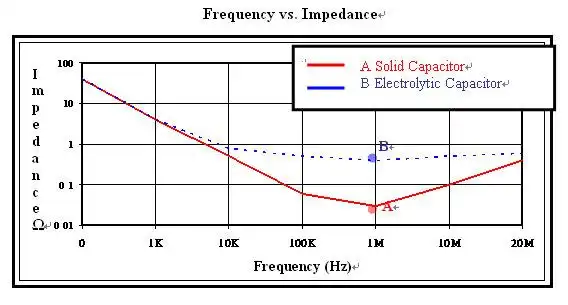
Fig. 1: Comparison of polymer (solid) capacitor and electrolytic capacitor in terms of frequency vs impedance
| Spec | Electrolytic (wet) | Polymer (solid) |
|---|---|---|
| Voltage rating | Up to 450V+ | Usually ≤ 35V, some to 100V |
| Capacitance range | Up to thousands of µF | Tens to low hundreds of µF |
| ESR | Ohms range | Milliohm range, often 10 times lower |
| Ripple current | Good | Better |
| Surge tolerance | Tens to hundreds of amps | A few to tens of amps |
| Rated life at 105°C | ~2,000 to 5,000 hours | 3 to 5 times longer |
| Price | Cheap | 2 to 3 times more |
| Failure mode | Dries out, bulges | Stays stable, drifts less |
The impedance curve above is the real reason people swap. The polymer part holds a lower impedance across a wider frequency band. That is what kills ripple on a busy rail. The equivalent series resistance is where the win lives, and the polymer capacitor page has the chemistry if you want it.
What Actually Changes After the Swap
People expect magic. Mostly they get quiet reliability. Here is what shifts once the solid part goes in.
Heat drops. A wet electrolytic warms itself through its own resistance, and that warmth boils off the electrolyte over the years. The solid dielectric has nothing to evaporate, so its endurance climbs while the ambient temperature barely moves it. Ripple smooths out too. Because impedance stays flat across a wide bandwidth, the transient spikes that used to leak through the reservoir cap get damped harder. On an oscilloscope the difference is obvious. The fuzzy noise floor tightens into a clean line. Fan whine and coil buzz often fade with it, because the regulator downstream finally sees a calm supply instead of a jittery one.
There is a subtle trade you should weigh. Humidity and vibration hit the two families differently. A sintered polymer body tolerates shock and moisture well, yet a rare batch can be sensitive to sudden thermal shock during reflow. Corrosion is basically off the table for the solid type. Longevity, throughput on a busy rail, and thermal margin all improve, but you pay for that endurance at the checkout. Think of it as buying reliability, not raw storage.
If your circuit truly needs a huge charge reservoir, a hybrid part splits the difference. A hybrid keeps a small amount of liquid electrolyte for self-healing while adding a conductive polymer layer for the low resistance. That combination survives the ugly inrush a pure polymer would fear, so it suits automotive and motor-adjacent nodes. Tantalum sits in this conversation too, though its failure behavior is harsher, and I compared the tradeoffs in my tantalum versus ceramic capacitor breakdown.
How I Swap One on the Bench
Here is the procedure I actually run. It takes ten minutes.
- Read the old part. Get the µF, the voltage, and the polarity band. Photograph it in place first. When I skip that photo, I regret it.
- Pick the polymer. Same capacitance or a touch higher. Voltage equal or higher, never lower. I like a 25V polymer for a 16V rail, so there is headroom.
- Check ESR fit. Lower ESR is usually fine. On a few old linear regulators, though, a cap that is too low-ESR can make the loop ring. If it is an LDO output, glance at the datasheet’s stable-ESR window.
- Discharge and desolder. Drain the board. Pull the old cap. Clean the pads.
- Mind the minus. The polymer stripe marks the negative leg. Line it up with the old footprint. Get this wrong and it can vent.
- Solder and power up. Watch for heat and listen for anything odd. Then load-test it.
A worked example. Last month I fixed a monitor with a bulged 1000µF 10V cap on the 5V rail. When I pulled it, the ESR meter read almost 3 ohms. I dropped in a 1000µF 16V polymer at about 12 milliohms. The rail flat-lined clean on the scope, and the flicker was gone. That is the whole pitch in one repair.
When You Should Not Swap
Some jobs stay wet. Do not force a polymer in here.
- High-voltage rails. Anything above the polymer’s ceiling. A 63V or 100V node wants a proper high-voltage electrolytic. If voltage headroom is your worry, my note on swapping a lower-voltage part for a higher one explains why higher is safe and lower is not.
- Massive bulk storage. When you need thousands of microfarads in one can, polymer cannot match the density cheaply.
- Brutal surge nodes. Motor drives, big inrush, repeated hot-plug. The wet part survives it better.
- Tight budgets at scale. Polymer costs more. On a hobby fix that is nothing. On a thousand-unit run it adds up.
One more thing people miss. Getting the value slightly wrong matters more than the chemistry. If you are unsure how close you have to be, read whether capacitance tolerance actually matters before you buy.
Frequently Asked Questions
Can I replace electrolytic capacitor with polymer on a motherboard?
Yes, and it is common. Motherboard rails run low, usually 12V or under, and they hate heat. A polymer swap there runs cooler and lasts years longer. Just match the µF and use equal or higher voltage.
Can I replace electrolytic capacitor with polymer in a power supply?
Sometimes. The secondary low-voltage side is usually fine. The primary high-voltage bulk cap is not, because polymer parts do not reach those voltages and take the inrush poorly. Keep the input electrolytic and swap only the low-voltage outputs.
Do polymer capacitors last longer than electrolytics?
Yes, by a wide margin. A wet electrolytic dries out over time, so it might give you 2,000 to 5,000 hours at full heat. A polymer part has no liquid to lose, so it commonly lasts 3 to 5 times longer at the same temperature.
Will lower ESR ever cause a problem?
Rarely, but yes. A handful of old linear regulators need a minimum ESR to stay stable. Drop in a milliohm polymer and the output can oscillate. Check the LDO datasheet for its stable-ESR band before you swap.
Are polymer capacitors polarized like electrolytics?
Most aluminium polymer caps are polarized, so the stripe still marks the negative leg. A few small polymer types are non-polarized, but do not assume it. Always read the body and line up the minus mark with the original.
Related Reading
Bottom Line
Can I replace electrolytic capacitor with polymer? For low-voltage filtering and decoupling, yes, and you usually come out ahead on ESR, heat, and lifespan. The swap only breaks on high-voltage rails, huge bulk storage, or heavy surge nodes. Match the capacitance, meet or beat the voltage, respect polarity, then solder with confidence.