Can Soldering Damage Diode? Heat Limits and 5 Safe Tips
Can soldering damage diode parts? Yes. Too much heat, held too long, cooks the junction and shifts the way a diode behaves. The good news is that the damage is almost always avoidable. Most diodes are tougher than people think. In my experience the failures come from a cheap iron with no temperature control, not from the act of soldering itself. Keep the tip time short and the heat sane, and the part survives fine.
Last updated: August 13, 2026. Rewrote the piece around real heat limits, added a soldering-temperature table, a five-step method, and an FAQ.
Can Soldering Damage Diode Junctions?
Yes, it can. A diode is a semiconductor, and every semiconductor carries a temperature ceiling printed in its datasheet. Push past that ceiling and the silicon starts to misbehave. Leakage current climbs. The forward voltage drifts. In the worst case the junction shorts and the part is dead.
Here is the physics in one line. The Shockley equation describes the current: I = I_S(e^(qV/nkT) – 1), where I is the forward current, I_S is the saturation current, q is the electron charge, V is the forward voltage, k is Boltzmann’s constant, T is the temperature in kelvin, and n is a factor between 1 and 2.
Notice the T. As temperature rises, the forward current rises with it. Cross the limit and leakage current runs away with itself. That feedback loop is called thermal runaway, and it is how a diode can cook itself in a fraction of a second. So can soldering damage diode junctions this way? Only when the heat has time to build. A quick, clean joint never gets there.
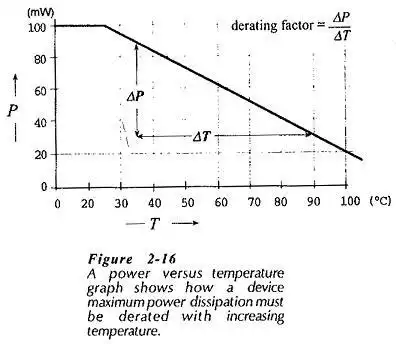
Figure 1: A diode’s safe power dissipation drops as temperature climbs, so the rated power must be derated at higher temperatures.
How Hot Is Too Hot for a Diode?
Most small-signal and rectifier diodes are rated for a junction temperature near 150C to 175C in normal operation. That is the operating ceiling, not the soldering ceiling. Soldering is a short, brutal spike, so the datasheet lists a separate figure for it. The datasheet calls this the “maximum lead soldering temperature”.
For a common part like the 1N4148 or the 1N4007, that soldering figure sits near 260C for up to 10 seconds. Go hotter, or linger longer, and you risk the junction. The real answer to can soldering damage diode reliability is time, not temperature alone. A hot, fast touch is safer than a warm, slow one.
If you are unsure which rectifier you are holding, the difference between the 1N4001 and 1N4004 is mostly reverse voltage, and both share similar thermal limits. Diodes can also run hot long after the joint is done. When that happens, the fault is in the circuit, not the iron, and I cover it in why diodes overheat during normal use.
What Temperature Should You Solder a Diode At?
Set the iron hotter than the solder’s melting point, but well under the part’s soldering limit. Standard leaded solder melts near 180C to 190C. Lead-free sits higher, closer to 217C to 220C. Your tip has to beat that so the joint forms fast.
Here is a quick reference table.
| Diode type | Example part | Max soldering temp | Max dwell |
|---|---|---|---|
| Through-hole rectifier | 1N4007 | ~260C | 10 seconds |
| Small-signal | 1N4148 | ~260C | 10 seconds |
| Surface-mount | SOD-123 | ~250C | reflow profile |
| Schottky (SMD) | SS14 | ~245C | reflow profile |
For leaded work I set a temperature-controlled station to 315C to 350C. The tip runs hot, so the joint is quick, so the heat never has time to crawl down the lead into the junction. Fast and hot beats slow and warm every time.
5 Tips to Solder a Diode Without Cooking It
People still ask whether can soldering damage diode leads with a single quick touch, and the honest answer is almost never. Here is how I do it on the bench, in order:
- Use a temperature-controlled iron. A cheap iron with no control just climbs until it burns the flux and the part alike. Don’t trust a fixed-wattage stick for delicate work. Set a real station to 315C to 350C and drop the guesswork.
- Clip a heat sink to the lead. A crocodile clip, or a proper heat-sink clip, placed between the iron and the body soaks up heat before it reaches the junction. I’d recommend this for every glass-body part. It saves more diodes than any other habit.
- Work fast. Touch, flow, lift. Aim for 2 to 3 seconds per joint. If you cannot wet the joint in the time it takes to count to three, your tip is too cold or too dirty, and that, not the diode, is the real problem. A clean iron tip transfers heat far faster than a crusty one.
- Check polarity first. The banded end is the cathode. When you solder it backwards the diode blocks current the wrong way, and no amount of careful heat will fix that.
- Read the datasheet. Every part lists its own soldering limit and dwell time. Trust the number the maker printed, not a forum thread. Two seconds under the limit is plenty.
Signs You Already Damaged the Diode
Not sure the last joint went well? I’ve seen more parts killed by a slow, lukewarm iron than by a hot one, and the symptoms are easy to spot. Watch for these:
- High leakage. The diode conducts a little in reverse when it should block cold.
- Wrong forward drop. A healthy silicon diode reads about 0.6 to 0.7 volts forward on a multimeter. Way off means trouble.
- Dead short. The junction measures near zero ohms in both directions. The part is gone.
- Open circuit. No conduction either way. Also gone.
- Intermittent behavior. It works cold and fails warm. That is the classic mark of a stressed junction.
If you’ve ever burned a part before, trust me, you learn to read these fast.
Frequently Asked Questions
Can soldering damage diode performance permanently?
Yes, when the junction overheats. A brief spike nudges the forward voltage a little. A long roast shorts the junction for good. Keep the iron on the lead under 3 seconds and you are fine.
How fragile are diodes, really?
Less fragile than most people fear. A through-hole rectifier shrugs off a quick 260C touch. Tiny surface-mount Schottky parts are twitchier, so give them a gentler profile and a faster tip.
Can you damage a resistor while soldering too?
You can. Resistors take heat, mechanical stress, and electrostatic discharge badly if you are rough. Excess heat can shift the resistance value or crack the body outright.
Do I need a heat sink for every diode?
No. For a sturdy rectifier on a quick joint, skip it. For small-signal glass parts, Schottky diodes, and anything you plan to reheat, clip one on first.
Does lead-free solder raise the risk?
A little. Lead-free melts near 217C, so your tip runs hotter and the safe window is tighter. Work faster, and watch the clock closely.
Related Reading
- our guide to what is the difference between diode 1n4001 and 1n4004
- can i use 1n4004 instead of 1n4001
Bottom Line
So, can soldering damage diode parts? Yes, but almost never by accident once you respect the heat. Use a controlled iron, clip a heat sink, get in and out in 2 to 3 seconds, and check the band before you flow. Do that and the part outlives the joint. For deeper reading on how these components behave, the Wikipedia entry on the diode is a solid start.