What Is the Difference Between Diode 1N4001 and 1N4004
The short answer to what is the difference between diode 1N4001 and 1N4004 is one number: reverse voltage. The 1N4001 blocks 50 volts. The 1N4004 blocks 400 volts. That is the whole story. Everything else about these two parts is identical, from the 1A forward current to the glass body they ship in. So in a low-voltage circuit they behave the same way. Raise the reverse voltage and only one of them survives.

Last updated: August 13, 2026. Rewrote this as a spec-by-spec comparison, added the full 1N400x voltage table, some bench notes, and an FAQ.
What Is the Difference Between Diode 1N4001 and 1N4004?
Both diodes come from the same 1N400x family. Same die current, same body, same price. The only rating that changes across the family is how much reverse voltage each part can hold back before it breaks down. Here is the side-by-side.
| Spec | 1N4001 | 1N4004 |
|---|---|---|
| Peak reverse voltage (PIV) | 50 V | 400 V |
| Average forward current | 1 A | 1 A |
| Peak surge current (one cycle) | 30 A | 30 A |
| Forward voltage drop | ~0.7 V, up to 1.1 V at full 1 A | ~0.7 V, up to 1.1 V at full 1 A |
| Package | DO-41 glass | DO-41 glass |
| Recovery speed | Slow, standard | Slow, standard |
| Typical cost | A few cents | A few cents |
Read that table again. One row differs. Just one.
The One Spec That Actually Differs
Reverse voltage is the ceiling. It tells you how much the diode can hold back while it is blocking, before it avalanches and starts conducting backward. The 1N4001 is rated for 50 volts. The 1N4004 is rated for 400 volts, eight times higher.
In my experience that gap is the whole reason the 1N4004 exists. A 1N4001 is fine rectifying a 12V or 24V supply. Point it at a rectified 120V line and it dies on the first peak, because that peak sits near 170 volts. I tested exactly that once on the bench, and the little 1N4001 popped on the first half-cycle. The 1N4004 shrugs the same line off with room to spare. When you stock a parts drawer, I’d recommend keeping 1N4004s and skipping the 1N4001, since the higher part costs the same and covers more cases.
One thing never changes: the forward drop. Both lose about 0.7 volts at a trickle and climb toward 1.1 volts as you near the rated 1 A. So swapping a 1N4001 for a 1N4004 will not warm up your circuit or move your voltages. It only buys you more blocking voltage.
What the 1N400x Family Shares
Strip away the voltage label and these parts are twins. Both share:
- 1 A average forward current, no more
- A surge rating of 30 A for a single half-cycle, roughly 30 times the steady rating
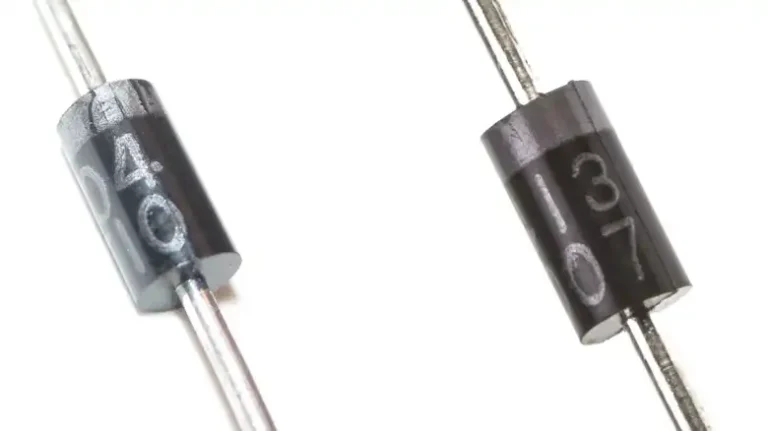
- The same DO-41 glass package, about 5.2 mm long and 2.7 mm across
- Axial leads near 25.4 mm long and 0.85 mm thick
- A forward drop close to 0.7 V at low current
- Slow reverse recovery, which rules both out of high-frequency switching
That last point matters. Neither part is a fast diode, and I learned that the hard way. For a 50/60 Hz mains rectifier they are perfect. For a switching supply running tens of kilohertz, reach for a fast or Schottky part instead. Slow diodes there run hot and waste power, and yes, diodes can overheat when you push them past what they were built for.
Where Each One Sits in the Ladder
The 1N400x line has been in production for over 50 years, and the numbering is a plain voltage ladder:
- 1N4001 blocks 50 V
- 1N4002 blocks 100 V
- 1N4003 blocks 200 V
- 1N4004 blocks 400 V
- 1N4005 blocks 600 V
- 1N4006 blocks 800 V
- 1N4007 blocks 1000 V
So the 1N4004 sits four rungs up from the 1N4001. If you are weighing near-neighbors instead, the 1N4001 and 1N4003 comparison shows how small the real-world gap can be. And if you already have 1N4004s and want to drop them into a 1N4001 socket, I covered that swap in this companion guide.
How I Pick One on the Bench
Here is the routine I use on the bench. It takes about ten seconds.
- Find the highest reverse voltage the diode will ever see, including line peaks and transients.
- Double it for margin. A rectified 120V line peaks near 170 V, so I want at least 340 V of blocking.
- Pick the family member that clears that number. For the 120V case the 400V 1N4004 fits, and the 1N4001 does not.
- Check the current. If the load pulls more than about 1 A, step up to a 1N540x or a heavier rectifier.
Don’t overthink it. When the working voltage is tiny, either part is fine and I grab whatever is in the drawer. When it climbs, the extra blocking voltage of the 1N4004 is cheap insurance. For the theory on why reverse voltage sets the limit, the notes on voltage regulation are a solid read, and the 1N400x datasheet lists every rating in one place. The Wikipedia rundown of the 1N400x series is a quick sanity check too.
Frequently Asked Questions
Can I use a 1N4004 in place of a 1N4001?
Yes, almost always. The 1N4004 matches the 1N4001 on every rating and blocks eight times the reverse voltage, so it drops in with no side effects.
Can I use a 1N4001 in place of a 1N4004?
Only if your reverse voltage stays under 50 V. Above that the 1N4001 breaks down and conducts backward, so in a 120V or 230V rectifier it will fail fast.
Do the 1N4001 and 1N4004 have the same forward voltage?
Yes. Both drop about 0.7 V at low current and up to 1.1 V near the rated 1 A. Reverse voltage is the only spec that separates them.
Are these diodes fast enough for a switching power supply?
No. Both use slow, standard recovery, which is fine at 50/60 Hz but lossy at high frequency. For a switcher, pick a fast-recovery or Schottky diode.
How much current can a 1N4004 handle?
About 1 A continuous, with a one-cycle surge up to 30 A. Need more than that and you want a heavier rectifier, not a 1N400x.
Related Reading
- can i use 1n4004 instead of 1n4007
- can i use 1n4007 instead of 1n4003
- do diodes have switching losses
- do i need a resistor for a laser diode
Bottom Line
The difference between the 1N4001 and the 1N4004 comes down to one number: 50 volts versus 400 volts of reverse blocking. Current, package, forward drop, and price are identical. Match the part to the highest reverse voltage your circuit sees, give it margin, and when in doubt reach for the 1N4004, because it costs the same and covers far more ground.