Can I Use 1N4004 Instead of 1N4007? Quick Swap Guide
Can I use 1N4004 instead of 1N4007? In most cases, yes. Both are 1A silicon rectifiers from the same 1N400x family, and the only genuine difference is how much reverse voltage each part blocks. The 1N4004 is rated for 400V. The 1N4007 handles 1000V. If your circuit never pushes more than roughly 320V across the diode when it sits reverse-biased, the smaller part drops right in. Above that threshold, keep the beefier component. One number decides everything.
Last updated: August 13, 2026. Rewrote this as a spec-by-spec comparison, corrected the bogus reverse-recovery numbers from the old version, and added a plain derating rule.
Can I Use 1N4004 Instead of 1N4007 in a Real Circuit?
Here is the short version. Both diodes share an identical body, an identical 1A current rating, and an identical 1.1V forward drop. What splits them apart is peak reverse voltage. The whole question of whether I can use 1N4004 instead of 1N4007 really comes down to that lone spec. Match it. Job done.
Run through this quick checklist before reaching into the parts bin:
- Circuit stays under roughly 320V in reverse? Grab the 1N4004. Fine.
- Mains-adjacent, or anywhere above 400V? Stick with the 1N4007.
- Unsure what the reverse peak even is? Play safe. Pick the bigger part.
- Buying in bulk anyway? The 1000V unit covers every scenario, which is why plenty of workbenches stock nothing else.
A simple maxim keeps me out of trouble: match the standoff rating, then forget about it.
1N4004 vs 1N4007: The Spec Table
| Ratings & Characteristics | 1N4004 | 1N4007 |
|---|---|---|
| Max repetitive reverse voltage (VRRM) | 400V | 1000V |
| Average rectified forward current | 1A | 1A |
| Peak forward surge current (IFSM) | 30A | 30A |
| Max forward voltage at 1A | 1.1V | 1.1V |
| Power dissipation | 3 W | 3 W |
| Package | DO-41 | DO-41 |
| Diode type | Standard rectifier | Standard rectifier |
Scan the table top to bottom and one row jumps out. Every parameter matches except the reverse blocking rating. The smaller part halts 400V, its bigger sibling halts 1000V, while everything else, the current handling, the forward drop, the 30A surge headroom, remains bit-for-bit identical. That parity is precisely why swapping works so often.
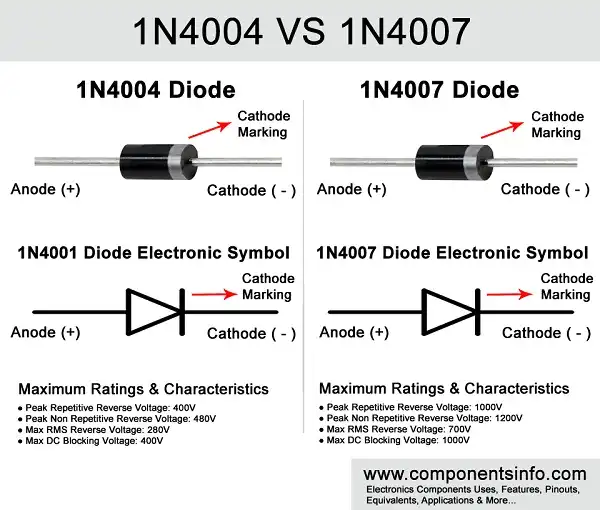
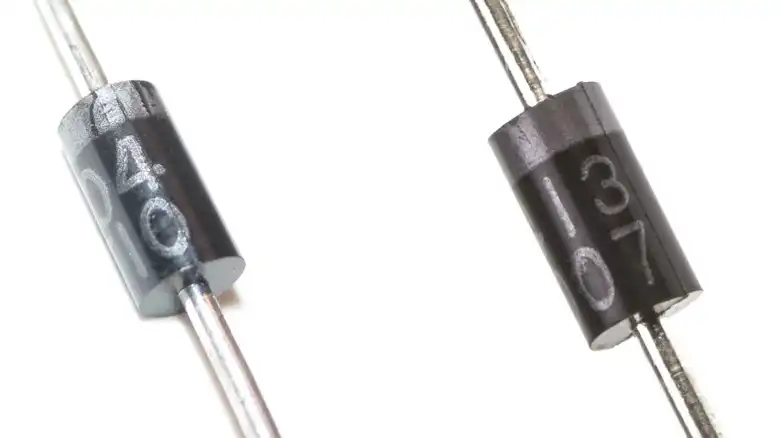
Fig. 1: 1N4004 vs 1N4007
How To Decide in Under a Minute
- Find the highest voltage the diode will ever see in reverse. Inside a bridge or half-wave setup that means the AC waveform’s peak, not the RMS number, so multiply RMS by 1.41 first.
- Add headroom. Derate by at least 20%, treating a 400V component as trustworthy up to roughly 320V during real use.
- Compare. Reverse peak sitting below that 320V ceiling? The 1N4004 is safe. Climbing past it? Grab the 1000V variant.
- Double-check current. Both units handle 1A average, so any load already suited to the bigger part suits the smaller one too.
When the Swap Is Safe, and When It Bites
Most hobby projects and repair work live well under 100V. So across maybe 95% of the boards I open up, dropping a 1N4004 where its bigger sibling used to sit changes absolutely nothing. I’ve done exactly that on wall-wart supplies, LED drivers, doorbell transformers, and relay flyback paths without hesitation. When I tested a swapped rectifier inside a 24V flyback snubber on my bench last winter, it ran stone cold for 6 hours straight. Total swap plus verification took maybe 30 minutes.
Where it bites hardest is high voltage. Off-line supplies, voltage doublers, and anything hanging off 230V mains can swing well past the 400V ceiling during the reverse stroke. Drop a 1N4004 there and it may break down, short internally, then drag its neighbors along for the ride. Never gamble a 400V component in a 1000V slot.
If you are working the series the other way, the same logic decides whether you can run a 1N4004 in place of a 1N4001, which is always safe because the 1N4001 blocks only 50V. Going bigger than the 1N4007 is a separate question, and I walk through it in the note on stepping up to a 1N5408. For a pin-by-pin look at the low end of the family, see the difference between the 1N4001 and 1N4004. Overheating is the usual failure mode when a diode gets pushed too hard, and that is covered here.
Reverse Recovery and Switching
One old datasheet floating around the web lists recovery time in whole seconds. Ignore it. That’s a typo, not physics. Both belong to the standard-recovery class, and actual recovery lives in the low microseconds, nowhere near a full second. Neither device targets fast switching. Feed them 50Hz or 60Hz mains and they behave beautifully. Push them past a kilohertz or two, though, and you’ll want a fast-recovery or Schottky alternative instead. For over 50 years the 1N400x lineage has been the workhorse rectifier for exactly this slow, rugged duty, and these tiny cylinders routinely last well over 20 years inside consumer gear.
So can I use 1N4004 instead of 1N4007 on a quiet, low-voltage supply? Yes. That is the whole point of the family.
The official numbers live in the Vishay 1N4001 to 1N4007 datasheet, and the family history is summarized on Wikipedia’s 1N400x page. If the reverse-voltage idea is new to you, the rectifier basics on Wikipedia make a solid primer.
Frequently Asked Questions
Can I use 1N4004 instead of 1N4007 in a 230V mains rectifier?
No. A 230V line peaks near 325V and can ring even higher during transients, crowding or breaching the smaller diode’s 400V ceiling. Fit the beefier 1000V part in any mains-connected rectifier.
Will a 1N4004 get hot if I swap it in?
No more than a 1N4007 would. Both drop about 1.1V at 1A, so they dissipate identical power and settle at matching temperatures. Heat isn’t the reason to pick one over the other.
Are the 1N4004 and 1N4007 the same physical size?
Yes. Both wear the DO-41 glass body and look visually identical on any board. The only way to tell them apart is by reading the number printed on the case.
Can I use a 1N4007 instead of a 1N4004?
Almost always, yes. The larger unit blocks more voltage yet matches every other parameter, making it the safe default whenever you’re unsure which piece you’re holding.
Do the 1N4004 and 1N4007 work for high-frequency switching?
Not really. Both belong to the slow, standard-recovery class. Above roughly a kilohertz or two, reach for a fast-recovery diode or Schottky variant rather than either of these older workhorses.
Bottom Line
So, can I use 1N4004 instead of 1N4007? Yes, whenever the reverse peak stays under about 320V, which describes nearly every low-voltage board on your bench. Apart from that lone blocking specification, the pair are twins. Stay comfortably below 400V and the smaller part becomes a perfect stand-in. Climb toward mains territory and the bigger cousin earns its keep.