Will Capacitor Drain My Battery? Facts Explained
Will capacitor drain my battery? No, not under normal conditions. A capacitor is two conductive plates held apart by a thin insulator, so once it charges up to the supply voltage it blocks steady DC. Real parts are never perfect. Every one leaks a tiny current across that insulator, usually a few microamps. That trickle is far too small to flatten a healthy battery in ordinary use.

Last updated: August 13, 2026 — rewrote with a leakage-current explanation, a wiring-fault checklist, and a new FAQ.
Will Capacitor Drain My Battery in Normal Use?
Short answer: no. A capacitor stores charge. It does not consume it the way a bulb or a motor does. Think of it as a small bucket, not a tap left running.
Here is the mechanism. When you first connect an empty capacitor, it looks like a dead short. Current rushes in. Electrons pile onto one plate and get pulled off the other. A voltage builds across the plates until it matches the source. Then the flow stops. From that point the part acts like an open switch to DC.
So a fully charged capacitor sits there quietly. The only current left is leakage, and leakage is governed by the resistance of the insulator, which is enormous. On a decent electrolytic that leakage runs from under a microamp up to maybe tens of microamps. A ceramic or film part leaks even less. Compare that to the tens of milliamps a car’s clock and alarm pull, or the amps a headlight draws. The capacitor is a rounding error.
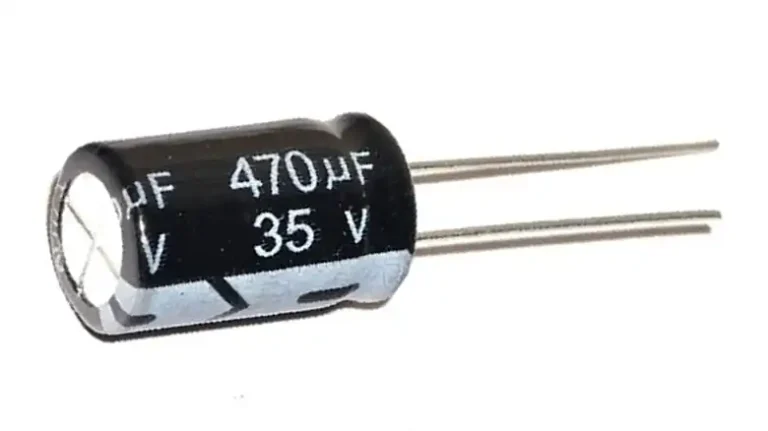
In my experience on the bench, a good capacitor sips. It does not gulp. When I tested a fresh 470 µF electrolytic across a 12 V bench supply, the settled current read well under 5 µA once it topped off. That is the normal picture.
Ideal vs Real Capacitor: What Actually Leaks
The gap between the textbook and the workbench is small, but it matters. Here is the side-by-side.
| Property | Ideal capacitor | Real capacitor |
|---|---|---|
| DC current when charged | Exactly zero | 0.1 to 50 µA leakage |
| Insulation resistance | Infinite | High, but finite |
| Self-discharge time | Never | Hours to weeks |
| Effect on a good battery | None | Negligible |
| Effect if faulty | None | Can be a real drain |
Leakage is why a charged capacitor on the shelf slowly loses its voltage. It is also why “does a capacitor self-discharge” is a fair question. Yes, it does, over time, through those internal paths. You can read the physics of that trickle on Wikipedia’s leakage entry. None of this drains a battery in any way you would notice.
When a Capacitor Actually Does Drain a Battery
Now the honest part. A capacitor can pull real current, but only when something is wrong. This is a decision tree, so walk it top to bottom.
- The capacitor is failing. Age, heat, and ripple wear out electrolytics. A tired part develops a low internal resistance and leaks milliamps instead of microamps. That is enough to flatten a car battery over a week. Bulging tops or a warm case are the tells. Our guide on what wears a capacitor out over time covers the aging curve.
- It is wired backward. Reverse the polarity on an electrolytic and it conducts hard, heats up, and drains whatever feeds it. It may also vent. Match the stripe to the negative rail. Always.
- The circuit around it is the load. A capacitor rarely acts alone. Amplifiers, relays, and control boards sit next to it and pull their own current. People blame the capacitor when the board is the culprit.
- It sits across a switched line that never truly switches off. If a big cap keeps a rail alive after “off,” downstream chips keep sipping. The cap is not the drain. It is just holding the door open.
If none of these apply, the capacitor is innocent. Do not chase a healthy part.
Do Capacitors Extend Battery Life?
Usually no. A plain capacitor does not add energy, so it cannot stretch runtime on its own.
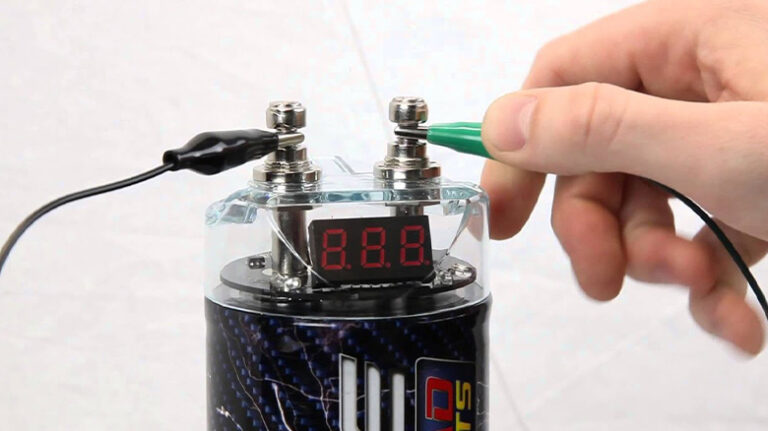
Supercapacitors are the exception, and they are a different animal. Rated in whole farads, they buffer short, sharp current spikes so the battery does not have to. In a car audio setup or a solar node, that buffering eases stress on the battery and can help it last longer. It is not magic. It is load smoothing. The supercapacitor overview lays out the numbers if you want the deep version.
How to Check If a Capacitor Is Draining Your Battery
Here is the exact routine I run. It takes about 5 minutes.
- Look first. Bulging, leaking, or crusty caps are guilty until proven innocent. Swap them.
- Feel for heat. Power the board briefly. A capacitor that gets warm on its own is leaking. Cut power.
- Measure the current. Put a multimeter in series with the suspect line. A healthy charged cap reads microamps. Milliamps means trouble.
- Isolate it. Lift one leg and re-measure the board. If the drain drops, you found it. If it does not, the load is elsewhere.
- Check polarity. On any electrolytic, confirm the negative stripe faces the ground side.
When I bench-test a suspect board this way, the answer usually shows up on the very first look. Don’t skip the visual pass. It saves the most time.
For a related worked example, see how long it takes a big cap to bleed down in the microwave capacitor discharge walkthrough. The same math tells you how fast leakage empties a stored charge.
Frequently Asked Questions
Will capacitor drain my battery if I leave it connected overnight?
No. A charged capacitor in good shape leaks only microamps, so overnight loss is trivial. If your battery is flat by morning, the drain is somewhere else in the circuit.
Will a capacitor help my alternator?
A bit, indirectly. A capacitor can steady the voltage rail and soak up spikes, which eases strain on the charging system. It does not add power on its own.
Will a capacitor help my car battery?
Not directly. A battery holds a fairly steady voltage as it discharges. A capacitor cannot mimic that, so it will not extend the battery the way another battery would.
Do capacitors lose their voltage over time?
Yes. Internal leakage paths bleed the charge slowly, so a shelved capacitor self-discharges over hours to weeks depending on the type and its condition.
How much current does a healthy capacitor draw?
Once charged, a good capacitor draws only its leakage current, typically from 0.1 to a few tens of microamps. That is thousands of times smaller than a normal standby load.
Can a bad capacitor kill a car battery?
Yes. A shorted or worn electrolytic can leak milliamps continuously, and over 5 to 10 days that is enough to leave you with a dead battery.
Related Reading
Bottom Line
Will capacitor drain my battery? Not when it is healthy. A charged capacitor blocks DC and leaks only microamps, which no battery will ever notice. The real drains are failed parts, reversed polarity, or the circuit around the cap, so test before you blame it. Match the stripe, check for heat, measure the current, and the guilty component shows itself fast.