Do I Need a Resistor for a Laser Diode? Quick Answer
Do I need a resistor for a laser diode? In most hobby builds, yes. A laser diode is a current-hungry part that cooks itself in milliseconds if you hand it raw voltage, and a series resistor is the cheapest way to cap that current. It is not the best way. A real constant-current driver wins every time. But a resistor beats nothing.

Last updated: August 13, 2026 — rewrote for accuracy, added a resistor-sizing worked example, a driver-vs-resistor table, and a full FAQ.
Do I Need a Resistor for a Laser Diode in Every Circuit?
No. It depends on what is feeding the diode. Walk the branches.
- If your source is already a constant-current supply or a dedicated laser driver, skip the resistor. The driver holds the current for you. Adding a resistor just wastes a little voltage.
- If you drive the diode straight from a battery or a fixed voltage rail, you need current limiting. A series resistor is the bare minimum here. Without it, current runs away and the diode dies.
- If the diode is a cheap red module with a built-in board, it may already have the resistor or driver inside. Check before you add another.
That middle case is where most people land. You have a 5V rail, a bare diode, and no driver. So yes, put a resistor in series. Just understand what it does and what it cannot do.
Why a Bare Laser Diode Kills Itself
A laser diode is not a resistor. Its current-versus-voltage curve stays nearly flat below threshold, then rockets almost vertical the instant you cross the lasing point, which means a swing of a tenth of a volt at the terminals can triple the milliamps racing through the semiconductor junction. Voltage control is useless here. Tiny nudge, giant jump.
Heat compounds the problem. As the junction warms, its forward drop sinks, so it draws even more current, gets hotter, draws more again. Engineers call that spiral thermal runaway, and it is the identical failure mode that wrecks unprotected diodes when they overheat. Except a laser chip finishes the job in a blink, sometimes catastrophically, leaving a scorched die and a dark window where coherent light used to escape.
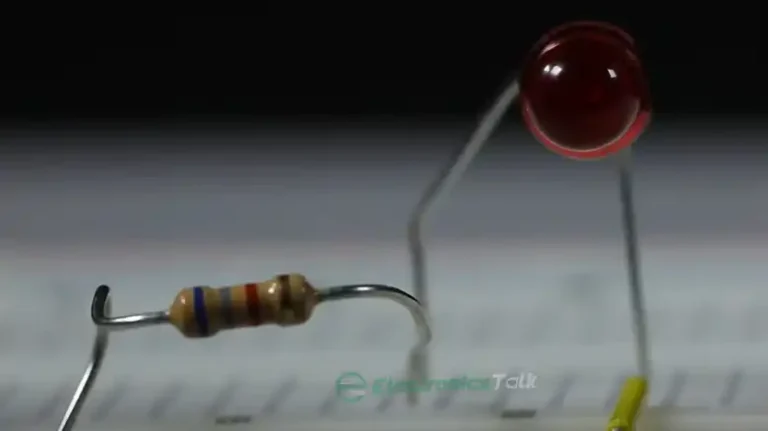
A resistor breaks the loop. Put one in series and the current can only climb so far before the resistor eats the extra voltage. The math is plain Ohm’s law, the same V = IR you already know.
Sizing the Resistor: A Worked Example
Here is the formula. Nothing fancy.
R = (V_supply − V_forward) / I_operating
Say you have a common red laser diode. Typical numbers:
- Supply: 5V
- Forward voltage: about 2.2V
- Target current: 30 mA (0.030 A)
Run the steps.
- Subtract: 5 − 2.2 = 2.8V across the resistor.
- Divide by current: 2.8 / 0.030 = about 93 ohms.
- Round up to the nearest standard value: 100 ohms. Rounding up lowers current a touch, which is the safe direction.
- Check power: P = I² × R = 0.030² × 100 = 0.09W. A 1/4-watt resistor covers it with room to spare. If your resistor runs warm, that heat is normal, the same way current-limiting resistors get hot in any LED circuit.
- Add margin. Aim about 20 percent under the diode’s rated max current, not right at it.
Blue and violet emitters sit at a much higher forward voltage, frequently 4.5 to 5V, so on a 5V rail your resistor inherits almost no headroom and any wobble in the battery translates straight into a wild current excursion through the delicate emitter. That single limitation pushes most careful builders toward a regulated driver.
Resistor vs Constant-Current Driver
A resistor sets the current for one supply voltage. Change the supply, or let the diode warm up, and the current drifts. A driver holds it fixed no matter what. Here is the honest trade.
| Factor | Series Resistor | Constant-Current Driver |
|---|---|---|
| Cost | Under $1 | Around $5 and up |
| Current stability | Drifts with supply and heat | Locked, tight |
| Battery sag handling | Poor | Good |
| Best for | Cheap red diodes, quick tests | Blue, IR, and any diode you care about |
| Setup time | Seconds | A few minutes |
My verdict: a resistor is fine for a throwaway red pointer or a bench test. For anything that cost real money, or a blue or infrared diode, spend the $5 on a driver. A rule I keep taped to my bench says it plainly: “size for the current, not the voltage.”
How I Wire One on the Bench
When I test an unknown diode, I never connect it straight to a supply. First I set my bench supply to current-limit mode, dial in a low current like 10 mA, and bring it up slowly while I watch the output. That tells me the real threshold before I commit to a resistor.
Then I pick the resistor from the math above, solder it in series on the positive leg, and re-check the current with a meter in circuit. I have wired dozens this way. If you skip the meter and trust the color code alone, you will guess wrong eventually. Static matters too, so ground yourself before you touch the leads, the same care you would take so soldering does not damage the diode.
Frequently Asked Questions
Do I need a resistor for a laser diode if I already have a driver?
No. A constant-current driver already limits the current, which is the whole job. Adding a series resistor on top just drops a little voltage and wastes power for no gain.
What resistor value should I use for a 5V laser diode?
For a red diode near 2.2V forward and 30 mA, about 100 ohms works. Use R = (5 − 2.2) / 0.030 and round up to the next standard value. Always confirm with a meter.
Can I use a resistor instead of a driver for a blue laser diode?
You can, but it is risky. Blue diodes need 4.5 to 5V, so a 5V supply leaves almost no headroom for the resistor, and the current gets unstable. Use a driver.
What happens if I use the wrong resistor value?
Too small and current overshoots, so the diode overheats and can die in seconds. Too large and the diode stays below threshold, so it glows dimly or not at all.
Does a laser diode resistor get hot?
A little, and that is fine. In the 5V example it burns under 0.1W, well inside a 1/4-watt part. If it scorches, your value or power rating is wrong.
How long will a properly driven laser diode last?
Well over 10,000 hours in many datasheets when you keep current in spec and the junction cool. Overdrive it once and that lifespan can drop to zero in a single flash.
Related Reading
Bottom Line
So, do I need a resistor for a laser diode? For a bare diode on a fixed voltage, yes, a series resistor is the minimum protection between your part and a dead junction. Size it with R = (V_supply − V_forward) / I, round up, and check the current with a meter. For cheap red diodes a resistor is enough. For blue, infrared, or anything you value, skip the shortcut and use a proper driver. For deeper reading on current-limiting values, SparkFun’s LED tutorial covers the same math, and you can see how a 220 ohm resistor is sized for an LED using the identical approach.