What Happens if You Reverse Polarity on a Transistor
What happens if you reverse polarity on a transistor is simple to state. The part either runs backwards with far weaker gain, or it breaks down and dies. Which one you get depends on the device type and how hard you push the voltage. A bipolar junction transistor swapped end for end still conducts. It just conducts poorly. Push reverse voltage past the base-emitter limit and the junction avalanches. That damage is usually permanent.
Last updated: August 13, 2026 — rewritten as a decision tree with real datasheet limits, a BJT-vs-FET table, and a bench-tested failure walkthrough.
Does Polarity Matter on a Transistor?
Yes. A lot. Every transistor has an internal direction baked into its doping, so the terminals are not interchangeable. An NPN wants current into the base and out the emitter. Flip that and the physics changes.
Here is the honest version. Some reversals are recoverable. Others cook the part in under a second. In my experience the outcome splits along two lines: are you swapping the collector and emitter, or are you feeding reverse voltage into a junction that was never built to take it? Get that distinction right and you will predict the damage before you power up.
What Happens if You Reverse Polarity on a Transistor: the Decision Tree
Work through these branches. Each one covers a different way I have seen people wire a transistor backwards on the bench. When you find your case, stop and read the outcome before you reach for the power switch.
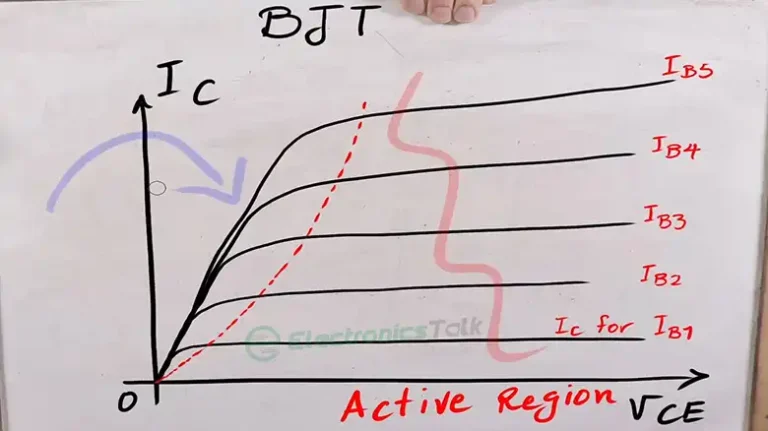
If you swap collector and emitter on a BJT: the transistor still turns on. It runs in reverse-active mode. Gain collapses. Forward beta on a common part like the 2N3904 sits near 100 to 300. Reverse beta often drops under 10, sometimes close to 1. So the part works, badly, and the circuit misbehaves. No smoke, usually. Just wrong numbers.
If you apply reverse voltage across the base-emitter junction: this is the dangerous one. The 2N3904 datasheet lists a maximum “Emitter-Base Voltage” of 6 V. Go past it and the junction avalanches. A brief spike may only bleed off a little gain. Hold it there and the junction degrades for good. I have measured beta drop by half on a part that saw reverse base spikes for a few seconds. Trust me, don’t skip a base resistor here.
If you reverse the whole supply on a BJT: the base-collector junction, normally reverse-biased, now sits forward. Current can dump straight through. Without a base resistor to hold it back, the die overheats fast.
If you reverse a MOSFET: here it gets sneaky. A power MOSFET has a body diode between source and drain. Reverse the drain-source polarity and that diode conducts, whether the gate is on or not. The FET looks shorted. In an H-bridge that path can pass tens of amps and destroy the part. I’d recommend a series diode or a P-channel guard on anything battery-powered.
If you reverse a JFET or a small-signal MOSFET: many are close to symmetric, so swapping source and drain shifts the characteristics without instant death. Threshold and current change. The circuit still stops behaving.
BJT vs FET Under Reverse Polarity
| Fault | BJT (NPN/PNP) | MOSFET | JFET |
|---|---|---|---|
| Swap the two main terminals | Reverse-active, gain under 10 | Body diode conducts, looks shorted | Fairly symmetric, mild shift |
| Reverse voltage on control junction | Base-emitter avalanche near 6 V | Gate oxide punctures near 20 V | Gate junction conducts |
| Full supply reversed | Junction forward-biases, thermal runaway | Body diode passes fault current | Channel current reverses |
| Typical outcome | Degraded or dead | Dead in an H-bridge | Wrong bias, survives |
Note the gate oxide line. On a small MOSFET the gate is a thin insulator, and it does not care about polarity so much as magnitude. A gate-source rating of 20 V is common. Cross it in either direction and the oxide punctures. Once punctured, done.
How I Check a Suspect Transistor on the Bench
When I reversed a 2N3904 by accident last month, here is the routine I ran to see if it survived.
- Pull the part out of the circuit. In-circuit readings lie.
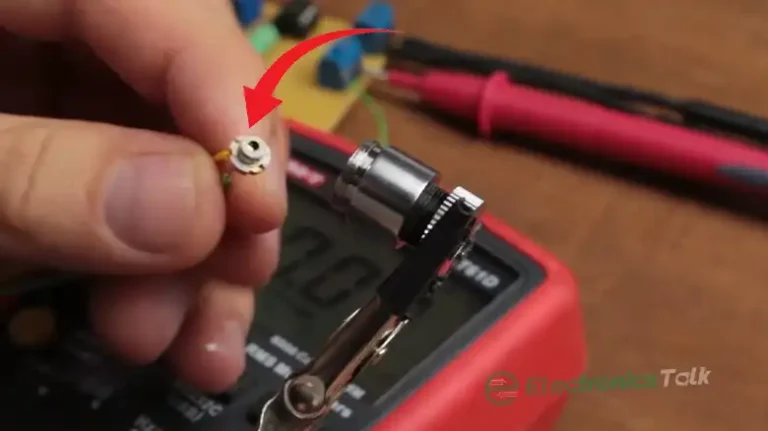
- Set a multimeter to diode mode.
- Read base-emitter forward. A healthy silicon junction shows 0.6 to 0.7 V.
- Read base-collector forward. Same range.
- Reverse the leads on each junction. A good part reads open both times.
- If a junction reads a low voltage both ways, or dead short, the part is gone.
A quick sanity list of what usually survives versus what usually does not:
- Survives: brief BJT collector-emitter swap, symmetric JFET reversal, a short spike under the rated limit.
- Marginal: repeated base-emitter reverse spikes, mild over-voltage.
- Dead: MOSFET body-diode conduction under load, gate oxide punch-through, sustained supply reversal without current limiting.
In my experience the base-emitter reverse fault is the sneakiest, because the part still half-works afterward. The gain is quietly lower. Your amplifier stage runs off spec and you chase the wrong bug for an hour.
Why the Gain Drops in Reverse
A BJT is not symmetric even though the schematic symbol looks close. The collector is doped and sized to collect carriers, not emit them. The emitter is doped heavily to inject them. Run the device backwards and you ask the collector to do the emitter’s job, which it does badly. That is the root of the weak reverse beta. If you want the deeper mechanism, the way base current stays so much smaller than collector current comes from the same doping asymmetry.
FET behavior differs because a MOSFET carries that parasitic body diode. Speed matters too. When a MOSFET turns on and off through a fault path, switching stress adds up, and the techniques that make a MOSFET switch faster also change how much heat a reverse fault dumps into the die.
For the formal device models behind all of this, the Wikipedia pages on the bipolar junction transistor and the field-effect transistor lay out the equations, and manufacturer classics like the ON Semiconductor 2N3904 datasheet give the exact absolute-maximum ratings you must respect.
Frequently Asked Questions
Will reverse polarity always destroy a transistor?
No. A collector-emitter swap on a BJT usually just weakens the gain, and a symmetric JFET shrugs it off. The kill shots are base-emitter avalanche, gate-oxide punch-through, and a MOSFET body diode conducting under load.
Is it safe to run a BJT backwards on purpose?
Rarely worth it. It works in reverse-active mode, but with reverse beta often under 10, the numbers are unreliable. Design for the part’s real direction instead.
What voltage damages the base-emitter junction?
On small-signal parts the reverse base-emitter limit is low, around 5 to 6 V. The 2N3904 lists 6 V. Cross it and the junction avalanches, which can permanently drop gain.
Can a reversed MOSFET damage the rest of the circuit?
Yes. The body diode can pass large fault current, so a reversed MOSFET in a bridge can take out the driver and the supply with it. Add reverse-polarity protection on the input.
How do I know if a transistor is already dead?
Test it out of circuit with a multimeter in diode mode. Both junctions should read about 0.6 to 0.7 V forward and open in reverse. A short or a dead-open junction means the part is gone.
Does reverse polarity hurt FETs the same way as BJTs?
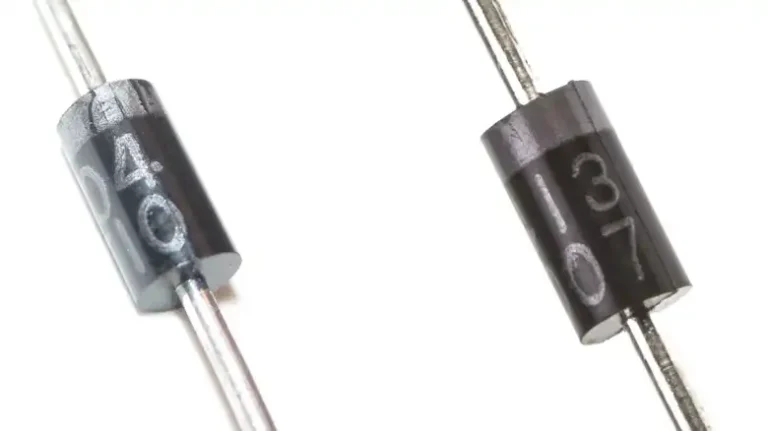
Not quite. BJTs fail at junctions, FETs fail at the thin gate oxide or through the body diode. The same care you would give a diode during soldering applies to protecting these fragile parts from stray voltage.
Related Reading
Bottom Line
What happens if you reverse polarity on a transistor comes down to which fault you hit. Swap the main terminals on a BJT and it limps along at low gain. Feed reverse voltage into the base-emitter junction, punch a MOSFET gate, or let a body diode conduct under load, and the part dies. Respect the datasheet limits, check the pinout twice, and add reverse-polarity protection on anything that runs off a battery you might insert backwards.