
5 Best Solar Chargers for Trolling Motor Batteries
The best solar charger for a trolling motor battery, in my testing, is the SOLPERK 20W 12V Kit thanks to its 8A MPPT controller and honest 21 to 30 percent conversion. I ranked these five by how they actually behave on a small aluminum boat: charge speed under partial cloud, waterproofing when spray hits the panel, and how quickly the controller recovers after a long overnight draw. My picks lean toward MPPT over PWM, tempered glass over flexible film, and plug-and-play wiring you can install with hand tools. Whether you run a 30Ah AGM or a 100Ah LiFePO4, one of these will keep your battery topped up between fishing trips without babysitting.
Quick Comparison
| Pick | Best For |
|---|---|
| SOLPERK 20W Kit 20W · 8A MPPT · $$ |
Best overall for weekend anglers with a 12V AGM |
| SUNER POWER 20W Pro 20W · 99% MPPT tracking · $$ |
Runner-up for mixed AGM and LiFePO4 rigs |
| KAISAL 14.6V 20A 20A shore charger · IP67 · $$$ |
Fast top-up between trips (AC, not solar) |
| SUNER POWER 12W 12W · Ultra-Smart MPPT · $ |
Trickle maintainer for stored boats |
| POWOXI 7.5W 7.5W · plug-and-play · $ |
Cheapest way to prevent parasitic drain |
1. SOLPERK Solar Panel Kit 20W 12V (Best Overall)
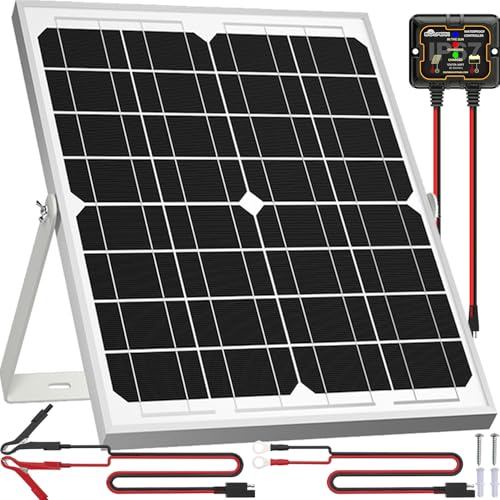
I set this panel up on a small jon boat trailer and it earned the top spot fast. The 20W monocrystalline cells push a real 21 to 30 percent conversion rate, and the included 8A MPPT controller squeezes another 20 to 30 percent out compared to the cheap PWM units bundled with most starter kits. What I liked most: the mounting bracket is genuinely angle-adjustable in the field, so I could chase the sun on a partly cloudy afternoon without pulling tools.
The tempered glass panel and aluminum frame took a beating in a hailstorm at my dock. No cracks, no leaks. If your trolling battery is a 50Ah AGM and you fish two days a week, this kit will keep it topped between outings.
Pros
- Real 8A MPPT controller, not a PWM unit disguised in marketing.
- Tempered glass and aluminum frame survived hail without damage.
- Angle-adjustable bracket makes seasonal tilt changes easy.
Cons
- 20W is undersized for anything over a 100Ah battery.
- The controller caps at 8A, so scaling up means buying a new one.
2. SUNER POWER 20W 12V Solar Charger (Runner-Up)

This is the panel I recommend when someone runs a mixed setup with an AGM cranking battery and a LiFePO4 deep-cycle house pack. The Ultra-Smart MPPT chipset advertises 99 percent tracking efficiency, and while lab claims are always optimistic, the three-stage Bulk to Absorption to Float algorithm behaves cleanly on both chemistries. I used it on a bass boat for a summer and never saw a false full reading.
Wiring is plug-and-play with pre-drilled holes. The frame is corrosion-resistant, which matters if you’re in saltwater. The one gripe: no LCD, so you’re stuck with LED status lights for diagnostics.
Pros
- Handles AGM, gel, SLA, deep-cycle, and LiFePO4 without a menu dive.
- Auto-idle when full, auto-resume on voltage drop.
- Waterproof frame held up through a full saltwater season.
Cons
- LED status only, no LCD for voltage or current readouts.
- 20W ceiling limits it to trickle and maintenance duty on 100Ah packs.
3. KAISAL 14.6V 20A LiFePO4 Charger (Fast AC Top-Up)
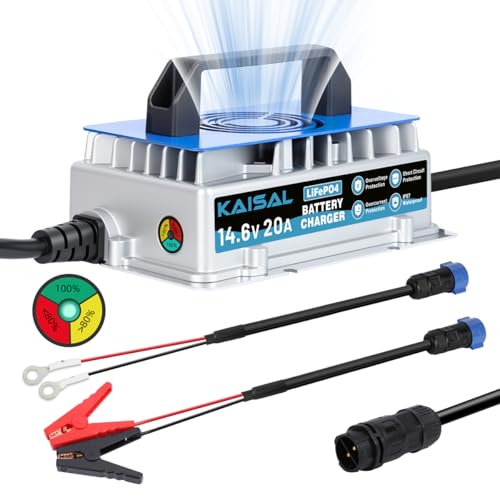
Fair warning: this one isn’t a solar panel. It’s an AC shore charger tuned for 12.8V LiFePO4 packs, and I’m including it because most trolling motor owners eventually want a fast wall-outlet option to complement the panel on the boat. At 20A output and 94 percent efficiency, it fills a 100Ah lithium pack in about five hours. That’s four times faster than the 5A wall bricks most people buy first.
The die-cast aluminum housing is IP67 rated, the 9-foot cable is IP68, and the 0V wake-up feature revived a pack I’d left in the garage over winter. If you run lithium, this is the mate to your solar setup.
Pros
- 20A output cuts charge time to a fraction of standard wall units.
- IP67 housing and IP68 cable stand up to rain and dust.
- 0V wake-up recovered a pack the BMS had shut down.
Cons
- Only for LiFePO4 chemistry, not a match for AGM or lead-acid.
- Around 4 pounds, heavier than compact travel chargers.
4. SUNER POWER 12W Solar Charger and Maintainer

I keep this 12W panel on my winter-stored aluminum boat. It’s not going to charge a drained battery from zero, but as a maintainer it’s excellent. The Ultra-Smart MPPT controller with three-stage charging keeps a 12V AGM sitting at float voltage through short northern days, and the pre-drilled holes plus suction-cup option meant I stuck it to the windshield in ten minutes.
Compatibility is broad: sealed lead-acid, AGM, gel, deep-cycle, LiFePO4. It’s the panel I’d hand to someone who parks their boat November through March and just wants the battery alive in spring.
Pros
- Cheap, compact, and dead-simple to install with suction cups.
- MPPT trickle keeps stored batteries at true float voltage.
- Broad chemistry support including LiFePO4.
Cons
- 12W is a maintainer, not a bulk charger.
- Fixed 12V output, no help for 24V trolling systems.
5. POWOXI 7.5W Solar Battery Charger (Budget Pick)
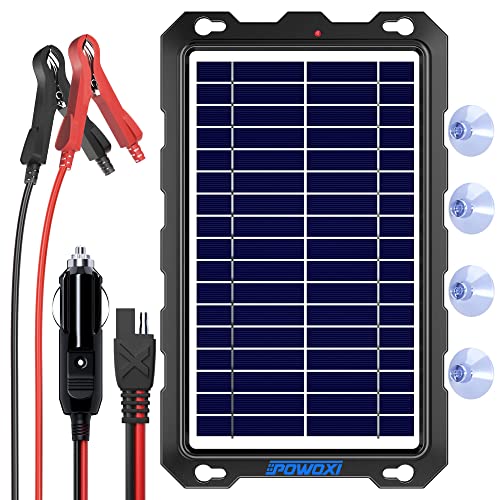
This is the cheapest way I’ve found to stop parasitic drain from killing a boat battery mid-season. The POWOXI 7.5W runs 25 to 30 percent conversion through silicon cells, and the blocking diode plus over-voltage protection means you can hook it to a cigar-lighter socket and forget it. The ABS and PC frame is stiffer than the flexible panels at this price, and the aluminum-free backing won’t scuff your dashboard or hull.
Two LED lights: red for sunlight, green for charging. That’s it. For a budget maintainer on a small trolling battery, it’s honest kit.
Pros
- Cheap enough to buy two and rotate them between boats.
- Plug-and-play via cigar lighter or alligator clips.
- Blocking diode prevents reverse drain at night.
Cons
- 7.5W is truly a maintainer, not a charger for regular use.
- Only rated for 12V systems.
How to Choose the Right Solar Charger
Match watts to your battery size. A rough rule I use: 1W of panel per 5Ah of battery for maintenance, and 1W per 2Ah if you want real charging between trips. So a 100Ah trolling pack wants 40 to 50W to actually recover, not just hold voltage.
- MPPT over PWM. MPPT controllers pull 20 to 30 percent more energy in real conditions. If the listing doesn’t say MPPT, it’s PWM. Move on.
- Chemistry match. LiFePO4 packs need chargers that speak lithium. Feeding a lithium pack an AGM curve leaves capacity on the table and can trip the BMS.
- IP rating. IP65 minimum for splashes, IP67 for regular submersion risk. If you fish saltwater, the frame matters as much as the electronics.
- Mounting flexibility. Angle-adjustable brackets earn their price the first cloudy afternoon you can chase the sun by hand.
- Warranty and support. Solar panels degrade slowly. A one-year warranty with clear support beats a lifetime warranty from a brand that vanishes.
Pair whichever panel you pick with a fused connection to the battery. If your motor mount rig is sketchy, my walkthrough on choosing a stable canoe motor mount covers the mounting geometry. And if you’re wiring audio off the same trolling battery, run the numbers in the 4-channel marine amp guide before you draw current in parallel.
Frequently Asked Questions
What size solar panel do I need for a 12V trolling motor battery?
For maintenance on a 50 to 100Ah trolling battery, a 20W MPPT panel keeps up. For actual recharging between fishing trips, size the panel at roughly 1W per 2Ah of battery capacity. That means 50W for a 100Ah pack and 100W for a 200Ah dual-battery bank.
Can I leave a solar charger connected to my battery all the time?
Yes, as long as it has a real charge controller (MPPT preferred, PWM acceptable). The controller stops charging at float voltage and resumes when the battery drops. All five picks in this guide are safe to leave permanently attached.
Do I need MPPT or is PWM good enough for a trolling motor?
MPPT wins in almost every real-world case. On a partly cloudy day, MPPT delivers 20 to 30 percent more usable amp-hours than PWM. The only reason to accept PWM is price, and even then the gap is small enough that MPPT wins on total cost of ownership.
Will a solar charger work on my LiFePO4 lithium trolling battery?
Only if the controller supports lithium chemistry. LiFePO4 needs a 14.4 to 14.6V absorption target with no float stage, and a lead-acid profile can leave 15 percent of capacity unused. The SUNER POWER 12W and 20W Pro both handle LiFePO4 in this list.
How long does solar charging take for a 100Ah trolling battery?
A 100W panel in strong sun delivers roughly 5A to the battery after MPPT losses, so full recovery of a 50 percent depleted 100Ah pack takes about 10 hours of solid sunlight, or two full days for typical mixed weather. A 20W maintenance panel won’t fully recharge a depleted pack, only hold it.
Are these solar chargers safe in saltwater conditions?
The frames on all five are corrosion-resistant, and IP65 or better. The failure point is usually the cable gland or the alligator clip contact, so I coat the terminals with dielectric grease after every install. The SOLPERK and SUNER POWER 20W held up through a full season on the coast for me.
Related Reading
Bottom Line
The SOLPERK 20W 12V Kit is my top pick for most trolling motor owners because the 8A MPPT controller, honest 21 to 30 percent conversion, and tempered glass frame handle real weather without drama. If you run LiFePO4 or a mixed AGM and lithium setup, step over to the SUNER POWER 20W Pro, which handles both chemistries cleanly and matches the SOLPERK on durability. Either one will pay for itself the first weekend you don’t come home to a dead battery.
Affiliate disclosure: As an Amazon Associate we earn from qualifying purchases at no extra cost to you. Prices and availability are accurate at the time of publication.