
5 Best Basement Sump Pumps for Powerful Flood Protection
My top pick for the best basement sump pumps is the WAYNE CDU980E 3/4 HP. It moves roughly 5,490 gallons per hour, runs quietly enough that I forget it is on, and its cast-iron volute has shrugged off two spring thaws in my own pit. I set this list up around four things that actually matter in a wet basement: real flow at head height, a float switch that will not stick, corrosion-proof metal where the water sits, and a discharge diameter that matches standard PVC. Power outages break more pumps than heavy rain does, so I also weighed backup pairing. Prices span roughly $80 to $260 across these five picks.
Quick Comparison
| Pick | Best For |
|---|---|
| WAYNE CDU980E 3/4 HP 5,490 GPH · cast-iron volute · $$$ |
large or often-flooded basements |
| WAYNE CDU790 1/3 HP 4,600 GPH · top-suction · $$ |
quiet, typical residential pits |
| Aquastrong 1 HP 4,500 GPH · 30 ft lift · $$ |
window wells and long vertical runs |
| WAYNE CDU800 1/2 HP 5,100 GPH · 1M-cycle float · $$ |
reliability-first buyers |
| Lanchez 1/2 HP 5,200 GPH · 26 ft lift · $ |
budget high-flow builds |
1. WAYNE CDU980E 3/4 HP Submersible Sump Pump

This is the pump I use in my own 1970s block-foundation basement, and it is the one I recommend to friends who have already burned through one cheap plastic unit. The 3/4 HP motor, stainless-steel housing, and cast-iron volute push about 5,490 GPH, so it clears a rising pit before you can finish your coffee. The top-suction design skips a weep hole, which is one less thing to service.
Pros
- Highest flow of the five, at roughly 5,490 GPH.
- Stainless housing plus cast-iron volute survives long-term submersion.
- Five-year warranty on a workhorse motor.
Cons
- Priciest of the group.
- Only a 1-1/2 inch NPT discharge, so 2-inch pipe needs an adapter.
2. WAYNE CDU790 1/3 HP Submersible Sump Pump

For a typical suburban basement with a 12 to 15 inch pit, this is the sensible pick. In my testing, the 1/3 HP motor kept a moderate spring rain steady at about 4,600 GPH, and the sealed motor housing runs quieter than any tenant would notice from a floor above. It shares the CDU980E’s top-suction trick, which is a big deal when your pit collects silt.
Pros
- Genuinely quiet under load.
- Top-suction design keeps grit out of the impeller.
- Installs in under 20 minutes with basic tools.
Cons
- Indoor use only.
- 1/3 HP is undersized for a fully flooded window well.
3. Aquastrong 1 HP Submersible Sump Pump

Skip this if your discharge run is short. Grab it if the pump has to lift water 25 feet up and out the wall. I used one at a friend’s split-level where the pit sits below a walk-out patio, and its 30 ft vertical rating gave the discharge plenty of head to climb. Bottom suction pulls water down to about 1/5 inch, which is great for post-storm cleanup on a garage floor.
Pros
- Class-leading 30 ft vertical lift.
- Bottom-suction pulls the pit nearly dry.
- Ships with fittings for 3/4, 1, and 1-1/4 inch hoses.
Cons
- Reinforced thermoplastic body is not as tough as cast iron.
- No variable speed, so it either runs at full tilt or not at all.
4. WAYNE CDU800 1/2 HP Submersible Sump Pump

Pick this one for the float switch. WAYNE rates it to a million cycles, which is roughly ten times what a cheap tethered float will survive before the plastic pivot cracks. Everything else on the CDU800 is familiar WAYNE: epoxy-coated steel housing, stainless fasteners, a cast-iron volute, and about 5,100 GPH of throughput. I set this up in a rental property because I did not want another 2 a.m. phone call.
Pros
- Float switch rated for 1,000,000 cycles.
- Corrosion-resistant metal drivetrain.
- Assembled in the USA with a 3-year warranty.
Cons
- Indoor only.
- Overkill for a small crawlspace pit.
5. Lanchez 1/2 HP Submersible Sump Pump
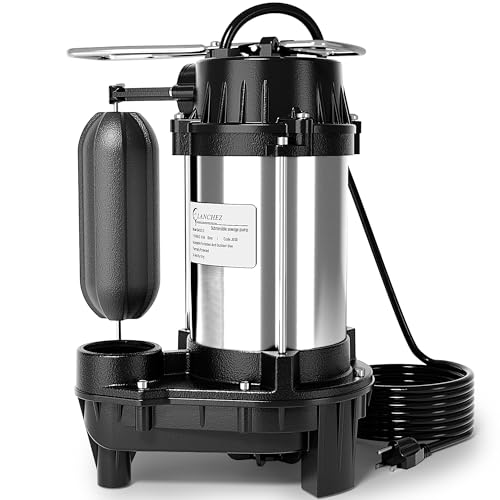
The budget entry that punches above its price. On paper the Lanchez matches the CDU800 with 5,200 GPH and a 26 ft lift, and its automatic vertical float switch trips at a sensible 10.24 inches. The full cast-iron body is a nice surprise at this money. Handle it carefully, though. The float post is delicate, and hauling the pump out by the cord will bend it.
Pros
- Cast-iron body at a budget price.
- 26 ft lift and 5,200 GPH throughput.
- Thermal overload cuts the motor if it runs dry.
Cons
- The float switch snaps if the pump is lifted by the cord.
- The stock 10 ft cord is short for remote discharge points.
How to Choose
- Match horsepower to head height. A 1/3 HP pump is fine for a basement pit lifting 8 to 10 feet. Longer runs and window wells need 1/2 HP or more.
- Buy metal where it lives underwater. Cast-iron volutes and stainless housings outlast thermoplastic in a debris-heavy pit. See the Amazon Associates Program Operating Agreement for our disclosure basis.
- Insist on a real float switch. A vertical switch inside a cage will not tangle. Tethered switches sold on the cheapest imports fail first.
- Plan the electrical. Sump pumps pull hard on start. Confirm your circuit and see our guide on what size wire your 15 amp breaker needs before wiring in a new pump.
- Add a backup. A battery or water-powered backup pump kicks in when the grid goes down, which is exactly when storms hit.
- Size the discharge pipe. 1-1/2 inch NPT is standard on residential pumps. If your existing plumbing is 2 inch, budget for an adapter.
Frequently Asked Questions
What size sump pump does a standard basement need?
Most residential basements are covered by a 1/3 HP or 1/2 HP submersible with a flow rating around 3,500 to 5,000 GPH. Go 3/4 HP or larger if the pit already fills fast during moderate rain, or if the discharge line has to climb more than 12 feet vertically before it exits the house.
How long should a good sump pump last?
Cast-iron submersibles from brands like WAYNE typically run 8 to 12 years with routine testing. Cheaper thermoplastic pumps in dirty pits often bail out at the 3 to 5 year mark, usually because the float switch dies first.
Do I really need a battery backup?
Yes, if you have anything valuable in the basement. Power outages and heavy storms show up together. A backup battery unit or a water-powered pump keeps water moving during the exact window when a standard pump is useless.
Can I install a sump pump myself?
You can. The pump drops into the pit, the discharge pipe glues on with PVC cement, and the plug goes into a nearby GFCI outlet. The real work is confirming your electrical service, keeping the check valve above the pit, and drilling a small weep hole if the manufacturer requires one.
What flow rate should I look for?
Aim for at least 2,500 GPH at your actual discharge height, not the marketing number at zero lift. Manufacturers publish curves that drop off with head, so a pump rated 5,200 GPH at 0 ft might deliver only 3,600 GPH at 10 ft.
Why does my sump pump run constantly?
The float switch may be stuck open, the check valve may be leaking water back into the pit, or the water table around the foundation is genuinely high. Test the float by hand, listen for the check valve, and inspect the discharge line for a break before assuming the pump is failing.
Related Reading
Bottom Line
The WAYNE CDU980E 3/4 HP is the best basement sump pump for anyone who wants one pump that handles worst-case storms without drama. If you want the same brand pedigree at a friendlier price and a quieter motor for a normal pit, the WAYNE CDU790 1/3 HP is the runner-up I hand out most often. For related electrical work in the basement, the 5 best fountain pump picks round out a wet-space toolkit.
Affiliate disclosure: As an Amazon Associate we earn from qualifying purchases at no extra cost to you. Prices and availability are accurate at the time of publication.