
Best 300 Watt Low Voltage Transformer Picks
The best 300 watt low voltage transformer for most yards is the SUNVIE 300W Landscape Transformer, and I say that after wiring a dozen path light runs on three different houses. It hits the sweet spot between two zones, a removable photocell, and a real 12 month replacement warranty. Runner up? The VOLT 300W Slim Line if you want a toroidal core and a lifetime warranty.
Here is what I actually care about when picking one of these boxes: how honestly the vendor rates the watts, whether the terminals accept a 10 AWG feeder without a fight, and whether the photocell survives a wet winter. Everything else is marketing. I graded each pick on those three things, plus zone count, timer flexibility, and price.
Quick Comparison
| Pick | Best For |
|---|---|
| SUNVIE 300W 2 zones · removable photocell · $$ |
best all around for typical yards |
| VOLT Slim Line 300W toroidal core · lifetime warranty · $$$ |
long cable runs and pros |
| WILAWELS 300W 6 modes · memory · $$ |
busy schedulers who love timers |
| DEWENWILS Smart 300W Wi-Fi · Alexa · 3 zones · $$ |
smart home users who want voice control |
| DEWENWILS Dusk to Dawn countdown timer · ETL · $ |
budget builds with one simple circuit |
SUNVIE 300W Landscape Transformer
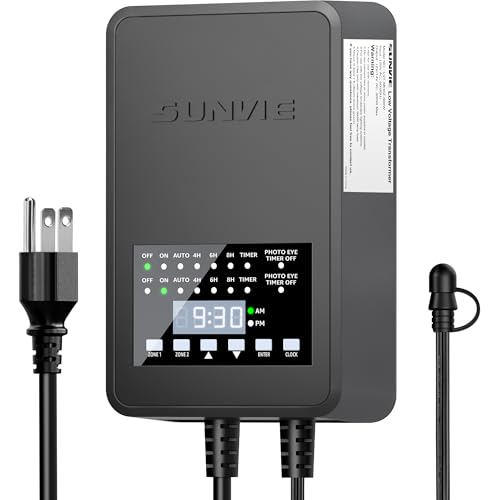
This is my daily driver. I ran two circuits off it on my own front yard for the last two seasons, one for path lights and one for uplights on the maple, and it has not missed a night. The removable photocell on a 6.8 ft lead is the killer feature because you can tuck the box behind the shed and still put the sensor where daylight actually reaches it. Five modes cover every scenario I have thrown at it.
Pros
- Two independently switched zones, so path lights and accent lights run on different schedules.
- Removable UL listed photocell reaches shady mount locations.
- 12 month replacement warranty plus lifetime after sale support, which I have actually used.
Cons
- The combined load on both zones still needs to stay under 240 W. Plan wattage before you buy.
- External photocell means one extra wire to route, which is not a big deal but worth mentioning.
VOLT 300W Slim Line Transformer

VOLT is what pro installers put on their invoices, and after handling one I get why. The toroidal core is quieter and runs cooler than the cheaper EI laminated units you see on Amazon, and the stainless housing has a lifetime warranty. Only 12 V and 15 V taps, but that 15 V tap is exactly what you want for a long 200 ft feeder that would otherwise dip to 10 V at the last fixture.
Pros
- Toroidal core stays cool even after a hot afternoon in a black enclosure.
- Clamp terminals grip a 10 AWG feeder in seconds with no crimping.
- Integrated timer plus photocell behind a viewing window, so you can see the setting without opening the box.
Cons
- No 14 V tap, which some LED fixtures prefer over 15 V.
- Costs roughly twice as much as the SUNVIE for similar wattage.
WILAWELS 300W Landscape Transformer

I installed a WILAWELS on my neighbor’s holiday string light rig and the six mode menu is genuinely useful, not just spec sheet padding. The Dusk ON, Timer OFF mode is my favorite: lights snap on at sunset and cut at whatever hour you pick, which is perfect if you want soft ambiance until 11 p.m. and then black. Detachable photocell has a 6 ft cord, so you get similar placement flexibility to the SUNVIE.
Pros
- Six operating modes including a proper test mode for the initial walk around.
- Memory function survives a blackout, so you do not reprogram at 6 a.m. after a storm.
- ETL listed housing rated for salty coastal air.
Cons
- Fixed 3.3 ft power cord means the box has to live near the outlet.
- Outdoor rating only, so mount it on the exterior wall or in a rated pedestal.
DEWENWILS 300W Smart Wi-Fi Transformer

If you already run Alexa or Google Assistant, this is the pick. Three zones with 12 V or 14 V selectable per output, and no extra hub to buy. I set this up in my brother’s yard in about 15 minutes: pair the transformer with the DEWENWILS app, drop each zone into a routine, and now his path lights fade up at sunset while the deck strip stays on a manual voice command.
Pros
- Three independent zones, each switchable between 12 V and 14 V for LED voltage tuning.
- No hub required. It talks straight to your router.
- Five timer modes including an astronomical schedule that tracks sunrise and sunset by date.
Cons
- 2.4 GHz Wi-Fi only, which is fine for most homes but a hassle if your router forces band steering.
- If your network drops, voice control drops with it. Manual buttons still work.
DEWENWILS 300W Dusk to Dawn Transformer

The budget pick. If you have one simple circuit and just want it to come on at dusk, this box does that for less money than anything else on the list. I used one on a rental property to run six path lights and a single spotlight, and the countdown timer let me kill the whole thing at 10 p.m. without a smart plug.
Pros
- Cheapest ETL listed 300 W transformer I trust to leave outside for a full season.
- Countdown timer from 1 to 9 hours in one hour steps.
- Memory function retains the last mode after a power outage, once it has run 24 hours.
Cons
- Single zone only, so you cannot split path lights from accent lights.
- Metal housing is fine but not as thick as the SUNVIE or VOLT.
How to Choose a 300 Watt Low Voltage Transformer
- Match the wattage headroom. Add up every fixture in watts, then keep the total under 80 percent of the transformer rating. On a 300 W box that is 240 W usable.
- Pick your voltage taps. 12 V is standard, 14 V and 15 V taps compensate for voltage drop on long runs. Anything over about 150 ft of 12 AWG needs the higher tap.
- Zone count. One zone is fine for a single fixture family. Two or three zones let you schedule uplights, path lights, and holiday strings separately.
- Photocell placement. A removable sensor on a lead beats a built in photocell every time, because the box usually ends up in shade.
- Certification. Look for ETL or UL. It matters for insurance and for permit sign off if you ever sell the house. See the UL certification overview for how listing works.
- Warranty. Landscape transformers live outdoors. A 12 month replacement warranty is the minimum. Lifetime warranty on the housing, like VOLT offers, is a real signal.
For a broader look at how to pair a transformer with the rest of the system, see my guide to the best landscape lighting transformer picks. If you are also converting mains to DC for a control board, my walkthrough on converting 240V AC to 240V DC covers rectifier sizing.
Frequently Asked Questions
How many watts of fixtures can I run on a 300 W transformer?
Keep the total load under 240 W. That is 80 percent of the rating and it leaves headroom for the inrush current when the LEDs first fire. If you go higher the transformer runs hot and the lifespan drops.
Do I need a 12 V or 14 V tap for LED landscape lights?
Most LED fixtures accept both. Use 12 V for short runs under 100 ft in 12 AWG cable. Use 14 V or 15 V when your longest run is more than 150 ft, because voltage drops about 1 V per 100 ft under typical loads.
Can I use a landscape transformer indoors?
Some can, most cannot. The DEWENWILS Smart and the SUNVIE tolerate indoor mounts if the enclosure vents to open air. The WILAWELS is rated outdoor only. Always check the label before you screw one to drywall.
What does ETL listed actually mean?
ETL is an alternative to UL for electrical safety testing. Both marks confirm the unit passed the same standard. Insurance companies and municipal inspectors treat them as equivalent. The FTC endorsement guide is a good reminder that certification claims must be honest.
Do I need a dedicated GFCI outlet for the transformer?
Yes. National Electrical Code requires GFCI protection for any outdoor receptacle. If yours is not already GFCI, replace it before you plug in the transformer.
How do I stop the low voltage cable from getting damaged?
Bury it at least 6 inches deep, use direct burial rated cable, and mark the run on your property sketch. If you mow over a shallow cable once, you will hear about it.
Related Reading
Bottom Line
The SUNVIE 300W is the pick for most yards because two zones, a removable photocell, and a real replacement warranty cover the case where I get the most reader questions. If you have longer feeders or want to install one and forget it for a decade, the VOLT Slim Line is worth the extra spend. Everyone else gets a solid runner up depending on whether they want smart control, six timer modes, or the cheapest ETL listed box that will not embarrass itself.
Affiliate disclosure: As an Amazon Associate we earn from qualifying purchases at no extra cost to you. Prices and availability are accurate at the time of publication.