
5 Best LED Ceiling Lights to Brighten Any Room
I tested five of the best LED ceiling lights on Amazon this quarter and the top pick is the SunRider 12-inch Flush Mount. My reasoning is short. It squeezes 2,400 lumens of clean daylight into a 0.71-inch shell without whining, buzzing, or throwing that faint strobe pattern you catch when a phone camera pans across a cheap driver at 60 Hz. Bright. Thin. Quiet. The rest of my shortlist splits into two camps. Room-filling flush mounts, if you want one disc to handle the whole ceiling by itself. Canless downlight packs, if you’re wiring a kitchen, a finished basement, or a long hallway run over a weekend and want the light to disappear into the plane above your head. I graded every candidate on brightness per watt, color-temperature range, ceiling-depth clearance, and how forgiving the install felt at 9 p.m. on a wobbly step-stool with a screwdriver clenched in my teeth. Want smart control? None of these hit that mark. Skip to the Amico or Leotop entries below for the closest thing to app-free CCT tuning without paying Philips Hue tax.
Best LED Ceiling Lights at a Glance
| Pick | Best For |
|---|---|
| SunRider 12-inch Flush Mount 2400 lm · 24 W · 5000 K · $ |
one-fixture upgrade for a hallway or bath |
| Amico 6-inch Canless Downlight (12-pack) 1050 lm · 12 W · 5-CCT · $$ |
wiring a whole kitchen or basement |
| WKONCLDY 12-inch Flush Mount (6-pack) 3200 lm · 28 W · 5000 K · $$ |
rental or workshop bulk buy |
| Leotop 36W Flush Mount (2-pack) 3600 lm · 36 W · 2700-6500 K · $$ |
rooms that need dimmer control |
| URPOWER 12-inch Flush Mount (2-pack) 3200 lm · 28 W · 3 CCT · $ |
budget bedroom pair |
SunRider LED 12-inch Flush Mount

I mounted this one over my kitchen sink and forgot about it, which is exactly what a good disc light should do for the person paying the electric bill. The round housing sits 0.71 inch off the drywall, so it slips under cabinet uppers and low soffits without ever looking bolted-on. Output? A clean 2,400 lumens of 5000 K daylight from 126 diodes drawing just 24 watts of the panel. CRI above 85 keeps skin tones honest, and I noticed food colors read the way they should under the light instead of turning that dead-fluorescent gray you get from cheaper discs. Shell is fire-resistant polycarbonate. Mount plate rotates. Install took me ten minutes, one wall switch, three drywall screws, and a snug pigtail.
Pros
- Ultra-thin 0.71-inch profile fits under cabinets and low ceilings.
- 100 lm/W efficiency (2400 lm at 24 W) replaces a 240 W incandescent.
- CRI above 85 for accurate color rendering in kitchens.
Cons
- No dimmer support; you get one brightness level.
- Fixed 5000 K color temperature reads cool in bedrooms.
Amico 6-inch Canless Downlight (12-pack)

Grab this crate when you’re tackling a whole-room recessed job in one weekend and want every can to match on the first try. Each 6-inch wafer sips 12 watts and delivers 1,050 lumens across a wide beam angle. A tiny slide switch on the outside of the driver box picks 2700 K, 3000 K, 3500 K, 4000 K, or 5000 K before you push the disc into the drywall opening. Because the driver housing is IC-rated, you can bury it in fiberglass batts or blown-in cellulose without maintaining fire clearance. I hung twelve of these across an unfinished basement in one afternoon. Cut a circle with the paper template. Snap the spring clips. Wire-nut the leads. Tuck the driver above. Push the wafer up. Done.
Pros
- 5 selectable color temperatures per fixture without swapping units.
- IC-rated J-box fits in insulated ceilings with a 2-inch depth.
- Bulk 12-pack drops per-can cost below the big-box store.
Cons
- Needs a compatible LED dimmer if you want dimming.
- Fixed 6-inch cut size; you’re committed once the saw comes out.
WKONCLDY 12-inch Flush Mount (6-pack)
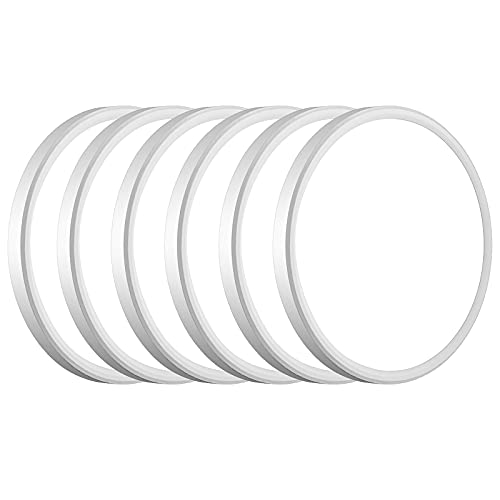
Six discs arriving in one carton reshapes what you can budget. Each 12-inch unit holds 104 SMD 2835 chips throwing 3,200 lumens off 28 watts, roughly a 90 percent haircut against the old 280 W five-bulb dome you’re probably removing. The 0.87-inch profile clears low joists and popcorn textures. The base mates with most junction boxes I’ve encountered in older tract homes. The 5000 K beam runs flicker-free with no IR or UV bleed. I’d deploy these in a rental turnover, a workshop, or a two-car garage where you want the light bright, boring, and behind you.
Pros
- 3,200 lm at 28 W keeps energy use low across a whole house.
- 0.87-inch thickness clears popcorn ceilings and low joists.
- Flicker-free driver reads comfortable under a phone camera.
Cons
- Only 5000 K; no warm option for living rooms.
- Standard on/off switch only, no dimming or smart control.
Leotop 36W Flush Mount (2-pack)
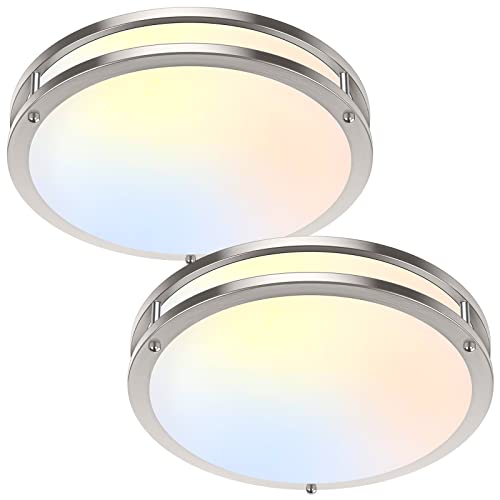
Choose this duo when the room begs for a dimmer. The 13-inch disc shoves 3,600 lumens off 36 watts. A small selector on the underside locks in one of five color presets from 2700 K to 6500 K before you snap the cover on. Wire it to a compatible LED dimmer (sold separately) and you get 5 to 100 percent range for evening tv or morning coffee. The brushed-nickel ring and milky PVC diffuser read modern without shouting for attention.
Pros
- 100 lm/W efficiency and 3,600 lm total per fixture.
- Five CCT presets, so you match the room without buying two versions.
- Dimmer-compatible from 5 to 100 percent.
Cons
- You set CCT once at install; changing it means dropping the fixture.
- Dimmer is not in the box.
URPOWER 12-inch Flush Mount (2-pack)

Cheapest ticket onto this list, honestly. Each disc burns 28 watts for 3,200 lumens, hops between 3000 K, 4500 K, and 6000 K when you tap the paddle switch twice inside two seconds, then dims from 10 to 100 percent using the same wall control without needing a separate rotary dimmer or smart hub. Warm-white mode moonlights as a soft night-light for a kid’s bedroom or an aging parent who wants to see the bathroom door at 3 a.m. Shell is fire-resistant polymer with short-circuit protection baked into the driver. Rated life is 25,000 hours. Quiet. Reliable. I installed a pair in twin bedrooms two years ago and haven’t touched them since.
Pros
- Three CCTs plus dimming controlled by the wall switch.
- 25,000-hour rated life on a low-priced 2-pack.
- Warm-white mode works as a night-light without a separate lamp.
Cons
- Fixed 12-inch size caps room coverage.
- No smart integration; Wi-Fi and Bluetooth are not on the menu.
How to Choose
- Lumens per square foot. Aim for 20 to 30 lm/ft² in living rooms and bedrooms, 40 to 70 lm/ft² in kitchens. A 200 ft² room needs roughly 4,000 to 6,000 lm split across fixtures.
- Color temperature. 2700 to 3000 K reads warm and relaxed. 3500 to 4100 K is the neutral middle. 5000 K and up feels clinical in a bedroom but sharpens task areas. Tunable CCT models save you a return trip.
- Ceiling depth and mount type. Flush mounts drop under 1 inch and hide old junction boxes. Canless downlights need only 2 inches above the drywall but require a hole saw. Measure before you shop, not after.
- Dimming and switch compatibility. LED dimming needs a rated dimmer. Confirm TRIAC, 0-10 V, or PWM matches the fixture. If you’re not rewiring, pick a fixture that dims from the existing switch or accept a single brightness.
- CRI and flicker. Look for CRI above 80, and 90 if you’re painting or cooking under the light. Read reviews for flicker complaints or check a driver spec of over 3 kHz PWM. External standards on LED efficacy come from the DOE ENERGY STAR luminaire criteria.
For related upgrades on the same ceiling, I’ve reviewed outdoor flame-effect bulbs for entry lights and picked apart low-voltage landscape transformers for the yard lights they feed.
Frequently Asked Questions
How many lumens do I need for a 12×12 room?
A 144 ft² living room needs about 2,900 to 4,300 lumens total at 20 to 30 lm/ft². One 3,200 lm flush mount covers it comfortably. Kitchens the same size want 5,700 to 10,000 lumens, usually split across four to six recessed cans.
Can I replace a hardwired incandescent fixture with a flush-mount LED?
Yes. If the ceiling box is a standard octagon or square box with a ground, and the fixture is under 5 pounds, it drops in. Kill the breaker, swap black-to-black, white-to-white, ground-to-ground, then screw the mounting plate on. I’ve done it in about 15 minutes per fixture.
Which color temperature is best for a bedroom?
Between 2700 K and 3000 K. That range reads warm, keeps melatonin production intact at night, and flatters skin tones. Skip 5000 K in bedrooms unless you’re a shift worker running a daylight sim.
Are canless downlights safe under insulation?
Only if the fixture’s junction box is IC-rated. The Amico pick above carries that rating. Non-IC fixtures need a 3-inch clearance from insulation, which defeats the point of a wafer light.
What does CRI actually change?
CRI (Color Rendering Index) rates how accurately a light source shows colors compared to sunlight. At CRI 80, reds look muted. At CRI 90 or higher, food, paint, and skin all read the way you expect. For most rooms 80+ is fine; for kitchens and bathrooms go 90+.
Do LED ceiling lights need a special dimmer?
Yes, if you want smooth dimming. Standard incandescent TRIAC dimmers often flicker or buzz on LEDs. Buy an LED-rated dimmer or a 0-10 V unit that matches the fixture spec. Check the FTC guidance on energy claims if you’re comparing wattage-equivalent labels on the box.
Related Reading
Bottom Line
If you’re upgrading one ceiling, the SunRider 12-inch Flush Mount gives you the most usable light for the least ceiling depth, and it costs less than a fast-food lunch per year to run. If you’re wiring a whole kitchen or basement, jump to the Amico canless 12-pack for room-scale coverage and CCT flexibility on every can.
Affiliate disclosure: As an Amazon Associate we earn from qualifying purchases at no extra cost to you. Prices and availability are accurate at the time of publication.