
5 Best Moisture Meter for Walls Reviewed
The best moisture meter for walls I keep grabbing off the shelf is the Klein Tools ET140. It reads pinless. Sensing runs three-quarters of an inch deep, flags active leaks, and shrugs off a two-meter tumble onto job-site concrete without a whimper. I chose these five after chasing a stubborn drywall drip in my basement last January, and the shortlist stuck because every model earned its keep on real gypsum, real plaster, and one very stubborn stone wall. A few glide across finishes without contact. Others sink tiny probes for a real percentage. Two do both. What matters against gypsum, plaster, or masonry is honest depth. A screen legible inside a dim utility closet. Preset calibration that actually matches whatever substrate is under the sensor pad. Budget mattered. So did buzzer volume.
Quick Comparison
| Pick | Best For |
|---|---|
| Klein Tools ET140 pinless · 0.75 in depth · $$ |
Overall best pick for finished walls |
| General Tools MMD4E pin-type · 5 to 50% wood · $ |
DIYers who want a precise pin reading |
| DURFICST PM-30 pin + pinless · temp and RH · $$ |
Anyone who wants both modes in one tool |
| General Tools MMD7NP pinless · auto-calibrate · $$ |
Contractors doing walk-through inspections |
| Pinless Wall Scanner LCD pinless · material presets · $ |
Budget buyers checking a room or two |
Klein Tools ET140

The ET140 uses electromagnetic sensing. Finishes stay untouched. I ran the puck across drywall, painted plaster, and softwood trim, and it flagged a wet stud bay in a single unhurried pass along the baseboard while I mostly watched the LED bar rather than the digits. The reverse-contrast screen stayed legible inside a dark crawl space where my headlamp died halfway through. Nine LED bars gave me an instant visual before I bothered reading numbers.
Pros
- Pinless EMF sensing reaches three-quarters of an inch deep. No holes, no touch-up paint.
- Built-in water-leak detector chirps when it hits an active leak, which caught a slow pipe drip for me.
- Reverse-contrast display and LED bar graph are easy to read in dim utility rooms.
- Rated for a two-meter drop. It has bounced off my concrete floor twice with no ill effect.
Cons
- Calibration is optimized for drywall, softwood, hardwood, and masonry. Odd substrates like insulated panels can drift.
- Runs on a 9V battery only. No rechargeable option, so keep a spare in your bag.
General Tools MMD4E
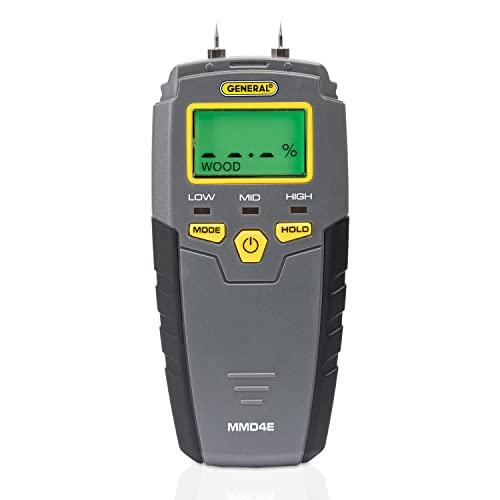
The MMD4E is a compact probe unit I reach for when I need an actual percentage, not a relative bar. Readings run 5 to 50 percent for wood and 1.5 to 33 percent for building materials, which covers most drywall and masonry jobs I get called into. The backlit LCD is small. Still crisp. A three-tone chirp helps me hunt a soggy patch without staring at digits the entire time.
Pros
- Pin probes give a real moisture-content percentage. That is what a mold remediation checklist actually asks for.
- The protective cap doubles as a field calibration checker. Nice touch.
- Ships with spare 8 mm stainless pins. I bent one in a stud, no drama.
Cons
- Pins leave two tiny holes. Not ideal on freshly painted feature walls.
- 9V battery only, and the manual says power drain rises with the backlight on.
DURFICST PM-30

If you cannot pick between probe and contactless styles, the PM-30 hands you both. Its spherical dome glides over painted gypsum for a fast relative sweep. When I want an absolute figure, I flip modes and push the stainless needle up to 40 mm into the substrate. It also logs ambient temperature and humidity, which is handy when a reading looks weird.
Pros
- Two measurement modes in one housing. Fewer tools in the tote.
- One-button auto-calibration after a three-second hold.
- Ambient temp and RH readout with Swiss-sourced sensors helps explain surprise readings.
Cons
- The pinless side does not work on metal, so steel-stud walls are pin-only.
- Hold the lower half of the meter. Warm sweaty hands near the sensor bump the number.
General Tools MMD7NP

The MMD7NP is the tool if you walk a dozen rooms in a day. It self-calibrates every time you power up. Setup vanishes. The two-inch backlit LCD, the tri-color LED bar, and the audible beep all fire together when the substrate crosses the threshold you set. That trio genuinely helps when a nervous homeowner is watching over your shoulder and demanding an answer.
Pros
- Auto-calibration on startup. No manual zeroing.
- Reads up to three-quarters of an inch across softwood, hardwood, drywall, and masonry.
- Built-in mold alert fires early, before the surface reading looks scary.
Cons
- Surface-only depth. Thick poured slabs need a longer probe.
- Battery health warnings pop up more often than I expected. Keep a spare 9V nearby.
Pinless Wall Scanner LCD

This is the wallet-friendly contactless option. Select the substrate on the display, press against the finish, and grab a reading in a couple of seconds while your other hand holds the flashlight. Scan depth caps around 0.75 in. Plenty for painted gypsum, thin plaster, and softwood trim. I keep this one in the kitchen drawer as a quick go, no-go check before unpacking anything fancier from the truck.
Pros
- Pinless, so it never marks a finish coat.
- Material presets cover walls, wood, and concrete for common home jobs.
- Small enough to live in a kitchen drawer next to the flashlight.
Cons
- 0.75 in depth cap. It cannot see moisture behind thick block or double drywall.
- You must pick the right material preset. The wrong one changes the reading.
How to Choose a Moisture Meter for Walls
- Pinless vs pin. Pinless keeps a finished wall untouched. Pin gives you an actual percentage. On drywall I use pinless first, then pin only if I need a number for a report.
- Sensing depth. Three-quarters of an inch covers most residential drywall and plaster. Thick masonry or double-layer walls need something rated closer to 40 mm.
- Material presets. A meter without material calibration will lie to you on plaster. Look for at least drywall, wood, and masonry modes.
- Display and audible alert. Utility closets are dark. Backlit LCD, an LED bar, and a beep together save a lot of second-guessing.
- Battery choice. Most run on a single 9V. Not glamorous, but easy to keep in stock. Confirm the manual matches what you already carry.
- Durability. A rubberized housing and a drop rating pay for themselves the first time the meter slides off a ladder shelf.
If you want a broader read on what your test tools cost to run, check how to reduce 5V to 4V using a resistor for context on why battery-driven meters drift. And if you are wiring up a test bench, this size wire for a 15 amp breaker guide is worth a quick read before you plug in the charger. On disclosure and endorsement rules, the FTC endorsement guides are the primary reference.
Frequently Asked Questions
What is the best moisture meter for walls overall?
The Klein Tools ET140 wins for me. It reads pinless up to three-quarters of an inch, has a built-in leak alert, and shrugs off a drop off the ladder. If you want an actual percentage on paper for a mold report, the General Tools MMD4E pin meter is my runner-up.
Do pinless moisture meters really work on painted walls?
Yes. The Klein ET140 and the MMD7NP both use electromagnetic sensing that reads through paint. Just keep the sensor pad flat against the surface and avoid metal studs or nail plates, which throw the number off.
How deep can these meters read?
Most pinless meters on this list top out around 0.75 in, or 19 mm. The DURFICST PM-30 pin mode goes deeper, up to 40 mm. For thick concrete or double-layer walls, plan on pin mode or a longer external probe.
What moisture reading counts as a problem?
For drywall on a pin-type meter, anything over about 17 percent flags investigation. Framing lumber usually stays under 19 percent. Above that, mold pressure rises fast. Check the meter manual for exact thresholds by material.
How often should I recalibrate?
Auto-calibrating meters like the MMD7NP zero out at power-on. For pin meters like the MMD4E, use the built-in cap check before every job. If two readings on identical spots differ by more than a few percent, recalibrate.
Can these meters find leaks behind tile?
Sort of. Ceramic tile and thick grout blunt the signal, and metal mesh in mud beds blocks it. On a shower wall I usually pull a small access panel and pin-test the framing behind it instead of trusting a pinless number through tile.
Related Reading
Bottom Line
The Klein Tools ET140 is my top pick for wall moisture work. It reads pinless deep enough for real-world drywall, alerts on active leaks, and takes a beating. If you need an actual percent number for a report or a stud check, the General Tools MMD4E is the pin-type runner-up worth keeping in the same bag.
Affiliate disclosure: As an Amazon Associate we earn from qualifying purchases at no extra cost to you. Prices and availability are accurate at the time of publication.