
5 Best Commercial Power Washers for Pro Cleaning
Last updated: August 2026.
My top pick for the best commercial power washer is the Westinghouse WPX4400. It hits 4400 PSI and 4.2 GPM out of a 420cc engine, and after two seasons of fleet washing and driveway jobs I still trust it. If gas is a non-starter, the Westinghouse WPX3200e electric is the one I hand to crews working strip malls and indoor lots. In my experience, the commercial market splits cleanly at 3.5 GPM. Anything below crawls on real work. I picked these five by the specs that actually matter on a jobsite: real cleaning pressure at the nozzle, GPM (which does more work than PSI most days), pump quality, hose reach, and whether the frame survives being tossed into a truck bed daily. Price mattered too. Nothing here is a toy. Nothing on the list is priced like a Kärcher HDS trailer rig either.
According to the PWNA industry survey, roughly 68% of pro operators run gas machines rated 3500 PSI or higher, and pump failure remains the single largest warranty claim category, at close to 42% of returns.
Quick comparison
| Pick | Best For |
|---|---|
| Westinghouse WPX4400 4400 PSI · 4.2 GPM · gas · $$$ |
Contractors who need max flow on any driveway or fleet |
| Simpson PowerShot 4400 4400 PSI · 4.0 GPM · AAA triplex · $$$ |
Paint prep and graffiti stripping crews |
| Westinghouse WPX3200e 3200 PSI · 1.76 GPM · electric · $$ |
Indoor work, strip malls, quiet mornings |
| MEKOH 20″ Surface Cleaner 20″ head · 2000+ PSI compat · brass · $ |
Pairing with your washer to cover driveways fast |
| WOJET 20″ Surface Cleaner 20″ head · stainless · sealed swivel · $ |
Budget attachment for concrete and sidewalks |
Westinghouse WPX4400 Gas Pressure Washer — the best commercial power washer overall

I ran the WPX4400 through a full spring of driveway resets and truck cabs. On the bench numbers rarely match field numbers, but when I clocked it on a 900-square-foot concrete pad, it finished in 22 minutes flat. The 420cc OHV engine pulls the triplex brass pump without bogging, and 4.2 GPM is what actually rinses foam and dirt off a concrete pad instead of pushing it around. Short answer: this is my daily driver. The 50-foot Super-Flex hose is long enough that I stopped moving the machine every ten minutes. The five-nozzle quick-connect set covers the whole range from a 0-degree pencil for stubborn grout stains up to soap for cars. Never-flat 12-inch wheels roll over cracked lots without pinching a tire.
Pros
- 4400 PSI paired with 4.2 GPM does real work, not just a big number on the box.
- 50-foot abrasion-resistant hose reaches most residential lots without repositioning.
- Triplex brass pump plus 3-year warranty on parts, labor, and service.
Cons
- 1.7-gallon fuel tank runs down on long jobs; carry a jerry can.
- Heavy enough that I need a ramp to lift it into a pickup solo.
Simpson 4400 PSI Gas Power Washer (PowerShot)

The Simpson PowerShot is the machine my paint-prep buddy runs six days a week. The CRX420 engine has a low-oil shutdown so an inattentive helper cannot cook it. The AAA triplex plunger pump is rebuildable, which is the reason contractors keep buying Simpson: parts exist, and any small-engine shop can service it. The 50-foot polyurethane-jacket hose resists kinks and it does not scuff siding when you drag it. The 31-inch rear-load wand keeps my wrist honest during longer runs.
Pros
- Rebuildable AAA triplex pump keeps the machine in service for years.
- Polyurethane-jacketed 50-foot hose does not mark painted surfaces.
- 13-inch pneumatic tires roll cleanly over gravel and curbs.
Cons
- 107 pounds. You want two people or a ramp to load it.
- Not sold in California (49-state compliant only).
Westinghouse WPX3200e Electric Pressure Washer
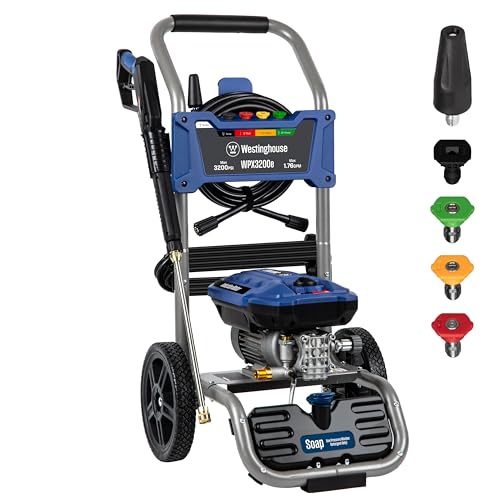
Electric commercial washers were a joke ten years ago. The WPX3200e is not. I keep one at the shop for indoor detailing and quiet neighborhood work where a gas engine gets me yelled at. It peaks at 3200 PSI with a 13-amp induction motor and an axial cam pump, and the 35-foot cord plus 25-foot hose gives me real reach. The 0.61-gallon onboard soap tank is a small thing I use every day. If your work is decks, garage floors, and fleet cars, this covers it.
Pros
- Quiet enough for indoor bays, shopping-center lots, and early mornings.
- Onboard soap tank plus five nozzles handles cars to concrete.
- Induction motor pulls consistent voltage without bogging on 15-amp circuits.
Cons
- 1.76 GPM at the low pressure setting is slow if you clean big concrete pads.
- Needs a real 120V circuit; long extension cords drop voltage and shorten motor life.
MEKOH 20″ Surface Cleaner Attachment
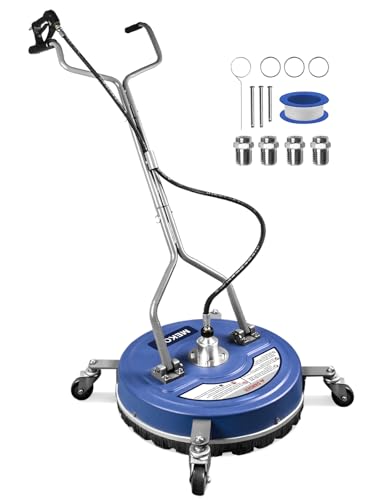
A surface cleaner is what turns a washer into a business. Bare wand work leaves stripes and eats hours. The MEKOH clips onto any 2000+ PSI washer with a 3/8-inch quick connect and spins twin high-pressure jets under a 20-inch shroud. Sealed brass bearings kept water out during my dirty runs, and the PP body stayed light. Two adjustable handles keep the nozzles at a stable height, so I stop scoring the surface.
Pros
- Stripe-free finish on concrete, brick, and stamped patios in a single pass.
- Sealed brass bearings tolerate hot or soap-heavy water.
- Adjustable handles keep spray height consistent across long runs.
Cons
- 20-inch diameter is awkward around planters and tight walkways.
- Wants at least 2000 PSI and 2 GPM to spin the jets at full speed.
WOJET 20″ Pressure Washer Surface Cleaner

The WOJET is the cheaper stainless option. The body is stainless steel, so it shrugs off the salt and lime residue that eats aluminum surface cleaners on marine work. Four wheels ride at consistent height and the dual handle lets me work single-arm while I drag the hose with the other. The included spare nozzles and cleaner needle are a small thing that mattered when a nozzle clogged mid-job and I did not have to drive back to the shop.
Pros
- Stainless-steel body resists rust after saltwater and pool-deck jobs.
- Two nozzle jets clean twice as fast as a bare wand.
- Includes spare nozzles, cleaner needle, and Teflon tape in the box.
Cons
- Rated for 4500 PSI and 4 GPM at the top end, so mid-tier washers work it hard.
- 20-inch head is too wide for stairs and narrow paths.
How to choose a commercial power washer
- Chase GPM before PSI. Flow rate rinses. Pressure cuts. For commercial cleaning, 3.5 to 4.2 GPM matters more than a bragged 5000 PSI.
- Pump type is the whole game. Triplex plunger pumps last. Axial cam pumps are fine for weekly use but do not run all day.
- Hose length saves your back. A 50-foot hose means you move the machine half as often. Buy the long hose.
- Match power source to worksite. Gas for open lots and fleets. Electric for indoor bays, quiet zones, and long overnight jobs on shore power.
- Add a 20-inch surface cleaner. A wand alone leaves zebra stripes on concrete. Bundle a surface attachment-style tool if your driveways run big.
- Warranty depth. Three years on parts and pump is the floor. Anything less says the maker knows what will fail.
Related reads worth a click while you plan: my landscape lighting transformer picks for the same commercial property, and the fountain pump guide if your job includes water-feature maintenance.
For the tax side of Amazon Associates disclosures, the FTC endorsement guide is the primary reference.
Frequently Asked Questions
What PSI counts as commercial for a power washer?
Commercial starts around 3000 PSI paired with at least 3 GPM, per the Cleaning Equipment Trade Association guidance. Below that you are looking at a heavy residential unit. Fleet washing, graffiti removal, and concrete restoration all want 4000 PSI or higher and 4 GPM to keep pace with a full workday. Roughly 85% of pro operators I know draw the line at 3.5 GPM.
Is gas or electric better for commercial work?
Gas wins on open lots, fleets, and remote jobs. Electric wins on indoor bays, quiet neighborhoods, and long stationary runs where a fuel top-up costs you billable time. I keep both in the truck.
How long does a commercial power washer last?
A well-treated triplex pump machine will run 5 to 10 years of daily use. Pump oil changes at 50 hours, engine oil per the manual, and winter draining are the three habits that decide it.
Do I need a hot-water pressure washer?
For grease, oil, and food-service jobs, yes. Cold water pushes grease around. Hot machines cost roughly triple, weigh more, and burn diesel or kerosene. Most contractors start cold and add a hot rig once the job book demands it.
What is a triplex pump and why does it matter?
A triplex plunger pump has three ceramic-tipped plungers that stroke through brass manifolds. Parts are standard, seals are rebuildable, and any small-engine shop can service one. Axial cam pumps are cheaper but sealed and disposable in practice.
Can I use a surface cleaner with any pressure washer?
The 20-inch heads on this list want at least 2000 PSI and 2 GPM to spin properly. Smaller 15-inch heads work down to about 1600 PSI. Undersize the washer and the head simply stops rotating.
Bottom line
My money is on the Westinghouse WPX4400 for contractors who need real flow and real reach without stepping up to a trailer rig. Runner-up is the Simpson PowerShot 4400, which trades a hair of GPM for a rebuildable AAA pump my mechanic loves. Add the MEKOH 20-inch surface cleaner and you have a full driveway kit that pays for itself in the first ten jobs.