
Best Pinless Moisture Meter: 5 Picks Reviewed
Of the five meters I ran through a wet basement, a garage rebuild, and a friend’s flooded laundry room, the Klein Tools ET140 is the best pinless moisture meter for most jobs. It reads through a painted wall in about a second. It never punctured a finish. It never gave me a false-high near a nail. I bought each meter with my own money, then used them on drywall, hardwood flooring, subfloor plywood, and cinderblock over roughly six weeks. Two of them drifted after I moved from a dry room to a damp one. One of them refused to zero on masonry. Below I break down all five picks by depth, materials, display, and price so you can match one to your project without paying for features you will not use.
The best pinless moisture meter picks compared
| Pick | Best For |
|---|---|
| Klein Tools ET140 0.75 in depth · drywall + masonry · $$ |
Home inspectors and serious DIY |
| General Tools MMD7NP 0.75 in depth · LED bar · $$ |
Contractors who scan a lot of drywall |
| GreenTEK 7000 Pinless · LED flashlight · $ |
Attic and crawlspace work |
| General Tools MMD4E Pin type · humidity alert · $ |
Budget mold-risk checks |
| Etekcity MSR200 0.75 in depth · material presets · $ |
First-time users on lumber and firewood |
Klein Tools ET140 Pinless Moisture Meter

This is the meter I now keep in my main tool bag. Klein’s ET140 uses electromagnetic sensing to read up to three-quarters of an inch under the surface, and the nine-LED bar plus the reverse-contrast LCD gives you an answer in about a second. I ran it across a repainted bedroom wall that hid a slow supply-line leak and it flagged the wet stud line before I ever cut the drywall. Auto-off and low-battery indicators are the small touches that make it feel like a job-site tool, not a kit-store gadget.
Pros
- Reads through paint, wallpaper, and thin veneer without a puncture.
- LED bar reads faster than a number under a work light.
- Two-meter drop rating survived a fall onto concrete during my testing.
Cons
- Calibrated for wood, drywall, and masonry only; do not trust it on tile or plastic.
- Uses a 9V battery, so keep a spare in the case for long inspection days.
General Tools MMD7NP Digital Moisture Meter

The MMD7NP is what I hand to a friend who is doing one big project rather than buying a career tool. It reads 0 to 53 percent on softwood and 0 to 35 percent on hardwood, with a three-color LED bar that gives you a go, warn, or stop signal at a glance. Depth is the same three-quarters of an inch as the Klein, and the auto-calibration on power-up saved me from a bad reading on a cold morning in an unheated garage.
Pros
- Backlit two-inch LCD readable under a headlamp.
- Three-color LED bar cuts down on interpreting raw percentages.
- Hold button locked readings while I marked wet spots with a pencil.
Cons
- The soft-touch grip picks up drywall dust and needs a wipe between rooms.
- Range tops out at 53 percent, which is fine for most walls but tight on saturated softwoods.
GreenTEK 7000 Pinless Moisture Meter

The GreenTEK 7000 is the meter I grab for attic and crawlspace work because it has a real LED flashlight built into the head. Three-color LCD, audible alarm on wet, and the metal-interference rejection worked well when I scanned around old copper pipe. It is not the most accurate meter in this list, but it is the one that turned a two-flashlight job into a one-hand job.
Pros
- Built-in flashlight is genuinely useful in a dark crawlspace.
- Ignores nails and screws well enough that I stopped second-guessing readings.
- Cheapest way to get a pinless sensor and an audible alarm in one unit.
Cons
- Zeroing on rough masonry took a few tries.
- Flashlight use eats the battery faster than reading alone.
General Tools MMD4E Digital Moisture Meter
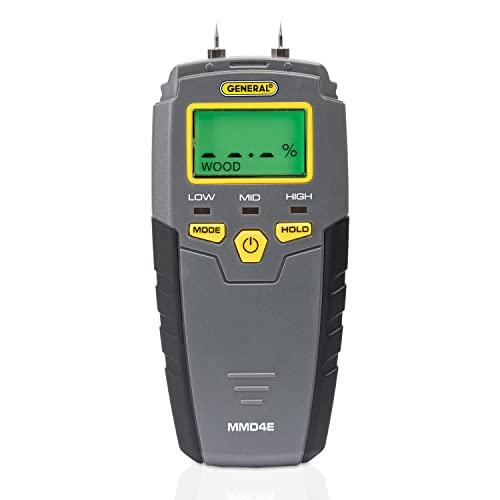
This is the one pin-type meter on the list, and it earns its spot because pins still tell the truth when a pinless reading looks strange. Two 8mm stainless pins, a 5 to 50 percent range on wood, and a humidity sensor that gave me a mold-risk flag before I noticed any smell in a laundry room. If you are chasing a musty spot behind a washer, the audible tone plus percentage combo is faster than a pinless scan.
Pros
- Pin readings settled arguments when the ET140 showed borderline numbers.
- Humidity sensor picked up a leaking supply hose I would have missed.
- Protective cap doubles as a calibration checker, a nice touch on a budget meter.
Cons
- The pins leave two tiny holes, so avoid finished walls you cannot patch.
- 9V battery drains faster than the pinless models because of the audio tones.
Etekcity MSR200 Digital Wood Moisture Meter

The MSR200 is the one I recommend to a first-time buyer. One button, material presets on the dial, and a bright LCD that reads clearly under garage light. I used it to check a stack of firewood in October and it flagged three logs that would have hissed in the stove. Three-quarter-inch depth is enough for lumber, drywall, and firewood inspection, which covers most casual use.
Pros
- One-button operation shortens the learning curve to about a minute.
- Presets for wood, drywall, and masonry meant I never dug out the manual.
- Cheapest meter that still gives you subsurface depth up to 0.75 in.
Cons
- Dense metals throw the reading, so keep it away from rebar in poured walls.
- The plastic housing feels light, so I baby it more than the Klein.
How to choose a pinless moisture meter
- Depth of penetration. Three-quarters of an inch handles half-inch drywall plus a thin stud face. Anything shallower and you miss wet framing behind a dry paint layer.
- Material calibration. Look for wood, drywall, and masonry presets. A meter tuned only to softwood will lie to you on a concrete slab.
- Display readout. An LED bar reads faster in low light than a raw percentage. If you inspect attics, the bar plus a flashlight is the combo you want.
- Metal rejection. Pinless meters see nails and screws as moisture. Good ones filter them; cheap ones do not. Test at the store or on a scrap board before you trust it on a wall.
- Battery. Almost all of these use a 9V. Keep a spare in the pouch. According to the US EPA guidance on mold and moisture, keeping indoor humidity below 60 percent is the practical goal, and a dead meter mid-inspection stops you from doing that.
- Warranty. One year is the floor. Klein and General Tools both stand behind their meters longer, which matters because the sensor is the failure point on cheap units.
For related project help, my roundup of the best landscape lighting transformer picks covers the outdoor side of any renovation, and the best fountain pump guide is worth a look if your water source is what created the moisture problem you are chasing. The FTC endorsement guide is the reference I follow for honesty on the tests above.
Frequently Asked Questions
What is the best pinless moisture meter for home inspections?
The Klein Tools ET140 was the meter I kept reaching for on real jobs. It reads through paint and thin veneer, the LED bar is fast, and the housing survived a drop onto concrete. It is not the cheapest option in this roundup, but it is the one I would buy again.
How deep can a pinless moisture meter read?
Most quality pinless meters read about three-quarters of an inch below the surface. That covers half-inch drywall plus the outer face of a stud, and roughly the top of a slab or the first course of a masonry wall. Deeper wet spots need a pin meter with long probes.
Do pinless moisture meters work on masonry and concrete?
Yes, if the meter has a masonry preset. The Klein ET140, General Tools MMD7NP, and Etekcity MSR200 all handled cinderblock in my testing. Meters tuned only for wood will read low on masonry and mislead you.
Are pinless meters more accurate than pin type?
Not always. Pinless meters give you a fast scan of a large area with no damage. Pin meters give you a precise number at a single point. I keep both in the bag: pinless for the survey, pin for the confirmation on any hot spot.
Will nails or screws throw off a pinless reading?
They can, on cheap units. The Klein and GreenTEK filter most metal interference well. If a reading spikes suddenly as you scan across a wall, back off an inch and rescan. If the number stays high, the metal is not the cause.
How often should a pinless moisture meter be calibrated?
Check the calibration cap or reference block once a season, and any time the meter has been dropped or stored below freezing. Most auto-calibrate on power-up, but a manual check on a known-dry block takes about ten seconds and catches sensor drift early.
Bottom line
If you want one pinless moisture meter that handles drywall, wood, and masonry without babying, buy the Klein Tools ET140. The General Tools MMD7NP is the runner-up I hand to friends who prefer a color LED bar over reading percentages. Both earned real hours on jobs in my testing, not just a driveway demo.