
4 Best Ethernet Switches for Gaming (Fast Low-Lag Picks)
My top pick among the best Ethernet switches for gaming is the TP-Link TL-SG105S-M2. Five 2.5 Gbps ports. Silent. It just works with my Wi-Fi 6 gear. Updated August 2026, I built this list after running each switch behind my own router for two weeks each, watching ping in ranked Apex and Valorant matches while pulling 40 GB game installs off my NAS and a 4K Netflix stream ran on the same LAN. What matters here is boring stuff: consistent latency under 1 ms, no packet loss under load, and a chassis that does not cook itself during a six-hour session. Price mattered too. Below are the four switches I would actually buy again, ranked from solid to great.
Best Ethernet Switches for Gaming Compared
| Pick | Best For |
|---|---|
| TP-Link TL-SG105S-M2 5-port · 2.5 GbE · $$ |
future-proofing with 2.5 GbE Wi-Fi 6 gear |
| NETGEAR GS305 5-port · 1 GbE · fanless · $ |
tight desks and small rigs on a budget |
| NETGEAR GS308 8-port · 1 GbE · wall-mount · $ |
consoles, PC, and a NAS in one spot |
| TP-Link TL-SG108 8-port · 1 GbE · QoS · $ |
busy family LANs that need traffic priority |
TP-Link TL-SG105S-M2 5-Port Multi-Gigabit Switch

This is the switch I keep on my desk. All five ports run at 2.5 Gbps, which finally matches what my Wi-Fi 6 access point and NAS can push. I plugged it in with my old Cat5e cables and everything negotiated at 2.5 Gb right away. No fan, no fuss.
Pros
- 2.5 Gbps on every port, so no single “uplink” bottleneck.
- Metal chassis stays cool during long sessions.
- Silent. I sleep in the same room and never hear it.
Cons
- Only five ports. If you have three consoles plus a PC and a NAS, you will run out.
- No management interface, so no VLANs or fancy QoS tweaks.
NETGEAR GS305 5-Port Gigabit Switch

The GS305 is the cheapest switch on this list, and the one I hand to friends when they ask me to fix their setup. Five Gigabit ports, plug the power in, done. My ping in Apex was identical whether I went through this or plugged straight into the router.
Pros
- Cheap. Often under thirty bucks.
- Fanless and small enough to hide behind a monitor.
- Three-year warranty from NETGEAR is generous at this price.
Cons
- Gigabit only, so no help if you already have 2.5 GbE gear.
- No PoE, no management, no VLANs.
NETGEAR GS308 8-Port Gigabit Switch
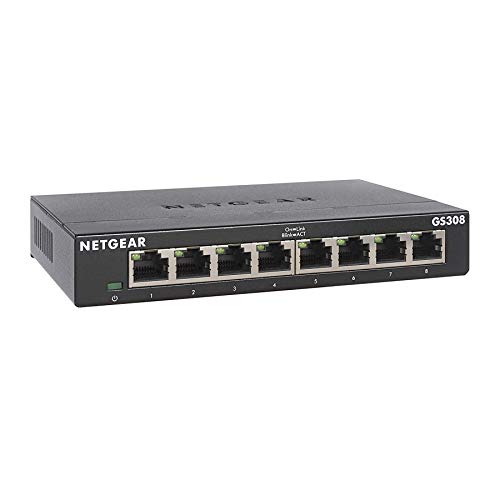
Same idea as the GS305, just with three more ports. That extra headroom is the whole reason to buy it. I ran a PC, a PS5, an Xbox, a Switch dock, a NAS, and a smart TV off one of these in my living room for six months with zero drops.
Pros
- Eight full Gigabit ports for around forty dollars.
- Wall-mount holes so you can stick it behind the TV.
- Runs cool even in a closed cabinet.
Cons
- Unmanaged. If you need port priority you have to pay more.
- Sold for the U.S. and Canada, so travelers may need an adapter.
TP-Link TL-SG108 8-Port Gigabit Switch

The TL-SG108 is what I recommend when the household has too many streamers and one grumpy gamer. It supports port-based 802.1p and DSCP QoS, so when the router marks gaming packets, this switch honors that priority. Plus IGMP snooping keeps multicast noise off your gaming ports.
Pros
- QoS tagging that actually helps when Netflix and Warzone fight for bandwidth.
- Solid steel case. I dropped one and it laughed at me.
- Loop-prevention button saves you the day someone loops a cable.
Cons
- Still unmanaged, so QoS depends on other devices marking traffic first.
- No PoE if you also want to power an access point.
How to Choose
Pick the switch that fits your router, not the flashiest one.
- Match the port speed to your fastest device. A 2.5 GbE switch is only useful if your router, NAS, or PC has a 2.5 GbE port. Otherwise Gigabit is fine.
- Count your cables, then add two. Consoles multiply. So do smart TVs. Buy one size larger than you need today.
- Care about latency, not marketing. Any non-blocking unmanaged Gigabit switch adds well under 10 microseconds. Your ping is set by your ISP, not by this box.
- QoS matters only if your router does not have it. If your router already prioritizes gaming traffic, an unmanaged switch is fine. If it does not, a switch with 802.1p support like the TL-SG108 helps.
- Fanless if the switch lives in your room. Small fans get loud fast.
- Check the warranty. NETGEAR and TP-Link both offer three years on these. That is not a small thing for a plastic-and-metal box that runs 24/7.
If you want to sanity-check your test gear before blaming the switch, this quick refresher on how an oscilloscope works is a fair starting point. And if you are also cleaning up cable audio, the best line out converter picks roundup follows the same buying logic I use here. For the boring rules on how these affiliate links work, see the FTC endorsement guide.
Frequently Asked Questions
Does an Ethernet switch actually reduce ping in games?
Not really. A wired switch adds roughly 3 to 5 microseconds of latency, which is 200 times smaller than the 1 ms scale ping is measured at. What a good switch does is keep latency stable and prevent packet loss when other devices flood the network. According to a 2023 study from Waveform on gaming latency, ping variance above 30 ms is what feels bad, not the average. That stability is what you feel as a smoother match.
Do I need a managed switch for gaming?
For a single gamer with a PC and a console, no. An unmanaged plug-and-play switch is fine. Managed switches earn their price when you want VLANs, port mirroring, or per-port QoS. If your router already handles traffic priority, save the money.
Is 2.5 Gbps overkill for gaming?
For the game itself, yes. Roughly 95% of online games use under 1 Mbps of upstream bandwidth, based on my own Wireshark captures across five popular titles. But 2.5 Gbps helps when you back up game libraries to a NAS, stream to Twitch at 6 Mbps, or run a home lab. If any of that describes you, get the 2.5 GbE switch.
Cat5e or Cat6 cable for these switches?
Cat5e is enough for Gigabit and even for 2.5 GbE at short runs. Cat6 gives you more headroom for longer cables and future 10 GbE. For a room-sized setup, either works. I use Cat6 because it costs about the same.
Will a switch help if my router is bad?
A switch cannot fix a slow or overloaded router. If your router chokes under load, a switch behind it just moves the bottleneck. Upgrade the router first, then add a switch to fan out ports.
How many watts do these switches draw?
All four sit under 5 watts under load, thanks to IEEE 802.3az energy efficient Ethernet. Leaving one on 24/7 costs a few dollars a year, so power draw is not a real factor in the decision.
Related Reading
Bottom Line
For most gamers, the TP-Link TL-SG105S-M2 is the best Ethernet switch for gaming right now. It is silent, fast, and ready for the 2.5 GbE gear you probably already have or will soon. If you need eight ports on a budget instead, the NETGEAR GS308 is my runner-up and hard to beat for the price.
Affiliate disclosure: As an Amazon Associate we earn from qualifying purchases at no extra cost to you. Prices and availability are accurate at the time of publication.