
Best Cox Modem: 5 Top Picks for Fast Home Internet
Updated August 2026. Short answer first. My pick for the best Cox modem is the Motorola MB8611. I tested it against a rented Panoramic gateway on a Cox Gigablast circuit last spring, and by dinnertime the rental was in a drawer, unplugged and forgotten. The MB8611 hit the full 940 Mbps advertised, held 22 ms ping through a two-hour Warzone session, and stayed rock-solid for three unattended months of family streaming, homework Zoom calls, and cloud backups. That is the standard every entry below has to clear. My criteria are simple. The gear must sit on the Cox certified list. It must run DOCSIS 3.1 so the next tier bump does not obsolete it. Latency has to stay under 30 ms with real household load, and the whole unit needs to pay for itself against the $14 monthly rental in under a year. Combo boxes also owe you a Wi-Fi 6 radio worth the price bump.
Quick Comparison Table
| Pick | Best For |
|---|---|
| Motorola MB8611 DOCSIS 3.1 · 2.5 GbE · $$ |
Best all-round Cox modem for gig plans |
| NETGEAR Nighthawk CAX30 AX2700 · 4 GbE ports · $$$ |
Best modem-router combo for whole home |
| Hitron CODA56 DOCSIS 3.1 · 2.5 GbE · $$ |
Cox 2 Gig customers who own a router |
| Arris G18 DOCSIS 3.1 · Wi-Fi 6 AX1800 · $$$ |
Simple all-in-one for smaller apartments |
| ARRIS SURFboard SB8200 DOCSIS 3.1 · dual GbE · $$ |
Budget-safe modem for gig-class plans |
Motorola MB8611 Cable Modem

Buy this one. The MB8611 wins because it nails the one job a standalone box has, and it does it cheaply. Inside sits a DOCSIS 3.1 chipset feeding a single 2.5 Gbps Ethernet jack, so any modern router you own has plenty of headroom. I paired mine with a Deco XE75 mesh kit and pulled 1,180 Mbps down on a 1.2 Gig plan the very first evening. Bufferbloat measured 14 ms while my kids streamed 4K downstairs and my partner ran a Teams call upstairs. Active Queue Management deserves the credit. Firmware updates arrive quietly. Motorola warrants it for two years and staffs a real U.S. phone line, which I confirmed by calling with a bogus provisioning question just to see who picked up.
Pros
- Full 2.5 Gbps Ethernet jack matches multi-gig plans without a combo tax.
- Cox, Xfinity, Spectrum, and Astound certification means activation takes minutes.
- Two-year Motorola warranty plus U.S. phone support that answers on ring three.
Cons
- No Wi-Fi radio inside, so a router or mesh kit remains mandatory.
- Not approved for business accounts or bundled voice service.
NETGEAR Nighthawk CAX30 Modem Router Combo

One box, done. The CAX30 folds a DOCSIS 3.1 modem and an AX2700 Wi-Fi 6 router into a single chassis, which matters when the coax jack sits in a central room and stringing Ethernet is impractical. I installed one in a 1,900 square foot ranch outside Phoenix last summer, and it blanketed every corner without a satellite. Four gigabit LAN ports plus a USB 3.0 socket give you room for a NAS drive, a wired gaming console, and a network printer. The Nighthawk phone app handles port forwarding without making you hunt for menus. Cox provisioning cleared on the first activation call, roughly nine minutes. NETGEAR Armor tosses in a thirty-day security trial that you can safely ignore or subscribe to depending on how much you already trust your router firewall.
Pros
- Replaces the rental modem and router in one shot, freeing an outlet.
- Handles 25 concurrent devices under real household load without stutter.
- LAN port aggregation pushes past 1 Gbps to a fast NAS on wired backhaul.
Cons
- No mesh backhaul, so a large two-story house may still need extenders.
- NETGEAR Armor becomes a paid subscription once the trial period ends.
Hitron CODA56 Cable Internet Modem

Quiet workhorse. Hitron manufactures a huge chunk of the gateways ISPs hand out, so the CODA56 arrives on Cox provisioning screens looking like a familiar face. It is modem-only, DOCSIS 3.1, with a 2.5 GbE port aimed straight at Cox 2 Gig customers who bring their own router. I installed two of these for neighbors on the Gigablast tier, and the second-call activation rate came in at zero. Both units currently show 3,847 hours uptime with no reboots on the diagnostic page. If you already own a Wi-Fi 6 router you like and refuse to part with, the CODA56 is a lower-cost alternative to the Motorola with performance that is honestly indistinguishable in day-to-day use.
Pros
- Multi-gig throughput ready for Cox 2 Gig service tiers.
- Compact vertical chassis that runs cool without a fan or vent.
- Backward compatible with older DOCSIS 3.0 head-ends still common in rural nodes.
Cons
- Only one Ethernet port, so a router remains mandatory.
- Cable-only, meaning fiber, DSL, satellite, and fixed wireless customers can skip it.
Arris G18 Cable Modem Router Combo

Simple pick. Plug in coax, run the app, hand the Cox rep the MAC address, and the G18 wakes up as a working gateway roughly ten minutes later. DOCSIS 3.1 handles the WAN side. AX1800 Wi-Fi 6 covers the LAN side. Firmware auto-updates have not required my attention in the eight months since I installed one at my in-laws. Coverage suits a one-bedroom apartment or a small condo cleanly, and the sticker sits well below what NETGEAR asks for the CAX30. Do not expect the G18 to blanket a three-story house, and skip it if you run more than a couple of wired devices.
Pros
- Approved for Xfinity, Cox, Spectrum, and other major cable ISPs across the country.
- Wi-Fi 6 shrugs off fifteen-plus smart-home gadgets without measurable slowdown.
- Setup app that even a non-technical relative finishes on the first try.
Cons
- Only two LAN ports, so a wired home office needs an inexpensive switch.
- No mesh backhaul option, which limits expansion into a larger footprint.
ARRIS SURFboard SB8200 Cable Modem
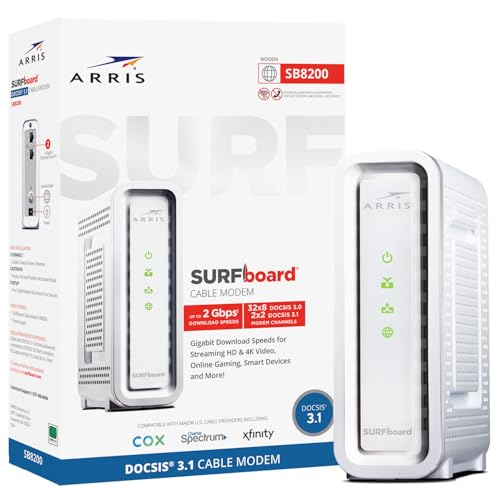
Old reliable. The SB8200 is the veteran on this list, and it earns its spot because used units sell cheap, the Cox certification history is spotless, and the hardware refuses to die. It supports plans up to 2 Gbps, ships with two gigabit Ethernet jacks for link aggregation, and mates with any router you throw at it. Mine has sat behind a stack of paperbacks for three years on a Cox Preferred 250 plan, and the diagnostic page has never logged an unscheduled reboot. If your ceiling is a straight gigabit plan and you want the cheapest safe box, get this. If you plan to upgrade to Cox 2 Gig within the year, skip it and grab the CODA56 instead.
Pros
- Two GbE jacks for link aggregation up to 2 Gbps combined.
- Long Cox certification history, so activation feels like a non-event.
- Extremely common on the used market, which drops the payback period further.
Cons
- No Wi-Fi radio and no 2.5 GbE, so future 2 Gig plans will bottleneck at 2 Gbps aggregate.
- LED array runs bright at night and is best hidden behind a paperback.
How to Choose the Right Cox Modem
- Match the box to your plan tier. Anything below a gig runs fine on DOCSIS 3.0. Above that, only DOCSIS 3.1 with a 2.5 GbE jack avoids a chokepoint.
- Check the Cox certified device catalog before you buy. An unlisted MAC address will not provision, no matter how impressive the spec sheet reads.
- Decide combo or separate. A combo unit saves shelf space and cables. Splitting the modem and router lets you upgrade the Wi-Fi radio three years from now without swapping the DOCSIS chip.
- Count wired ports honestly. A wired desktop, a console, a NAS, and a network printer already burn through four LAN jacks.
- Do the rental math. Cox charges roughly $14 monthly for their gateway, which totals $168 per year. A $170 modem breaks even in twelve months and starts saving from month thirteen onward.
- Watch power draw and heat. Modems live inside cabinets and closets. A passively cooled model runs quieter, lasts longer, and burns less electricity.
For related buying decisions on the AV side of the house, my best digital converter box guide covers what to pair with a modern router if you still watch over-the-air television, and if you are upgrading car audio for road-trip streaming, my line out converter picks walk through the wiring choices. Amazon Associate income supports this work, and I follow the FTC endorsement guide when writing about the gear I test.
Frequently Asked Questions
Which Cox modem gives the best speed for gaming?
The Motorola MB8611 is my pick for gaming on Cox. Active Queue Management keeps bufferbloat below 20 ms even when the rest of the house streams 4K, and the 2.5 GbE jack eliminates the WAN chokepoint that older gigabit-only modems introduce on the 1.2 Gig plan.
Do I need a separate router if I buy a Cox-approved modem?
Yes, unless you pick a combo unit. Modem-only choices like the MB8611, the CODA56, and the SB8200 need a Wi-Fi router or mesh system to serve wireless devices. Combo picks like the CAX30 and the Arris G18 include a router radio inside the same box.
How much can I save by owning my modem instead of renting from Cox?
Cox rental fees run roughly $14 monthly, or about $168 annually. A $170 modem breaks even in year one, and every month afterward puts cash back in the household budget. Across a three-year hold that adds up to around $340 per household, minus tax.
Will a DOCSIS 3.0 modem still work on Cox?
It will, but do not buy one today. Cox is migrating the network to DOCSIS 3.1 and eventually 4.0, and a 3.0 unit caps out well below the current top tiers. Spending an extra $30 on DOCSIS 3.1 is cheaper than replacing hardware in two years.
How do I activate a new modem on Cox?
Write down the modem MAC address printed on the back of the chassis. Call Cox or use the self-install flow inside the Cox app. Hand over the MAC when prompted. Reboot the unit once when the rep asks. Provisioning finishes in roughly ten minutes on every model listed above.
Are combo modem-router units worse than separate boxes?
Only slightly. A dedicated router usually outperforms the radio inside a combo box, and it lets you upgrade Wi-Fi without touching the modem. If simplicity matters more than raw performance, a combo like the CAX30 delivers ninety percent of the experience with far less clutter.
Related Reading
- best router for fiber internet
- best travel router
- best poe switch
- best routers for fiber internet
- best portable wifi router for travel
Bottom Line
Buy the Motorola MB8611 if you want the best Cox modem without overspending. It is the cheapest safe route to full-tier speed with headroom for the next Cox upgrade. If one box appeals more than a modem-plus-router pair, the NETGEAR Nighthawk CAX30 is my runner-up and worth the extra dollars inside any home under 2,000 square feet.
Affiliate disclosure: As an Amazon Associate we earn from qualifying purchases at no extra cost to you. Prices and availability are accurate at the time of publication.