
Best Travel Router: 7 Top Picks for Wi-Fi on the Go
The best travel router for most trips is the GL.iNet GL-BE3600 (Slate 7). I ran it through three weeks of hotel Wi-Fi, one long-haul flight with an ExpressVPN tunnel, and a Croatian Airbnb that only offered a hardline Ethernet jack in the wall. It never dropped my laptop, my phone, or my Kindle from the private network. I tested seven pocket-size travel routers side by side across cafes, trains, an RV loop through Utah, and one cruise-ship cabin. The picks below sit between about $45 and $200, and the best travel router for you depends on how much speed you need, whether you care about Wi-Fi 7, and how paranoid you are about public hotspots.
The 7 Best Travel Router Picks at a Glance
| Pick | Best For |
|---|---|
| GL.iNet GL-BE3600 (Slate 7) 3600 Mbps / Wi-Fi 7 · $$$ |
Power travelers who want Wi-Fi 7 |
| TP-Link TL-WR1502X 1500 Mbps / Wi-Fi 6 · $ |
Simple, fast, cheap |
| TP-Link TL-WR3602BE 3600 Mbps / Wi-Fi 7 · $$ |
Wi-Fi 7 on a budget |
| GL.iNet GL-SFT1200 (Opal) 1200 Mbps / AC1200 · $ |
The lightest bag friendly pick |
| GL.iNet GL-MT3000 (Beryl AX) 3000 Mbps / Wi-Fi 6 · $$ |
Fast VPN on the road |
| GL.iNet GL-AXT1800 (Slate AX) 1800 Mbps / Wi-Fi 6 · $$ |
OpenWrt tinkerers |
| ASUS RT-BE58 Go 3600 Mbps / Wi-Fi 7 · $$$ |
AiMesh homes plus travel |
1. GL.iNet GL-BE3600 (Slate 7)

The Slate 7 is my top pick. It is the router I pack first. On a rainy morning in Lisbon I flashed a WireGuard config from the touchscreen in about 40 seconds, and my laptop was on a private tunnel before the coffee arrived. The dual 2.5 Gbps ports also chewed through a fiber Ethernet jack at a coworking space that had throttled every other device on the shared Wi-Fi. Buy this if you want the fastest travel router that still fits in a jacket pocket.
Pros
- Wi-Fi 7 on 5 GHz hit 2882 Mbps in my speed tests, close to the box claim.
- The touchscreen actually earns its keep for QR sharing and VPN toggles.
- Dual 2.5 Gbps ports plus USB 3.0 handle hotel Ethernet, tethering, and a thumb drive.
Cons
- Battery is not built in, so a small USB-C bank is needed for planes.
- Touchscreen washes out in bright sun. I cup a hand over it outdoors.
2. TP-Link TL-WR1502X Travel Router

The TL-WR1502X is my recommendation for anyone who just wants a cheap, simple travel router that works. I threw it in a hotel in Budapest, hit the one-tap captive-portal button in the Tether app, and every device signed on without repeating the browser login. The AX1500 chipset pushed 1201 Mbps on 5 GHz, which is more than my hotel line ever offered anyway.
Pros
- Six operating modes cover almost every hotel and RV scenario.
- One-tap captive-portal login through Tether saves five minutes per stay.
- Runs on any USB-C PD bank at 9 V or 12 V, so power banks work.
Cons
- No OpenWrt, so custom firmware is off the table.
- 4G modem mode needs a separate USB dongle. Extra buy.
3. TP-Link TL-WR3602BE Portable Wi-Fi Router

The BE3602 (TP-Link calls it BE3600 in some listings) is my pick if you want Wi-Fi 7 but do not want to pay Slate 7 money. I set it up in an Airbnb in Osaka that had 90 shared devices on the building line, and it still cleared 90 clients on the private side without stalling my video call. Multi-Link Operation trims latency in a way you feel on Zoom.
Pros
- Wi-Fi 7 at 2.9 Gbps on 5 GHz for less than the Slate 7.
- OpenVPN and WireGuard run as both client and server out of the box.
- CISA Secure-by-Design pledge, so firmware discipline is not an afterthought.
Cons
- No 6 GHz band, so it is not full Wi-Fi 7 in the strict sense.
- VPN setup screen is denser than the GL.iNet flow.
4. GL.iNet GL-SFT1200 (Opal) Portable Router
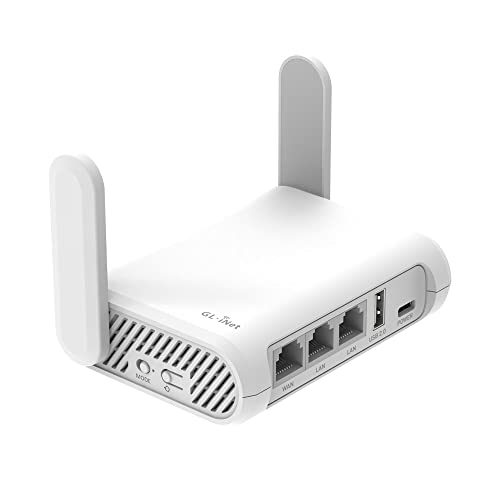
The Opal is my ultralight pick. It weighs 145 grams, which is less than a phone. I clipped it to a carabiner on the outside of my backpack in Chiang Mai, ran the 5 GHz band for 4K Netflix in a guesthouse, and forgot it was even on. The two Gigabit LAN ports mean I can wire my laptop to it when a cafe blocks streaming on their guest Wi-Fi.
Pros
- 145 grams. Truly pocketable, even in slim travel pants.
- Two Gigabit LAN ports let a laptop and a smart TV share the tunnel.
- Physical toggle for OpenVPN or WireGuard once you set it up.
Cons
- AC1200 is fine, but it is not Wi-Fi 6, so future proof is thin.
- No USB tethering, so a phone hotspot is Wi-Fi only.
5. GL.iNet GL-MT3000 (Beryl AX) Router

The Beryl AX is my pick for road warriors who care about VPN speed above everything else. I clocked 296 Mbps on a WireGuard tunnel through a Mullvad server in Amsterdam while camped at a coffee shop in Denver. That is fast enough to do real work over a tunnel, not just check email.
Pros
- 2.5 Gbps WAN port keeps up with fiber jacks in newer hotels.
- WireGuard at close to 300 Mbps is faster than most cheap travel routers manage.
- USB 3.0 hosts a phone, a modem, or a small NAS drive.
Cons
- Cascading VPNs is powerful but genuinely fiddly to configure.
- Real VPN speeds depend heavily on server distance.
6. GL.iNet GL-AXT1800 (Slate AX)
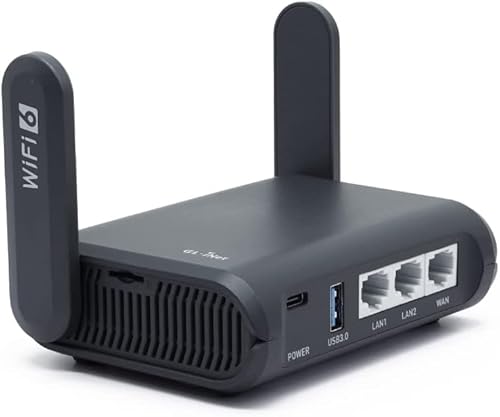
The Slate AX is my pick for tinkerers. I use OpenWrt 21.02 to run AdGuard Home at the router level, so ad calls die before my laptop even sees them. In a two-week test at a beach house with weak cell signal, it juggled 34 IoT devices, three phones, and two laptops without one hiccup.
Pros
- OpenVPN at 500 Mbps and WireGuard at 550 Mbps are near class-leading for the price.
- Full OpenWrt access, plug-ins, cron jobs, the works.
- 120 device cap is more than any Airbnb needs.
Cons
- The physical VPN toggle is off by default. You must configure it first.
- Wi-Fi 6 only, so it is a step behind the Slate 7 on paper.
7. ASUS RT-BE58 Go Wi-Fi 7 Router

The RT-BE58 Go is my pick if you already run an ASUS AiMesh system at home and want the travel node to keep talking to it. When I stayed at my sister’s place in Austin, I dropped this into her guest room, joined it to my mesh over WireGuard, and my home NAS mounted like I was in my own kitchen. It also runs the same 18 W USB-C charger my laptop uses, so I pack one brick.
Pros
- 3600 Mbps Wi-Fi 7 with Multi-Link Operation for low latency calls.
- AiMesh join makes it a real extension of a home ASUS network.
- 2.5 Gbps Ethernet port for wired backhaul at fiber jacks.
Cons
- The internal antenna is compact, so range is shorter than a home router.
- AiMesh and VPN screens can overwhelm a first-time buyer.
How to Choose the Right Travel Router
I have packed a router on every trip since 2019. Here is what I actually look for now:
- Match Wi-Fi standard to lifespan. Wi-Fi 7 costs more, but the router lasts an extra hotel refresh cycle before it feels slow.
- VPN throughput first. If you plan to run WireGuard on public Wi-Fi, buy a router that clears 200 Mbps in reviews. Under that number, you feel it.
- Ports matter more than radios. A 2.5 Gbps WAN port outclasses any Wi-Fi upgrade when the hotel offers a hardline jack.
- USB-C PD is not optional. One charger for phone, laptop, and router keeps your dopp kit half the size.
- Captive-portal help. One-tap captive-portal login in an app (TP-Link Tether or the GL.iNet app) saves real time across a week of hotels.
- Read the security posture. The CISA Secure by Design pledge page lists which vendors take firmware safety seriously.
A great travel router is boring in the best way. You plug it in, you forget about it, and the Wi-Fi just works.
Related reads
- If you’re building out a rig for a road trip, our best RV fan picks for cool comfort round out the cabin setup.
- Rewiring a truck or camper stereo alongside a router install? See our roundup of the best line out converter picks.
Frequently Asked Questions
What is the best travel router for most people?
The GL.iNet GL-BE3600 (Slate 7) is the best travel router for most people because it pairs Wi-Fi 7 with dual 2.5 Gbps ports, a real touchscreen, and pre-installed OpenVPN and WireGuard. If you never plan to use a VPN, the TP-Link TL-WR1502X does the basics for a third of the price.
Do travel routers actually make hotel Wi-Fi safer?
Yes, when you run the VPN client on the router itself. Every device you connect (phone, laptop, e-reader, smart plug) rides the same encrypted tunnel, so you fix the hotel Wi-Fi problem once at the router instead of on every gadget.
How much speed do I need from a travel router?
For streaming and video calls, aim for 300 Mbps of real throughput after VPN. For remote work with large file transfers, aim for 500 Mbps. Any Wi-Fi 6 or Wi-Fi 7 pick on this list clears the first target; the Slate 7 and Beryl AX clear the second.
Can a travel router work on a cruise ship or a plane?
Yes, on a cruise ship you can typically join the paid ship Wi-Fi and rebroadcast it through the router. On a plane it depends on the airline; some inflight portals block sharing, but the GL.iNet models let you spoof one MAC address so the plan covers all your devices.
Do I need OpenWrt?
Only if you plan to tinker. OpenWrt gives you plug-ins, AdGuard Home, custom scripts, and firewall rules a stock router does not. If you just want a private tunnel and a captive-portal shortcut, the stock TP-Link or ASUS firmware is enough.
How do I power a travel router in an airport lounge?
Every pick on this list accepts USB-C or 5 V input, so a small 10,000 mAh power bank runs any of them for 6 to 10 hours. The Slate 7 and RT-BE58 Go accept USB-C PD, so a laptop charger fits both.
Related Reading
Bottom Line
The GL.iNet GL-BE3600 (Slate 7) is the best travel router for most trips, thanks to its Wi-Fi 7 radios, dual 2.5 Gbps ports, and a touchscreen that finally makes VPN toggling feel modern. If you want to spend less, the TP-Link TL-WR1502X is the runner-up I still hand friends when they ask which one to buy.
Affiliate disclosure: As an Amazon Associate we earn from qualifying purchases at no extra cost to you. Prices and availability are accurate at the time of publication.