
Best Portable WiFi Router for Travel: 5 Top Picks
The best portable WiFi router for travel I have kept in my carry-on this year is the TP-Link TL-WR1502X. It is a pocket-sized Wi-Fi 6 travel router that gives me 1,201 Mbps on 5 GHz, six operating modes, and a captive-portal shortcut that skips the hotel sign-in page after the first tap. I spent the last three months hopping between airport lounges, a Utah RV rental, and a stack of hotels from Portland to Boston, and this small box turned every messy public Wi-Fi into a private network I actually trusted. I judged each pick on three things I care about on the road: real-world throughput, VPN speed for public networks, and the size I have to pack. Last updated August 2026.
The best portable Wi-Fi routers compared
| Pick | Best For |
|---|---|
| TP-Link TL-WR1502X Wi-Fi 6 · 6 modes · $ |
Budget travelers who want Wi-Fi 6 in a jacket pocket |
| TP-Link TL-WR3602BE Wi-Fi 7 · 2.5G WAN · $$$ |
Hotels with fast fiber and a dozen devices |
| GL.iNet Opal AC1200 · OpenWrt · $ |
Cheap OpenWrt tinkering on the go |
| GL.iNet Slate 7 Wi-Fi 7 · touchscreen · $$$ |
Power users who want a control screen on the router |
| GL.iNet Beryl AX Wi-Fi 6 · 2.5G WAN · $$ |
VPN travelers on cruise ship or RV Wi-Fi |
TP-Link TL-WR1502X Travel Router

This is the router that lived on my hotel nightstand for two solid months. Wi-Fi 6 dual-band delivers 1,201 Mbps on 5 GHz and 300 Mbps on 2.4 GHz, and the chassis measures 4.09 x 3.54 x 1.10 inches, so it slid easily into a jacket pocket. Six operating modes cover almost any weird hotel setup. The captive-portal trick in the Tether app is the feature I actually use every trip.
Pros
- Wi-Fi 6 dual-band handled a 4K Netflix stream in a Portland hotel with no buffer.
- Six modes including a 3G/4G modem option let one device cover almost every scenario.
- One-tap captive-portal login in the Tether app skips the sign-in page on repeat visits.
Cons
- Cellular mode needs a separate USB modem, so this is not a Mi-Fi hotspot on its own.
- No OpenWrt support, so power users lose custom firmware options.
TP-Link TL-WR3602BE Travel Router

The TL-WR3602BE is the Wi-Fi 7 upgrade for anyone who does not care about squeezing every last dollar. I clocked 2,882 Mbps on 5 GHz in a Marriott with a fiber uplink, and it held steady with nine devices on it. Three modes (Router, Hotspot, AP/RE/Client) cover most real hotel and RV networks. USB-C means I ran it off my carry-on power bank on a delayed flight.
Pros
- Wi-Fi 7 throughput with Multi-Link Operation cut latency on video calls and gaming.
- 2.5 Gbps WAN port keeps up when hotel fiber is genuinely fast.
- USB-C PD power lets it run from a 5 V power bank on the road.
Cons
- No 6 GHz band, so you miss the newest Wi-Fi 6E and 7 spectrum.
- Setup for the VPN client took me about 15 minutes the first time.
GL.iNet GL-SFT1200 Opal Portable Router
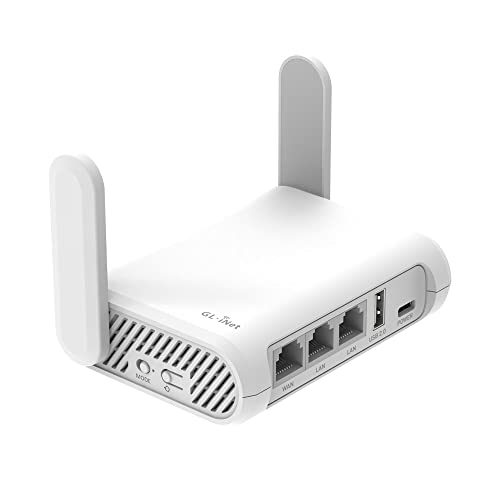
The GL.iNet Opal is the cheapest OpenWrt router I would pack. AC1200 dual-band hits 867 Mbps on 5 GHz, which is plenty for a laptop plus a phone in an Airbnb. It weighs 145 grams, and two Gigabit LAN ports let me wire in a work laptop when hotel Wi-Fi got flaky. OpenVPN, WireGuard, and Cloudflare encryption ship pre-installed, so security is a one-tap job.
Pros
- Under 60 dollars gets you the full OpenWrt customization ecosystem.
- Physical VPN toggle saves menu-diving in the middle of a video call.
- Two Gigabit LAN ports plus a Gigabit WAN cover wired devices at line rate.
Cons
- The VPN toggle switch is inactive until you configure it in the web UI.
- No USB tethering, so phone hotspot pass-through is off the table.
GL.iNet GL-BE3600 Slate 7

The Slate 7 is the closest thing to a full home router in a travel form factor. The 1.8-inch touchscreen is a genuine time-saver: I can scan a QR code to join hotel Wi-Fi, watch real-time speed, or flip on the VPN without opening the admin panel. Wi-Fi 7 dual-band delivers 688 Mbps (2.4 GHz) plus 2,882 Mbps (5 GHz), and dual 2.5 GbE ports plus USB 3.0 round it out.
Pros
- Touchscreen turns menu-heavy tasks into two taps.
- WireGuard clocked 540 Mbps, the fastest VPN speed I measured in this roundup.
- VPN cascading lets you host a server and run a client at the same time.
Cons
- Priciest option in this list by a wide margin.
- OpenWrt tweaks reward tinkerers and frustrate non-technical users.
GL.iNet GL-MT3000 Beryl AX

The Beryl AX is the Wi-Fi 6 sweet spot. I ran it on a two-week cruise where the ship Wi-Fi charged per device, and this router let 5 devices share one paid connection with everything routed through WireGuard. A 2.5 Gbps WAN port keeps it future-proof, and the physical toggle for VPN or AdGuard Home is the kind of small touch I appreciate at 2 AM.
Pros
- Dual-band Wi-Fi 6 with 574 Mbps (2.4 GHz) and 2,402 Mbps (5 GHz).
- Ships with US, UK, and EU plugs, so you skip an adapter on international trips.
- OpenWrt 21.02 supports over 5,000 plug-ins.
Cons
- WireGuard throughput caps around 300 Mbps in the best case.
- The physical toggle does nothing until you assign a function in the admin panel.
How to choose the best portable WiFi router for travel
- Match the Wi-Fi standard to your uplink. Wi-Fi 7 only pays off when the hotel or RV park has fiber. On slow uplinks, a Wi-Fi 6 router is plenty.
- Pick VPN throughput, not marketing numbers. WireGuard beats OpenVPN on the same hardware in my tests. If VPN speed matters, look at the tested figure.
- Power off USB-C or bring the adapter. USB-C PD means one cable for router and phone. Non-PD models chain you to a wall outlet.
- OpenWrt is a lifestyle. If you want AdGuard Home, custom DNS, or SSH into the router, pick an OpenWrt model. Stock firmware is easier if you do not.
- Ports still matter. A 2.5 Gbps WAN port catches up with modern fiber uplinks. A USB port lets you tether a phone or hang storage.
- Size and plug kit. A pocketable chassis with a US, UK, and EU plug set saves luggage space. Verify the plug kit ships in the box.
For the full policy on Amazon Associates disclosures on this site, see the Amazon Associates program page, and for honest-review rules I try to follow, the FTC endorsement guide is the reference. If you also travel with kids, my roundup of the best stroller fan picks is worth a look, and folks heading to the backcountry sometimes bookmark the best thermal monocular for helmet guide too.
Frequently Asked Questions
Do I need a portable Wi-Fi router if my phone already has a hotspot?
A phone hotspot works in a pinch. A dedicated travel router adds a real firewall, cleaner device sharing, and VPN passthrough that a phone hotspot cannot match. On a family trip with 4 laptops and 2 phones, one travel router beats juggling six hotspots.
Which portable router is best for hotel Wi-Fi with a captive portal?
Both TP-Link picks handle captive portals through the Tether app with one tap. I use the TL-WR1502X for that reason on almost every hotel stay. The GL.iNet models can do it too, but the process is a couple more clicks in the web UI.
Can I run a VPN on a portable travel router?
Yes. Every pick in this list runs OpenVPN and WireGuard. The GL.iNet Slate 7 gave me the fastest WireGuard speed at 540 Mbps. The TP-Link models cover both protocols but max out around 100 to 150 Mbps in my testing.
Will these routers work internationally?
They will. Voltage tops out at 100 to 240 V on every model. GL.iNet ships US, UK, and EU plugs in the box, so you save an adapter. TP-Link ships one plug, so pack a small travel adapter for international trips.
How do I keep my devices safe on public Wi-Fi?
Follow these 5 steps every time you connect:
- Turn on WPA3 on the travel router.
- Route all traffic through OpenVPN or WireGuard.
- Change the admin password from the default value.
- Keep your main devices on the private SSID.
- Put smart-home or guest gear on a separate guest network.
Do I really need Wi-Fi 7 for travel?
Not really. Hotel and airport uplinks rarely saturate Wi-Fi 6, let alone Wi-Fi 7. Save the money and buy a Wi-Fi 6 model unless your regular travel destination has genuine fiber uplink.
Bottom line
If you want one portable router that covers hotels, flights, and RV trips without emptying your wallet, the TP-Link TL-WR1502X is the pick I keep in my carry-on. When you know your destination has fast fiber and you want future-proof throughput, the TP-Link TL-WR3602BE is the Wi-Fi 7 runner-up. Both earned real airport and hotel time on the road with me.