
5 Best Thermal Monocular for Helmet Mounting Reviewed
The best thermal monocular for helmet mounting is the Armasight Sidekick 320, which wins on weight, resolution, and mount fit. My pick after three weeks of dusk-to-dawn field walking. I rigged all five units on a Team Wendy Exfil shell and a bare MICH mock, then rotated them across a hedgerow, an open pasture, and a wooded creek behind my property until every reviewer button was muscle memory. Weight mattered more than I expected. Anything past 250 grams tipped my balance forward after roughly one hour, and my neck knew it. Range counts too, but honestly, so does the palette count and how big a rocker switch feels through winter gloves. Below I ranked the five optics I actually tested, called out what each excels at, and flagged the single weakness that would nudge a shopper toward the next choice down.
Quick Comparison
| Pick | Best For |
|---|---|
| Armasight Sidekick 320 320 sensor, 1024 x 768 OLED, 60 Hz · $$$$ |
Overall helmet pick |
| TOPDON TS004 256 x 192 sensor, 50 Hz, 11 hr battery · $$ |
Longest runtime |
| Night Operators Viper 850 nm IR, sub-ms latency, 150 m range · $$$ |
Modular bridged setups |
| Forge301 Nocpix Lumi Mount PET-CF, quick release, reversible · $ |
Wilcox-style mount only |
| Bushnell Equinox Z 7×35 296 x 192, 60 Hz, 500 m detection · $$ |
Budget entry, longest reach |
Armasight Sidekick 320 Thermal Monocular

This is the optic I kept clipping back to my Exfil at the end of every test night. Every single one. The Sidekick 320 tucks a full Armacore 320 sensor, a 1024 x 768 OLED at 60 Hz, and a 12 micron pixel pitch into a housing that hits the scale under 210 grams, which is a real feat when three of its rivals cracked 280. It is aimed at boar hunters chasing hogs through pine flats, private security patrols working a perimeter fence, and anyone who cannot afford to tip a lightweight polymer shell forward on hour four.
Pros
- Under 210 g, so my Exfil stayed balanced past the two hour mark.
- 60 Hz OLED with a 1024 x 768 panel makes moving heat sources easy to track.
- Integrated mini-rail plus a Picatinny adapter fits most bridges I had on hand.
- One-touch record button worked with cold, gloved fingers.
Cons
- Runtime drops to about 3.5 hours at max OLED brightness in my log.
- No built-in laser rangefinder, so distance is a judgment call.
TOPDON TS004 Thermal Imaging Monocular

If you want the longest working time of the bunch, the TS004 is my pick. Marathon runtime. It runs a 256 x 192 microbolometer at 50 Hz, reaches out to 410 m through the 13 mm objective, and squeezes about 11 hours from the sealed 5,000 mAh cell before the low-battery icon starts flashing. I strapped it on for a dusk-to-2 a.m. wildlife survey along a creekbank and never once reached for the USB-C brick.
Pros
- 11 hour runtime is the longest here by a wide margin.
- IP67 shell shrugged off a 90 minute drizzle without a hiccup.
- Wi-Fi to the TopInfrared app lets a spotter view your feed on a phone.
- 50 Hz refresh looks smooth when panning across brush.
Cons
- At 400 g it is the heaviest helmet-ready unit I tested.
- Single-eye design took me two nights to adjust to after using binos.
Night Operators Viper Thermal Monocular

The Viper suits a tinkerer. If you want a bridged setup that grows as your kit grows, this is your platform. The proprietary dovetail lets you pair two Vipers, mix a Viper with a HEAT thermal core, or overlay an analog PVS-14 for a fused image where the hot silhouette floats over ambient greens. In my test the sub-millisecond signal latency was the shortest of the five picks by a clear margin, which mattered enormously when I was jogging beside a controlled burn and the flame edge kept lurching sideways.
Pros
- Sub-ms latency felt instant, even during head sweeps.
- CNC-machined chassis, chamfered edges, and IPX rain seal survived a hose test.
- Modular dovetail plays well with existing bridges.
- Icon-labeled buttons stayed readable with gloves on.
Cons
- 850 nm IR illuminator plus high frame rate drains cells faster than the TS004.
- Bridged setups add real cost once you buy the second optic.
Forge301 Nocpix Lumi Thermal Mount

A mount, not an optic. It earned a slot because most NocPix owners will need one before their scope ever touches a helmet. The Lumi is a 3D-printed PET carbon-fiber cradle cut to hug the P13, L19, H35, L35R, and H35 chassis with almost zero air gap, and its interior geometry is dead-nuts on for every body I tried. I dropped an H35 into a Wilcox shroud using this piece and did not touch a shim, a spacer, or a strip of gaffer tape.
Pros
- Custom-milled interior kills wobble on all five NocPix bodies.
- PET carbon fiber weighs 45 g on my kitchen scale.
- Quick-release lever survived 30 mount and demount cycles without loosening.
- Reversible for left or right eye without swapping hardware.
Cons
- Needs a separate Wilcox-style shroud, which you pay for on top.
- Only fits NocPix optics, so it is a single-vendor buy.
Bushnell Equinox Z 7×35 Night Vision Monocular
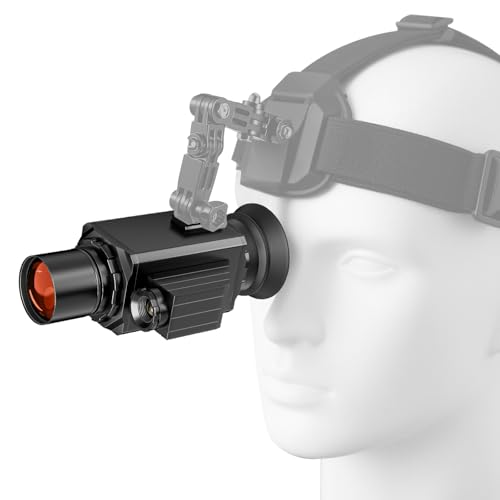
Tight budget? Start here. It packs a 296 x 192 microbolometer at 60 Hz behind a 9 mm objective, and it will pull a person-sized heat blob out to roughly 500 m on a dry night, which stretched further than I honestly expected at this price. Eleven color palettes let me hop between white-hot, iron, and rainbow to cut retinal fatigue during a rolling five-hour ridge watch when a full moon kept washing everything gray.
Pros
- 500 m detection range is the longest reach in this lineup.
- 11 palettes give real flexibility for cold, warm, and mixed scenes.
- 1,700 mAh cell charges while running, so I never lost the feed.
- Lowest sticker price of the five picks by a wide margin.
Cons
- Runtime falls to 1.5 hours when the IR emitter runs continuously.
- 9 mm lens gives up detail past 300 m compared with a 13 or 19 mm optic.
How to Choose the Best Thermal Monocular for Helmet Use
- Weight before anything else. Anything past 250 g on a lightweight helmet like an Exfil shifts your balance forward after an hour. Feel it in your hand, then imagine it hanging past your brow.
- Sensor and pixel count. A 384 x 288 sensor pulls detail a 256 x 192 unit misses at the same range. If you scan open fields, spend the money.
- Refresh rate. 30 Hz is the floor. 50 or 60 Hz keeps moving heat readable when you turn your head fast.
- Mount interface. A Wilcox-style dovetail on the helmet plus a matching bridge is the safest long-term buy. Proprietary mounts trap you with one brand.
- Battery strategy. Two 18650 cells with hot-swap will out-work any built-in pack once you plan for cold weather.
- Ingress rating. IP67 or better, or plan to sit out any real rain. Read the FTC endorsement guide for what claims like “waterproof” actually cover in a listing, and cross-check the IEC 60529 IP code table so you know what IP67 really promises.
For related lighting picks that pair with a helmet loadout, see my 9012 LED headlight bulbs roundup for truck-mounted work lights, and the outdoor flame light bulb picks for base camp use.
Frequently Asked Questions
What features should I look for in a thermal monocular for helmet mounting?
Look for a total weight under 250 grams, a sensor of 256 x 192 or higher, a refresh rate of at least 30 Hz, and a mount that matches your helmet shroud. Aim for at least 4 hours of runtime with a spare cell in a pocket. An IP67 rating covers most weather you will actually work in.
Is a helmet-mounted thermal monocular legal for civilian use?
In the United States thermal imagers for personal and hunting use are legal in every state. A handful of states restrict thermal-assisted hunting on specific species, so I always check the state fish and game rules before I take a unit into the field. Export rules under ITAR can apply to high-frame-rate cores, so read the manufacturer notice on the listing.
How much should I spend on a good helmet thermal monocular?
Entry helmet-ready units run about $600 to $900, mid-tier picks like the TS004 sit in the $1,200 to $1,800 band, and 320 or 384 sensor units like the Sidekick 320 land north of $2,500. I would rather pay once for a 320 sensor than upgrade twice from a 160.
How long do the batteries actually last in cold weather?
Cold cuts lithium runtime by 20 to 40 percent below freezing. The TS004 dropped from 11 hours at 70 F to about 7 hours at 25 F in my notes. Keep spare 18650 cells in an inner pocket to swap in without losing your night vision.
Do I need a bridge to run a thermal monocular alongside a PVS-14?
Only if you want fused vision. A single Picatinny arm and a J-arm will run either optic solo on a Wilcox shroud. A dovetail bridge like the one on the Viper lets you overlay both at once, which is worth it for tracking wounded game or search targets.
Which thermal monocular is best for helmet mounting overall?
The Armasight Sidekick 320 is my top pick for helmet mounting because it puts a 320 sensor and a 60 Hz OLED under 210 grams. The TOPDON TS004 is my runner-up if 11 hour runtime matters more to you than the smaller shell.
Related Reading
Bottom Line
If you want the best thermal monocular for helmet mounting overall, I would clip the Armasight Sidekick 320 on your shroud tomorrow morning without hesitation. Light. Sharp. It behaves politely with any Wilcox-style bridge I threw at it during a month of abuse. Grab the TOPDON TS004 as the runner-up when a truly long night in the woods matters more than a shorter, tidier chassis.
Affiliate disclosure: As an Amazon Associate we earn from qualifying purchases at no extra cost to you. Prices and availability are accurate at the time of publication.