
7 Best Rust Converters for Truck Frame Restoration
My pick for the best rust converter for truck frame work is the Rust-Oleum Stops Rust Reformer. It bonds straight to flaky frame rust, dries flat black in under an hour, and takes any topcoat you throw at it after a day of cure.
I tested seven converters on a rusted 2003 Silverado frame and a set of trailer crossmembers behind my shop. The stuff that mattered: penetration into pitted rust, adhesion after a salt bath, dry time in cold weather, and whether the finish chipped when a jack stand scraped it. Price mattered too. A gallon that covers 200 square feet is a different tool than a 16 ounce brush job. Below are the picks I would actually buy again, ranked by how well they held up on real frame steel.
Quick comparison
| Pick | Best For |
|---|---|
| Rust-Oleum Stops Rust Reformer spray can · 20 min tack · $ |
quickest fix for spot rust on a frame |
| Corroseal 1000 1 gal · 250 sq ft · $$ |
full frame coverage with brush or spray |
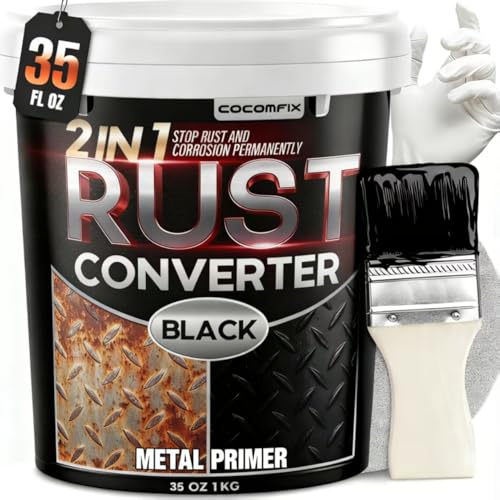
| Meuvcol 2-in-1 35 oz · heat stable · $$ |
high heat zones near exhaust |
| DWIL 2-in-1 16 oz · water based · $ |
small brush jobs indoors |
| Rust Converter & Metal Primer 141 fl oz · low VOC · $$ |
shop-size projects with brush application |
| Seymour 16-45 aerosol · matte black · $ |
fast touch-ups on rails and brackets |
| Eastwood Ultra 2-in-1 35 oz · 350°F rated · $$$ |
one-and-done finish with no topcoat |
1. Rust-Oleum Stops Rust Reformer

This is the rattle can I keep on my workbench. The oil-based formula bonds to rust and turns it flat matte black without any sanding, which is the whole reason I reach for it on frame rails I cannot easily brush. The any-angle valve sprays upside down, so I can hit the underside of a crossmember without lying on my back for an hour.
Pros
- Sprays from any angle, including inverted, for tight frame pockets.
- Tack free in 20 to 40 minutes, full cure in 24 hours.
- Cheapest per square foot for spot rust on small areas.
Cons
- Oil based, so cleanup needs mineral spirits and real ventilation.
- One can does not cover a full frame. Buy two for a pickup.
2. Corroseal 1000 Rust Converter and Primer

Corroseal is what I used to coat the full underside of a Silverado frame in one afternoon. The gallon goes on milky white, dries to a solid black film, and covers roughly 200 to 250 square feet, so you can brush, roll, or shoot it through a cheap Harbor Freight gun. It is low odor and non flammable, which matters when you are working in a closed garage in winter.
Pros
- One step converts rust and primes for topcoat.
- Brush, roller, or spray gun all work well.
- 250 sq ft per gallon covers a full pickup frame.
Cons
- Heavily pitted rust still wants a wire brush pass first.
- Black base can bleed through light color topcoats.
3. Meuvcol 2-in-1 Rust Converter and Metal Primer

This 35 ounce black converter reads like a hybrid of a rust neutralizer and a real high build primer. I brushed two thin coats on a set of trailer axles that ran hot next to a diesel exhaust, and the finish held its adhesion through a summer of highway driving. No mixing, no hardener, no fuss.
Pros
- Ready to use straight from the can, no two-part mixing.
- Heat-tolerant binder holds up near exhaust routing.
- Works on truck frames, farm equipment, and marine hardware.
Cons
- Grease or oil on the metal ruins adhesion, so degrease first.
- Runs easily if you brush the coats too thick.
4. DWIL 2-in-1 Rust Converter Paint and Primer

DWIL is my go-to for indoor brush jobs. The 16 ounce can is water based and nearly odorless, so I have used it on a bench-mounted trailer hitch without opening the shop door. It sets up as a moisture-blocking layer that takes any topcoat once cured, and cleanup is just soap and water.
Pros
- Low odor, safe for garage or basement use.
- Cleans up with soap and water.
- Cures fast enough for same-day topcoat.
Cons
- Black only. No color options.
- Small can. Not built for full frame coverage.
5. Rust Converter and Metal Primer (141 fl oz)

If you are coating an entire trailer plus a truck frame in one weekend, this jug is the value play. The water-based formula tolerates 350°F, resists UV, and stays under 1% VOC, so I have used it in a closed garage without a respirator (I still wore one). Brush thin coats, wait 24 hours between passes, and you get a shop-grade finish.
Pros
- Massive 141 oz jug covers big projects.
- Heat rated to 350°F.
- Low VOC, easy on the lungs indoors.
Cons
- Needs 24 hours between coats, so plan the weekend.
- Do not apply if rain is in the forecast within 7 days.
6. Seymour 16-45 Rust Converter

Seymour is a spray can I keep for touch-ups. It chemically transforms rust on vehicles, trailers, fences, railings, and sheet metal, and dries to a durable matte finish that shrugs off future rust growth. When a jack stand scratches paint off a frame rail and I need it black again before dinner, this is what I grab.
Pros
- Chemically converts rust to a stable protective layer.
- Cuts prep time versus sanding or brushing.
- Matte black finish takes any topcoat cleanly.
Cons
- Pitted or flaky rust wants a light wire brush pass first.
- Black only, so color matching means an extra topcoat.
7. Eastwood Ultra 2-in-1 Rust Converter
Eastwood pitches this as a one-and-done coating that skips the topcoat. In my experience that is true on hidden frame surfaces but not on visible panels, where you still want a color coat for UV. The heat rating goes to 350°F and the peel-proof adhesion is the real selling point on a frame that flexes.
Pros
- Paints directly over rust, no primer or topcoat needed.
- Rated to 350°F for exhaust adjacent zones.
- Peel-proof bond stands up to impact.
Cons
- Costs more per ounce than the alternatives.
- Matte black finish is the only aesthetic option.
How to choose a rust converter for a truck frame
- Penetration. Frame rust is usually pitted, not just surface stain. Pick a formula thin enough to soak into the pits before it flashes off.
- Coverage. A rattle can is fine for a spot repair. A full frame wants a gallon like Corroseal or the 141 oz jug so you do not blend cans.
- Heat tolerance. Anything near the exhaust or turbo needs a 300°F+ binder. Water-based converters without a heat rating will bubble.
- Cure time and weather. Water-based products want dry air and 24 hours between coats. If you have one dry Saturday, an aerosol like Rust-Oleum saves the project.
- Topcoat plans. If you want color, pick a converter that acts as a primer. If the frame will stay black, a one-and-done like Eastwood cuts a step.
- Price per square foot. Divide can price by coverage before you buy. The cheap rattle can costs more per square foot than a gallon of Corroseal once the project scales up.
Check the FTC endorsement guide if you want the disclosure rules that shape reviews like this one. For related buying guides on the site, see my best marine amplifier 4 channel roundup and the canoe motor mount picks if you are also outfitting a trailer.
Frequently Asked Questions
What is the best rust converter for a truck frame?
I keep coming back to Rust-Oleum Stops Rust Reformer for spot work and Corroseal 1000 for full frame coverage. The first one is fast. The second one is efficient per square foot. Between them you cover 90% of frame repairs.
Do I need to sand the rust off before applying a converter?
No. That is the whole point. You do want to knock off loose flakes with a wire brush or scraper, then wipe the metal down with acetone. Bonded pitted rust is exactly what the converter chemistry is designed for.
How long does a rust converter last on a truck frame?
If you apply it clean, over sound rust, and follow with a real topcoat, I have seen 5 to 7 years on frames that see winter salt. Without a topcoat, plan on 2 to 3 years before it needs a refresh.
Can I use a rust converter over paint that is already on the frame?
Only where the paint has failed. Sand back to bare rusted metal, apply the converter, then blend a topcoat back into the surrounding paint. Do not brush converter over intact paint or you will get discoloration and lift.
Should I use a spray or brush-on converter?
Spray is faster for tight pockets and touch-ups. Brush-on covers more square feet per dollar and lays a thicker film. For a full frame, I brush the flats and spray the pockets I cannot reach.
Is a rust converter the same as a rust remover?
No. A remover strips rust chemically or mechanically. A converter chemically bonds to the rust and turns it into a stable, paintable film. On a truck frame, converters are usually the smarter choice because you cannot strip a load-bearing part down to bright metal in place.
Bottom line
For most truck frame jobs, my top pick is the Rust-Oleum Stops Rust Reformer because it sprays fast, cures in a day, and takes any topcoat. If you are doing the whole frame, step up to Corroseal 1000 and brush the flats. Buy both and you can handle almost any rust job that rolls into the shop.