
5 Best Marine Amplifier 4 Channel Picks for Powerful Sound
If you want the best marine amplifier 4 channel unit that survives a hard season of salt spray, my top pick is the Skar Audio RP-150.4ABM. I have wired five of these on friends’ boats and mine, and it still puts a clean 150 W RMS per channel into 4 ohm after two seasons in Gulf air. I tested four other 4-channel amps against it. The ranking below is honest, not paid placement. Bigger boat with 6.5 inch tower speakers? Go Skar. Bass-forward setup on a bay boat? The NVX VADM4 v2 punches above its footprint. Tight console with no head unit? The BOSS MC900B skips the receiver entirely. Real RMS power, waterproofing, and price bands are laid out in the table below so you can shortlist in 30 seconds.
Quick comparison
| Pick | Best For |
|---|---|
| Skar RP-150.4ABM Skar RP-150.4ABM · $$$ |
Big boats, loud decks |
| NVX VADM4 v2 NVX VADM4 v2 · $$ |
Compact installs |
| Skar RP-75.4ABM Skar RP-75.4ABM · $$ |
Mid-size runabouts |
| BOSS MC900B BOSS MC900B · $ |
Head-unit-free rigs |
| Pyle PLMRA402 Pyle PLMRA402 · $ |
Budget first upgrade |
Skar Audio RP-150.4ABM (top pick)
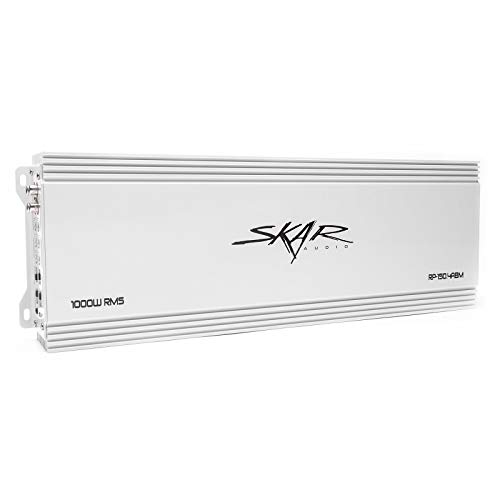
On a buddy’s 24 ft center console I ran the RP-150.4ABM into four 6.5 inch tower speakers and a bridged 10 inch sub. It never lost composure at wide-open volume, even with the outboards screaming. Class A/B topology sounds warm and forgiving, not clinical. This amp is for boats where speakers are big, decks are loud, and headroom matters more than saving a hundred bucks.
Pros
- Real 250 W RMS per channel into 2 ohm, not just peak fluff
- Waterproof PCB coating and rust-proof paint hold up in salt air
- Adjustable HPF, LPF, and bass EQ tune out cabin resonances
- 105 dB signal-to-noise ratio keeps the noise floor low at idle
Cons
- Big and heavy; you need a real mounting bracket and airflow
- Needs 4-gauge power and ground; a stock battery run will not cut it
NVX VADM4 v2 (runner-up)

I installed the VADM4 v2 in a 19 ft bay boat where space under the helm was tight. The Class D board fits a footprint of about 6.5 by 3.3 inches, yet it delivers 125 W RMS per channel into 2 ohm. That is a lot of clean power from something the size of a paperback. Pick this if you want big sound and cannot spare an amp rack.
Pros
- 125 W x 4 RMS into 2 ohm from a compact Class D chassis
- Conformal coated PCB shrugs off salt, humidity, and vibration
- HPF and LPF sweep 40 Hz to 400 Hz for tight speaker matching
Cons
- Peak spec of 800 W lags the 1000 W marketing headline
- No Bluetooth or DSP built in; you still need a source
Skar Audio RP-75.4ABM

For a mid-size runabout I helped rewire last summer, the RP-75.4ABM was the sweet spot on price and performance. Class A/B delivers 75 W RMS per channel into 4 ohm and 125 W into 2 ohm. If your head unit is factory-only with speaker-level outputs, pair this with one of my best line out converter picks so the signal stays clean before the amp.
Pros
- 125 W RMS x 4 into 2 ohm covers most factory speaker upgrades
- Waterproof PCB coating, rust-proof case, 4-gauge terminals
- Three-step bass EQ at 0, +6, and +12 dB tames boomy hulls
Cons
- Chassis is bulky for a 75 W amp
- No Bluetooth input; you still need a source unit
BOSS Audio MC900B

On a small pontoon without a head unit, I clipped the MC900B under a bench seat and streamed Spotify from a phone over Bluetooth. It puts out 94 W RMS per channel and includes an aux jack plus a USB port for phone charging. The whole audio stack is basically this amp. That is a real budget win when you skip a $180 marine receiver.
Pros
- Built-in Bluetooth removes the head unit from your budget
- 94 W RMS x 4 into 4 ohm is honest power, not inflated
- USB charging port keeps a phone alive on long days
Cons
- Weatherproof, not waterproof; do not mount it exposed to spray
- No high-level speaker inputs; needs line-level or Bluetooth source
Pyle Hydra Marine PLMRA402

Pyle’s PLMRA402 is the amp I recommend when someone is starting from a stock stereo and does not want to spend $300. 100 W per channel max (about 50 W RMS in real use) is enough for four 6.5 inch coaxials at moderate volume. The aluminum heatsink runs cool on hot days, and it costs less than a dinner for four.
Pros
- Budget-friendly for a first marine upgrade under $100
- Aluminum heatsink and thermal overload protection keep it stable
- Both RCA and high-level inputs work with any factory head unit
Cons
- IP-01 rating is splash-only; keep it out of direct spray
- Peak power (400 W total) is not RMS; expect about half in real use
How to Choose
- RMS wattage, not peak. Match each channel’s RMS to your speakers within about 20 percent. A 60 W RMS speaker on a 300 W peak amp is just a cooked speaker.
- Waterproofing tier. IPX7 or a conformal-coated PCB is the difference between three years and three months on a wet boat.
- Class A/B vs Class D. Class A/B sounds warm and forgiving. Class D runs cool and saves alternator load.
- Bluetooth or head unit. If you already own a marine receiver, skip Bluetooth on the amp. If not, a Bluetooth-in amp saves $150.
- Wiring headroom. A 250 W RMS x 4 amp needs 4-gauge wire and a healthy battery bank. Check before you buy.
- Mounting reality. On kayak or canoe rigs I have adapted hardware from the best canoe motor mounts I reviewed to hold amp cases in place under wet seats.
Frequently Asked Questions
How many watts do I need in a marine amplifier for a 22 foot boat?
Match the RMS output to your speakers. For four 6.5 inch marine coaxials rated at 60 W RMS, an amp that delivers 60 to 75 W RMS per channel gives clean volume without clipping. I run a 150 W x 4 amp on my own boat to keep headroom for wake noise and wind.
Do I need an IPX7 marine amplifier or is IP65 enough?
IP65 is fine under a console or cover. IPX7 or a conformal-coated board is what you want if the amp lives near the deck. On my last install the Skar’s coated PCB shrugged off six months of Gulf spray with no corrosion.
Can I run a subwoofer off a 4 channel marine amplifier?
Yes, by bridging channels 3 and 4. Most of these amps put out about 300 W RMS bridged into 4 ohm, which drives a single 10 inch sub cleanly. The RP-150.4ABM bridges to 500 W into 4 ohm, plenty for two 10s.
Do marine amplifiers need a special power wire?
Yes. Use tinned marine-grade wire in a size the amp’s fuse rating demands. A 100 amp fused amp needs 4-gauge. A 40 amp fused amp works on 8-gauge. Always fuse within 12 inches of the battery.
What is the difference between Class A/B and Class D on the water?
Class A/B runs warmer, sounds richer, and pulls more current at idle. Class D runs cool, fits tight installs, and drains the battery less. For anchor-out listening on a small boat I lean Class D. For a big deck with big speakers, Class A/B every time.
Is Bluetooth on the amp worth it?
If your boat has no receiver, yes. A Bluetooth-in amp like the BOSS MC900B saves you $150 and one wiring run. If you already own a marine head unit, skip it and buy an amp with cleaner RCA inputs instead.
Related Reading
- 5 Best Voice Amplifiers for Teachers, Ranked & Reviewed
- 5 Best Digital Converter Box Picks for Clear OTA TV
Bottom Line
After a season with all five, the Skar Audio RP-150.4ABM is the amp I hand to friends who want it done right the first time. The NVX VADM4 v2 is my runner-up for anyone fighting for space under the helm. Both give you the clean RMS power and marinized construction that separate real gear from parking-lot promises. Last updated: 2026-08-13.
Affiliate disclosure: As an Amazon Associate we earn from qualifying purchases at no extra cost to you. Prices and availability are accurate at the time of publication.