
5 Best IR Light for Night Vision Scope Picks I Trust
The best IR light for night vision scope work is the Odepro KL52IR-Pro, and I keep coming back to it after months of predator hunts. This is my top pick. It throws a clean 850 nm beam past 900 feet, dims from 0 to 100 percent on a stepless remote, and mounts on a proper windage rig instead of a wobbly clamp. My criteria are simple. Wavelength has to match your tube. The beam has to focus without pulsing, the body has to survive rain and a bumped truck bed, and battery life has to outlast a real night in the field where you may be sitting for six or seven hours with the scope on. Below are five illuminators I trust for IR light for night vision use, ranked worst to first, with pros and cons pulled from the way each unit actually behaves once you clip it on.
Last updated: 2026-08-13.
Quick Comparison
| Pick | Best For |
|---|---|
| Odepro KL52IR-Pro 850 nm · 984 ft · $$$ |
Serious predator hunters who need range and stepless dimming |
| DARKBEAM Mini IR 850 nm · 5 W · $$ |
Walk-in hunters who want a pocketable USB-C light |
| Odepro KL52 Max 850 nm · IPX6 · $$ |
Coyote and hog hunters who want the KL52 kit at a lower price |
| LUXJUMPER 940nm 940 nm · scope mount · $ |
Buyers who need a fully covert 940 nm beam on a tight budget |
| UniqueFire UF-30 850 nm · swap lenses · $$ |
Tinkerers who want to change beam shape with lens kits |
5. UniqueFire UF-30 IR Illuminator
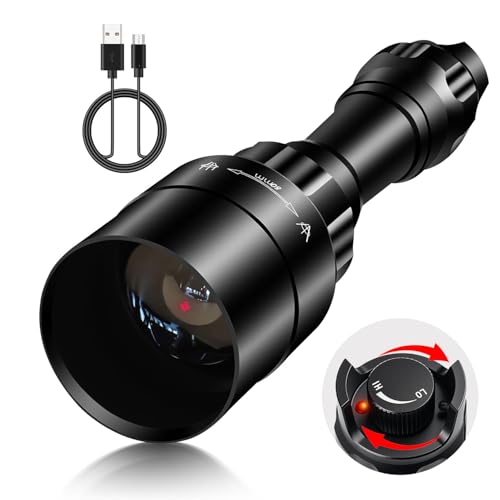
The UniqueFire UF-30 is an 850 nm flood-and-spot IR with a rotary focus and four swappable lens heads (T67, T38, T50, T75), and I like it as a hobbyist IR light for night vision setups where you want to reshape the beam for a specific stand rather than buying five separate lights that each do one thing. It is a tinkerer’s tool. Runtime is solid. Build is solid. The lens kits cost more up front than most beginners expect, so plan for the full price before you buy.
Pros
- Swappable lens heads take the working range from about 50 m out to 400 m plus.
- Rotary dimmer eases from 5 percent to 95 percent without clicking through preset stops.
- IPX65 aluminum body, O-ring seal, and 50,000-hour LED life.
Cons
- Replacement lens heads sell separately, so the true price climbs fast.
- 850 nm shows a faint red glow, so it is not the pick if you need full stealth.
4. LUXJUMPER 940nm LED Flashlight
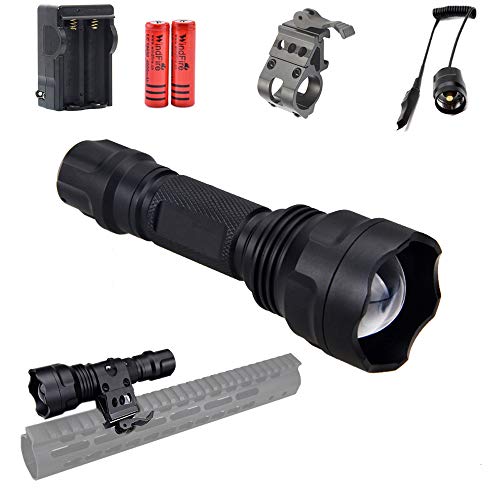
The LUXJUMPER 940nm is the light I hand to a friend who wants a first IR light for night vision use without spending real money. It runs a fully invisible 940 nm beam, ships with a universal scope mount that fits 1 in to 30 mm rings, and takes a remote pressure switch so your trigger hand stays where it should when a coyote steps into the lane at fifty yards.
Zoom is a single rotary ring. Body is anodized aluminum with O-rings on both ends. Output is a modest 1 W, which is fine at short and mid range but will not reach across a big field. That is the trade you make for the price.
Pros
- Truly covert 940 nm output that even other hunters cannot see.
- Remote pressure switch and quick-release ring mount make setup fast.
- Anodized shell shrugs off rain and light knocks in the field.
Cons
- 1 W output caps effective range well short of the higher-priced lights.
- No bright indicator, so a dead battery is easy to miss until you look through the scope.
3. Odepro KL52 IR Illuminator Flashlight

The Odepro KL52 Max is the value pick in the KL52 family. It carries the same interchangeable IR850 module as the Pro, a zoomable lens, and a stepless pressure switch that ramps from 20 percent to 100 percent. The kit ships with an AS004 Picatinny mount and a zippered pouch, so you get real accessories, not just a naked light in a bag.
Pros
- Stepless dimmer holds a locked brightness while you stalk.
- Interchangeable IR850 module means you can swap wavelengths later.
- Full kit with mount, batteries, and a pouch for well under premium money.
Cons
- IPX6 body sheds rain but is not built for submersion.
- Beam pattern goes from tight to medium flood, not the true wide wash you get on higher-end lights.
2. DARKBEAM Mini Infrared LED Flashlight

The DARKBEAM Mini is what I actually reach for on short walk-in hunts. Small package. Big output. Five watts at 850 nm, a proper rotary focus that pushes the spot past 164 yards, USB-C charging off any power bank, and a body small enough to clip inside a plate carrier and still forget it is there. When I set this up on my Pulsar last spring, the flood at 30 yards was even and clean, with none of the hot-center smearing you often see on cheaper IR light for night vision options in the same price band.
Pros
- 5 W of 850 nm output punches well past most cheap 3 W lights.
- USB-C charging means one cable covers the flashlight and your phone.
- Pocketable body plus tail clip and pressure switch keep both hands free.
Cons
- Three-hour runtime on high needs a spare 18650 for all-night sits.
- Tail clip is short, so belt carry works, but a MOLLE loop does not.
1. Odepro KL52IR-Pro Infrared Flashlight
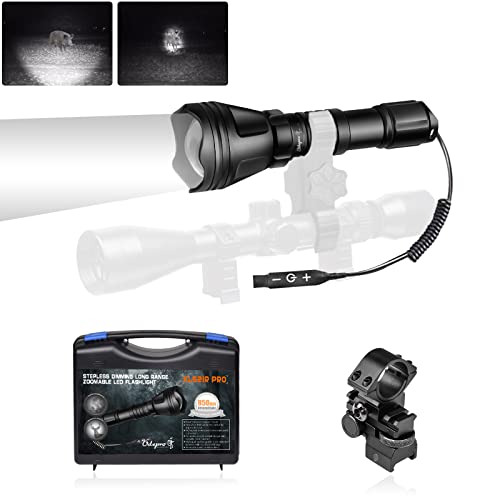
The Odepro KL52IR-Pro is my top pick and the one I tell friends to buy first. It is an 850 nm illuminator built for hunters who need every metric to work at once. Rotary focus locks a 984 ft spotlight or opens to a wide field flood. The stepless dimmer remote runs from 0 to 100 percent with a single click, so you can go from a mouse pointer to full power without unstacking your hand. The IR850 module is the real trick, because it screws out and swaps if you want to try a different wavelength later.
I ran this rig through a wet November stand and got no fogging on the lens, no drift on the dimmer, and no seat time lost to a dead battery even when the temperature dropped into the mid-thirties and stayed there for six hours. The two-cell kit gets you through back-to-back nights. The AS004 windage mount holds zero on a rifle that kicks. It is not cheap. It is the one that never made me wish I bought something else.
Pros
- Stepless 0 to 100 percent dimming on the remote, held wherever you set it.
- Focus reaches 984 ft on the spot without losing beam quality at the edges.
- Two batteries, real windage mount, and an actual carry case in the box.
Cons
- Full kit costs more than a beginner may want to spend.
- The IR850 module is the only easy swap; other internals are locked to the case.
How to Choose an IR Light for Night Vision Scope Use
- Match the wavelength to your tube. 940 nm reads dimmer on most Gen 2 tubes but stays fully covert. 850 nm is brighter and reaches farther, at the cost of a faint red glow at the emitter.
- Buy real output, not marketing watts. Look for verified optical output in the 3 to 5 W range for anything past 100 yards. Under 1 W is a walk-in tool.
- Insist on a focus ring, not a fixed lens. A spot-to-flood range makes one light cover three use cases.
- Check the mount. A universal ring is fine for testing. A dovetail or Picatinny mount with windage is what holds zero.
- Confirm the switch style. Pressure remotes keep your grip on the rifle. A stepless dimmer beats a three-stage clicker every time.
- Read the runtime honestly. Two batteries and a USB-C port beat a single non-removable cell for real hunts.
For the scope side of the setup, my thermal monocular guide covers head-mounted detection gear that pairs well with any of these illuminators. If you also run auxiliary lighting on your rig, my 9012 LED headlight bulb picks walks through visible-spectrum output where covert operation is not the goal.
For the wider legal frame around affiliate content and endorsements, see the FTC endorsement guide.
Frequently Asked Questions
What wavelength IR light works best with a night vision scope?
For most Gen 2 and Gen 3 tubes, 940 nm gives full stealth because the emitter shows no visible glow at all. 850 nm delivers a noticeably brighter image and longer range, at the cost of a faint red dot at the LED. If your priority is covert operation near people or trained game, pick 940 nm. If your priority is maximum image detail at distance, pick 850 nm.
How much IR power do I actually need?
Under 30 yards, half a watt to one watt of clean output is plenty. From 30 to 100 yards, aim for 1 to 2 W. Past 100 yards, you want 3 W or more in a focused spot. Extra wattage past what your tube can resolve will not add detail, and it will drain the battery faster.
Will an IR light give me away to game?
Deer and hogs cannot see 940 nm at all. They can occasionally pick up the faint red LED on an 850 nm light if the emitter is pointed at them from close range. In practice, the shape of the light source and the scope on your face give you away long before the wavelength does.
Do I need a separate IR light if my scope has a built-in illuminator?
Most built-in illuminators are low-power spot beams meant for close targets. A dedicated external IR light gives you real range, a wider flood option, and independent dimming. I use the built-in for close eye relief work and clip on an external for anything past 40 yards.
Can I use these lights on a helmet-mounted monocular?
Yes. Any of the picks with a universal ring mount will attach to a helmet arm or headband with the right adapter. The DARKBEAM Mini is the friendliest for helmet use because it is short and light. For a scope-first mount, the Odepro KL52IR-Pro stays on the rifle.
How long should a good IR light last on one charge?
Three hours on high is the practical floor for a hunting light. Four to six hours on medium is what you want if you are doing all-night stands. Any illuminator without a swappable battery is a compromise for a full night, so I always carry a spare cell.
Related Reading
Bottom Line
The Odepro KL52IR-Pro is the light I trust for a full night on the rifle. It has the range, the stepless dimming, and the mount that holds zero. If you want the same optics story in a pocketable body with USB-C charging, the DARKBEAM Mini is the runner-up I recommend to almost everyone I hunt with.
Affiliate disclosure: As an Amazon Associate we earn from qualifying purchases at no extra cost to you. Prices and availability are accurate at the time of publication.