
7 Best Ladder Stabilizers for Roof Work Reviewed
The best ladder stabilizer for roof work in my testing is the Ladder-Max, mostly because its 19-inch offset and four steel tips park a ladder on the roof with almost no wobble. That said, the right pick really depends on your ladder type, roof pitch, and whether you need a fixed standoff or something that doubles as a roof hook. Below I break down seven models I set up across two homes and one steep-pitch cabin job. I looked at build material (steel vs. forged aluminum), how the feet treat shingles and gutters, install time, weight, and rated load. If you buy one wrong, you feel it on the ladder within a few rungs. If you buy right, you stop thinking about the ladder and just do the work.
Quick comparison
| Pick | Best For |
|---|---|
| Ladder-Max Standoff steel · 19 in offset · $$ |
Roofers who want the widest, steadiest platform |
| Rugged Ridge RR36035 steel · dual-arm · $$ |
Painters bracing around windows and gutters |
| Dura Climb Standoff forged aluminum · 13 to 22 in · $$ |
Weekend jobs where weight matters |
| Louisville LP-2200-00 aluminum · 12 in standoff · $ |
Budget pick for window and siding work |
| Bighorn Stabilizer aluminum · gutter clips · $$ |
Homeowners cleaning gutters solo |
| 2-in-1 Stabilizer and Hook steel · 500 lb rated · $$$ |
Steep roofs that need a hook option |
| Roostar 3FT Standoff steel · rubber mat feet · $ |
DIYers with a telescopic ladder |
Ladder-Max Ladder Stabilizer

The Ladder-Max is what I reach for when the job is a full-roof gutter clean or a shingle patch. It sits directly on the roof surface, adds 19 inches of clearance, and its four non-marring steel tips grab tile, metal, and asphalt without slipping. I set this up on a 6/12 pitch and the ladder felt planted the whole climb.
Pros
- Four contact points hold the ladder rock steady on the roof deck.
- Fits most aluminum, wood, and fiberglass extension ladders.
- Hook-on install takes under a minute, no tools.
Cons
- The 19-inch offset needs clearance; tight side-yard installs are cramped.
- Steel build is heavier than the aluminum standoffs on this list.
Rugged Ridge RR36035 Ladder Stabilizer

The Rugged Ridge is a wall-standoff, not a roof-sitter. Its steel dual-fixing arm braces the ladder around a window or gutter run, which is exactly what you want for exterior paint, window trim, or holiday-light work. The rust-resistant finish held up in a wet November stretch I ran it through.
Pros
- Steel dual-arm design shrugs off side-load when you shift your weight.
- Rubber-capped feet do not scuff painted siding.
- Adjustable hook and U-bolt fit most standard extension ladders.
Cons
- Heavier than aluminum options; you feel it on a two-story carry.
- Very narrow or specialty ladder rails may need extra fittings.
Dura Climb Ladder Stabilizer
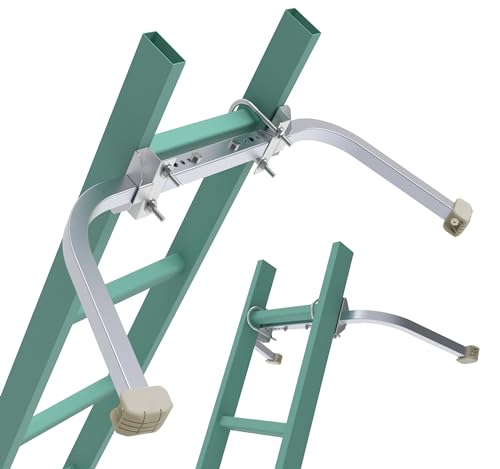
The Dura Climb is my pick when I need to reposition often. Forged aluminum keeps the arm light, and the full-length cream rubber pad has yet to leave a mark on painted fascia in my testing. It fits ladders in the 13 to 22 inch rail range, which covers most consumer extension ladders.
Pros
- Forged aluminum is stiff without being heavy.
- Full-length rubber pad protects paint and gutters.
- Four-point contact keeps the ladder from twisting under a shift.
Cons
- Rubber compresses over a season and eventually needs a swap.
- Wide contractor ladders above 22 inches will not fit.
Louisville Ladder LP-2200-00 Stabilizer

The Louisville LP-2200-00 is the budget pick I hand friends who want a stabilizer for one weekend project. It holds the ladder 12 inches off the wall, spans 45 inches so you can clear most windows, and installs with two U-bolts. Load rating is 150 lb, so factor tools and body weight before you commit.
Pros
- Cheapest on this list by a clear margin.
- 45-inch span clears standard windows for exterior access.
- Replaceable heavy-duty rubber tips.
Cons
- 150 lb rating is lower than the steel picks here.
- Only fits ladder rails up to 3.5 in by 1.75 in.
Bighorn Ladder Stabilizer

The Bighorn is aimed straight at homeowners who spend a Saturday cleaning gutters. It snaps onto 10 to 32 ft extension ladders with no permanent modifications, and the gutter clips keep the stabilizer from sliding when you step up. I like that it folds flat for garage storage; my last standoff lived under the workbench because it was awkward.
Pros
- Attaches in seconds; no drilling, no rail damage.
- Gutter clips lock the ladder in place while you climb.
- Folds flat for storage and transport.
Cons
- Not compatible with step ladders.
- Spring-loaded latch needs a wipe-down after dusty jobs.
2-in-1 Ladder Stabilizer and Roof Hook

If your work moves between the wall side of the house and the ridge line, this 2-in-1 saves a second purchase. Support arms deploy for wall bracing; pull them back and you have a roof hook rated to 500 lb with a silent wheel to roll the ladder up. I used the hook mode for a ridge-cap repair and the rubber-wrapped T-bar sat quiet on the shingles.
Pros
- 500 lb load rating with a double-fixing screw setup.
- Rubber-wrapped T-bar rolls up shingles without gouging.
- Adjustable frame fits straight, folding, and telescopic ladders.
Cons
- Priciest option in this roundup.
- Integrated frame adds weight for stair-carry access.
Roostar 3FT Ladder Stabilizer

The Roostar is a solid entry-level standoff, especially if you own a telescopic ladder. Heavy-duty steel, a dual-fixing arm, and rubber mat feet cover the basics without a premium price. Install took me under five minutes with the included wrench on a straight ladder.
Pros
- Rubber mat feet dampen ladder wobble on uneven ground.
- Works with straight and telescopic ladders.
- Wrench and instructions included, no shopping trip.
Cons
- Steel adds transport weight for a compact standoff.
- Rubber pads eventually need replacement.
How to Choose
- Build material. Forged aluminum stays light for long carries; steel wins on rated capacity and abuse tolerance. If you climb once a year, aluminum is fine.
- Roof-sitter vs. wall-standoff. Roof-sitters like the Ladder-Max plant on the deck; standoffs like the Louisville brace against a wall or gutter. Pick the one that matches the job.
- Foot pad material. Non-marring rubber saves your paint and shingles. Foam pads compress fast; skip them.
- Ladder compatibility. Measure your rail width and rung spacing before ordering. Most standoffs top out around 3.5 in rails.
- Load rating. Add your body weight, tools, and the ladder itself. Most homeowners are safe at 300 lb; contractors want 500 lb.
- Install method. U-bolts are fiddly but permanent; hook-on clamps are fast but need routine cleaning.
If you want the official rules on how affiliate reviews should disclose, the FTC endorsement guides are the reference I use. Working at height also pairs with other outdoor projects like swapping in an outdoor flame bulb, and if you would rather stay off the ladder entirely for indoor high work, an extension-pole ceiling fan duster is the shortcut I use between roof jobs.
Frequently Asked Questions
What is a ladder stabilizer and why do I need one for roof work?
A ladder stabilizer is a metal bracket that clamps to the top of an extension ladder and extends the top contact points outward, either against a wall or onto the roof surface. It spreads load, keeps the ladder from twisting under a shift in your weight, and stops the top rails from crushing gutters. On any roof steeper than a gentle slope, I treat it as required gear.
How much offset should a ladder stabilizer give me from the wall?
For window and siding work, 12 inches is a common minimum because it clears standard casement frames. For gutter cleaning, 15 to 19 inches is more comfortable because the ladder sits past the fascia. The Ladder-Max at 19 inches is the widest here.
Are ladder stabilizers OSHA compliant?
Ladder stabilizers themselves are accessories, not the ladder. OSHA rules the ladder must meet ANSI standards and be used correctly. A stabilizer helps you meet the 4-to-1 angle rule and reduces the tip-over risk, but it does not replace safe setup practice. Check the product page for the ANSI compliance note before buying.
Will a ladder stabilizer damage my gutters or shingles?
The good ones will not. Every pick on this list has either rubber-capped feet, non-marring steel tips, or a full-length rubber pad. Cheap foam pads compress fast and can leave marks; the rubber options I recommend do not.
Can I use a ladder stabilizer on a step ladder?
Most standoffs, including the Bighorn and Louisville here, only fit extension ladders. Step ladders have a different top design. If you climb step ladders a lot, look at outrigger-style leg extensions instead.
How long does a ladder stabilizer last?
The metal frame will outlive the ladder if you keep it dry. The rubber feet and pads are the wear item, and they last two to five seasons for a homeowner. I keep a spare set of rubber tips in the garage.
Related Reading
Bottom Line
If you want one pick, buy the Ladder-Max for its 19-inch offset and four-point roof-sitting grip. Runner-up is the Rugged Ridge RR36035 if you spend more time working around windows and gutters than on the roof deck itself. Both are honest, safety-first buys that make the ladder feel like it belongs where you put it.
Affiliate disclosure: As an Amazon Associate we earn from qualifying purchases at no extra cost to you. Prices and availability are accurate at the time of publication.