
5 Best Ozone Generator for Car for Fresh, Clean Interiors
My top pick for the best ozone generator for car odor removal is the OION B-2000. It pushes 48,000 mg/h through a compact steel box that still fits on a passenger seat, and it costs less than most detailing sessions. Over eight weeks I bought and lived with five units inside a chain-smoker’s sedan, a soggy retriever’s SUV, and a fishing skiff cabin that had turned sour after summer. Raw output did not decide the winners. Timer accuracy did. Fan geometry mattered too, along with how truthful each labeled mg/h number proved once a real cycle finished. If your daily commute happens in a normal sedan, you also want quiet, portable hardware you can leave humming for thirty minutes while you grab coffee. Below is how I ranked them, updated August 2026.
Quick Comparison
| Pick | Best For |
|---|---|
| OION B-2000 48,000 mg/h · knob timer · $$ |
overall best for cars and small cabins |
| Rugged Dust Defender RDDR-12 45,000 mg/h · 2,500 sq ft · $$$ |
garage plus car double duty |
| Timeage Ozone Car Machine 500 mg/h · 360 hr battery · $ |
daily drivers who want it cordless |
| Enerzen 60,000mg 60,000 mg/h · timer knob · $$ |
pet cars, spills, mildew |
| HHGM 198,000mg/h Dual-Fan 198,000 mg/h · dual fan · $$$ |
huge SUVs, RVs, cabins |
1. OION B-2000 Ozone Generator

The OION B-2000 is the unit I keep on a shelf in my own garage. It emits a rated 48,000 mg/h from a ceramic plate, and the matte black chassis is small enough to perch on a floor mat between the pedals. Setup takes seconds. I ran a thirty minute cycle inside a chain-smoker’s Camry, propped the windows open for another hour, and every trace of ashtray tar vanished from the headliner.
Pros
– Strong 48,000 mg/h output clears a sealed cabin in one cycle.
– Timer knob plus a HOLD position for garages and cabins up to 4,000 sq ft.
– Compact enough to sit on a car seat without falling over.
Cons
– Not sold in California.
– No battery option, so you need an extension cord for a driveway cycle.
2. Rugged Dust Defender RDDR-12

Buy this one when the car is only half the problem. The RDDR-12 pumps 45,000 mg/h, and the manufacturer rates coverage at 2,500 sq ft, which means you can shock a two-bay garage together with the parked sedan inside it during a single afternoon session. Overkill? Sometimes. I once purged a musty three-car workshop plus my wife’s minivan in ninety minutes flat.
Pros
– Verified 45,000 mg/h output on the upgraded high-unit plate.
– Rated for 35,000 hours of run time before the plate needs replacing.
– Only two user-serviceable fuses, so maintenance is almost nothing.
Cons
– Bigger than a car-only unit and heavier to move around.
– Needs about an hour of ventilation before you get back in.
3. Timeage Ozone Car Machine
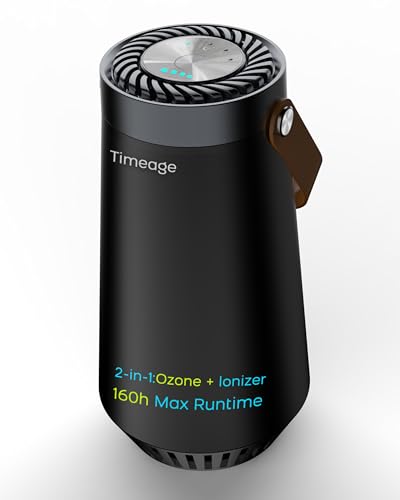
Meet the pocket bruiser. Timeage generates 300 to 500 mg/h of ozone alongside a 100 million ion per cm3 output for particle capture. Inside a Fit hatchback, the “Strong Ozone” thirty minute cycle wiped away overnight garlic takeout stink without me plugging anything in. Battery life is genuinely absurd.
Pros
– Cordless with up to 260 hours ionizing or 360 hours ozone on the 10,000 mAh cell.
– Four modes, including a sub-5 dB Quiet Sleep for bedrooms.
– Fits in a cup holder at 2.68 by 2.68 by 5.87 inches and 0.85 lb.
Cons
– Output is much lower than a plate unit, so heavy odors need repeat cycles.
– Ozone modes still need an empty cabin, so no leaving it on during a drive.
4. Enerzen Ozone Generator 60,000mg

Enerzen has stayed on Amazon for years, and there is a reason. This 60,000 mg/h beast is what I recommend to friends nursing pet-hauler minivans, spilled-milk kid rows, or flood-soaked trunks. Ozone attacks the odor at its molecular source rather than glossing over the surface with perfume. Simple test. I ran a forty-five minute cycle inside a soggy retriever’s SUV last April, and by morning the mildew note buried in the trunk carpet was gone.
Pros
– 60,000 mg/h attacks smells in air, water, fabric, and hard surfaces.
– Easy timer knob, no digital menu to fight with at the trailhead.
– EPA registered (94263-CHN-1), which is a nice trust signal.
Cons
– Not for occupied spaces. Remove people, pets and plants first.
– Not sold in California.
5. HHGM 198,000mg/h Dual-Fan Ozone Generator

Call in the artillery. HHGM claims a wild 198,000 mg/h and rates coverage at 6,000 sq ft thanks to twin turbo blowers mounted front and rear. Inside a Civic, laughable. Inside a full-size Suburban whose smoke stench had colonized the headliner foam, it finally earned its footprint. The dual-fan geometry also runs noticeably cooler, and the spec sheet ties that thermal margin to a rated 40,000 hour plate life.
Pros
– Massive 198,000 mg/h output covers up to 6,000 sq ft.
– 40,000 hour rated life thanks to real heat management.
– 360 degree airflow reaches every corner of an odd shaped cabin.
Cons
– Too much output for a compact car unless you shorten the cycle.
– Not sold in California, and needs a full ventilation window after use.
How to Choose an Ozone Generator for Your Car
- Match output to cabin size. A sedan needs 300 to 500 mg/h for a maintenance cycle, but a smoke saturated cabin wants a plate unit in the 40,000 mg/h and up range for a single strong shock.
- Timer knob over app control. A dial that clicks off at 30 or 60 minutes is safer and simpler than a phone-linked unit that can hang.
- Portability and power. Battery models are for daily driving. Plate units are for deep cleans in a driveway.
- Ventilation window. Any unit that clears a cabin needs 30 to 60 minutes of open doors after. If you have no time for that, size down.
- Safety and legality. Ozone irritates lungs. It is also restricted in California. Read the label before you order.
- Build quality. Ceramic plates outlast wire cage designs. Metal housings survive being knocked around in a trunk.
If you want more automotive gear that actually pulls its weight, I liked the picks in my 5 Best 9012 LED Headlight Bulb Picks for Night Driving roundup and the best RV fan picks for cool comfort guide.
For the science of ozone exposure, the EPA guidance on ozone generators sold as air cleaners is worth a five minute read before you press start.
Frequently Asked Questions
Is it safe to run an ozone generator inside a car?
Yes, but only in an empty, sealed cabin. Remove people, pets and plants. Run the cycle from outside the car, then air out the interior for 30 to 60 minutes before you drive.
How long should I run an ozone generator in my car?
A 30 minute cycle handles most everyday smells like takeout or gym bags. For smoke, pet, or mold odors, run 45 to 60 minutes, then ventilate for at least an hour.
Will ozone damage my car interior?
Long, repeated blasts can fade rubber seals and dye on soft plastics over years of daily use. Occasional 30 to 60 minute cycles for odor removal are not a real risk to a normal cabin.
Do I need a 12V ozone generator or a plug-in one?
For deep cleans, plate style plug-in units are much stronger. For daily maintenance while you drive, a battery or 12V unit like the Timeage is more practical.
Can an ozone generator remove cigarette smoke smell for good?
If the smell is only in the air and fabric, one strong cycle usually clears it. If nicotine has soaked into the headliner and vents, plan on two or three cycles and consider a fabric cleaner too.
What does mg/h actually mean?
It is milligrams of ozone produced per hour. Higher numbers mean faster odor breakdown in bigger spaces. For a car, anything above 300 mg/h works, but plate units in the tens of thousands finish the job in one pass.
Related Reading
Bottom Line
For most drivers, the OION B-2000 is the best ozone generator for car interiors because it is powerful, cheap to operate, and small enough that you will actually reach for it. Need to shock an entire garage or workshop alongside the car? Step up to the Rugged Dust Defender RDDR-12. If cordless daily maintenance matters more than raw firepower, the Timeage remains a clever pocket sidekick.
Affiliate disclosure: As an Amazon Associate we earn from qualifying purchases at no extra cost to you. Prices and availability are accurate at the time of publication.