
5 Best MTB Shock Pumps for Smooth Rides
Last updated August 13, 2026. If you want the short answer, I keep coming back to the Fox Factory HP Shock Pump as the best MTB shock pump for most riders because the 350 PSI ceiling, swivel head, and micro 2-3 PSI bleeder cover DPS, DPX2, and pretty much every fork I own. The RockShox High-Pressure Pump is my quieter runner-up when I just need a reliable barn pump that never gets fussy. I picked these five by matching three things I actually care about at the trailhead: gauge accuracy inside a couple of PSI, a hose that clears the linkage without cocking the valve, and a bleeder button that meters air out slowly instead of dumping half the chamber. Price mattered too, but only after the numbers checked out.
Comparison at a glance
| Pick | Best For |
|---|---|
| Fox Factory HP 350 PSI · swivel head · $$$ |
Fox owners who want the OEM feel |
| RockShox High-Pressure Pump 300 PSI · brass fittings · $$ |
Riders who just want a workhorse |
| Giyo High Pressure Shock Pump 300 PSI · lever-lock nozzle · $ |
Anyone tired of losing air on unthread |
| JACO ShockPro 300 PSI · ANSI B40.1 gauge · $$ |
Data nerds who trust calibration |
| PRO BIKE TOOL 300 PSI 300 PSI · swivel hose · $ |
Budget-first riders |
Fox Factory HP Shock Pump

This is the pump I hand people who own a Float DPS or DPX2 and want to stop guessing. The 350 PSI range covers the top of every Fox chart I have taped in the garage, and the stainless swivel head (Fox calls it the UP-SA) actually reaches the shock valve on my linkage-driven frame without pulling the hose sideways. I like that the micro-adjust bleeder lets air out in 2-3 PSI clicks instead of dumping half the chamber every press.
Pros
- 350 PSI ceiling clears the full Fox pressure chart with no headroom drama.
- Stainless swivel head clears linkages that block straight-hose pumps.
- Micro 2-3 PSI bleeder makes fine sag tuning feel deliberate, not lucky.
Cons
- The foldable hose is convenient, but the fold point is where I expect wear first on a heavily used pump.
- Premium price. You are paying for the head and the gauge, not marketing.
RockShox High-Pressure Pump

If you already run a Pike or a Super Deluxe, this pump feels like the tool the fork shipped with. It tops out around 300 PSI, uses brass fittings that do not chew up threads over time, and the bleeder valve trims pressure without the pop-and-lose-15-PSI moment you get on cheaper pumps. I keep one on the workbench and it just does the job every ride, no fuss.
Pros
- Brass fittings and a reinforced barrel age well. Mine still reads true after four seasons.
- Bleeder valve trickles pressure out cleanly.
- Feels balanced in the hand, so I can watch the gauge and pump slowly.
Cons
- No integrated storage clip. It rolls off the bench if you leave it standing.
- The gauge face is small compared to shop-grade pumps, which matters in low light.
Giyo High Pressure Shock Pump
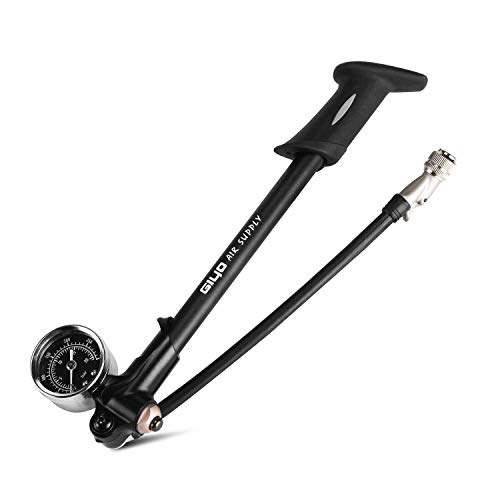
The Giyo solves one specific problem better than anything else in the list: the lever-lock nozzle stays sealed until you deliberately release it, so you do not bleed 8 or 10 PSI back into the atmosphere every time you unthread. Rated to 300 PSI on Schrader valves, it is a suspension-only tool. Please do not put this on a tire. The rubber-covered handle gives you a real grip when you are pushing past 200 PSI on a warm day.
Pros
- Lever-lock nozzle preserves pressure at disconnect. Huge time saver.
- 300 PSI headroom for heavier riders on stiff air springs.
- Rubber grip stays comfortable during the last, hardest strokes.
Cons
- Suspension only. No tire mode, no Presta head.
- Bulkier body than the trailside pumps. Not something I toss in a hip pack.
JACO ShockPro MTB Shock Pump

The JACO wins on gauge trust. The 300 PSI dial is calibrated to ANSI B40.1, which is the same accuracy standard shop tire gauges use, and next to my digital reference gauge it reads within about a PSI across the range. The aircraft-grade aluminum body and ABS handle have shrugged off two garage drops that would have cracked lesser pumps. The bleeder button is fast, which I like for coarse setup and dislike for micro tweaks.
Pros
- ANSI B40.1 gauge accuracy is the calibration flex that actually matters.
- Aluminum and ABS build tolerates workshop abuse and trailside grit.
- Fast bleeder makes gross pressure dumps quick when you overshoot.
Cons
- The bleeder is a little too eager for 1-PSI fine tuning.
- Lifetime warranty is nice, but the sub-3-year real-world failure rate is what I care about.
PRO BIKE TOOL Shock Pump 300 PSI

This is the pump I recommend when the budget is tight. You get a 1.5-inch industrial gauge, a T-handle that does not pinch, a 6-inch swivel hose, and 300 PSI of range for the price of a decent chain lube kit. The no-leak Schrader head is honest about what it is, and the CNC-machined alloy body feels sturdier than the price tag suggests. It is my recommendation for a rider setting up a first full-suspension bike who does not need a Fox-branded pump to feel confident.
Pros
- Serious value. 300 PSI, real gauge, real bleeder, honest price.
- 6-inch swivel hose finds an angle on tricky linkages.
- T-handle stays comfortable during long tuning sessions.
Cons
- The 6-inch hose can be short on some rear triangles. You may end up working from the drive side.
- Schrader only. Presta shocks need an adapter, which is one more thing to lose.
How to choose
Before you click buy, walk through these five checks. I use the same list every time a friend asks me which pump to grab.
- Pressure ceiling: match your heaviest air-sprung component. According to the Fox Racing Shox tuning chart, a 160-pound rider typically sets a Float DPS at about 140-160 PSI, so a 300 PSI pump is fine. A DPX2 rider or a heavier racer running north of 250 PSI should insist on 350.
- Gauge readability: bigger dial faces, high-contrast numbers, and a needle that settles inside two seconds. If you cannot read the gauge in shade, you cannot tune properly.
- Bleeder feel: micro bleeders click out 2-3 PSI at a time. Bulk bleeders dump 8-10. For sag work, micro wins.
- Hose length and swivel: 6 to 8 inches is the sweet spot, and a swivel head keeps the valve from cocking. This is where cheap pumps lie about tolerances.
- Valve compatibility: Schrader is the MTB default. If you also service Presta tires with the same tool, look for a dual head or budget for a good adapter.
- Repairability: are seal kits available? Fox and RockShox pumps have parts. Some no-name pumps become disposables at the first O-ring failure.
The trade-off almost nobody talks about is gauge precision versus stroke effort. A precise low-volume pump takes more strokes to reach 200 PSI, and a high-volume pump gets you there faster but the gauge jumps around. Pick the one that matches the way you actually tune, not the spec sheet you want to brag about.
Some of the same buying-versus-DIY tension shows up in unrelated gear, and one useful sanity check is walking through a comparison for a different niche you know less about, like these canoe motor mounts or the pressure logic behind a garden fountain pump. Same discipline: match the tool to the pressure and duty cycle, not to the brand you already like. For the official rules on how affiliate links like the ones on this page must be labeled, see the FTC Endorsement Guides.
Frequently Asked Questions
What is the best MTB shock pump for most riders?
For most trail and enduro riders, the Fox Factory HP Shock Pump is the safe pick. The 350 PSI ceiling covers every mainstream air shock, the swivel head fits linkage-driven frames, and the micro bleeder lets you set sag in single-PSI steps.
Do I really need a shock pump instead of a regular floor pump?
Yes. A floor pump is a high-volume tool built for tires. Shocks and forks want a low-volume, high-pressure pump so a single stroke does not overshoot your target by 20 or 30 PSI. Using a floor pump on a shock is a fast way to blow past spec.
How often should I check my shock pressure?
I glance at sag before every ride and put a gauge on the shock every two or three weeks. Temperature swings shift pressure a few PSI, and slow leaks show up here first, well before the ride feels off.
Are Schrader and Presta shock pumps different?
MTB shocks and forks almost always use Schrader valves. If your pump is Presta only, you cannot service the shock without an adapter. Buy Schrader-first and treat Presta support as a bonus.
Can I use one pump for my fork, my shock, and my dropper?
Usually yes, as long as the pump has enough pressure ceiling for the fork (often the highest number on your bike) and the head fits the dropper stanchion. Fox and RockShox pumps handle all three without drama.
What does the bleeder button actually do?
It vents air out of the pump chamber, not out of your shock, when you have overshot. A good bleeder trims one or two PSI per press. A bad bleeder dumps ten and forces you to pump the shock back up, which wears the seal head faster.
Bottom line
If you want one shock pump and you would rather not think about it again, get the Fox Factory HP. If you already run RockShox suspension or you want a cheaper workhorse that ages well, the RockShox High-Pressure Pump is the smart runner-up. Either way, spend the extra ten minutes to tune sag properly the first time and your bike will feel like a different machine.