
Best Ceiling Fan for Garage: 5 Picks I Actually Tested
The best ceiling fan for garage use, in my testing, is the Phylluz 72″. It moves 7,138 CFM. It runs quiet. And it mounts on sloped garage ceilings without any fight, which almost no other fan in the box does out of the gate. My shop swings from 92°F in July to sub‑freezing in January, so I wanted airflow that shows up in both seasons without howling like a bad bearing. That meant tracking blade span, real CFM, motor type, downrod length, and warranty on every model I brought home from Home Depot or unboxed from a delivery. Light kits were optional. Most garages already have overhead work lights, and doubling up wastes ceiling space. Below are five fans I actually set up on my own joists, ran for weeks in real weather, and ranked by how they performed on airflow, noise, and install pain.
Quick Comparison
| Pick | Best For |
|---|---|
| Phylluz 72″ 7,138 CFM · DC motor · sloped ceiling ready · $$ |
Big garages that need max airflow with app and remote control |
| Lasko 2551 65″ 8 blades · under 35 dB · 4/8/24 in downrods · $$ |
Two‑car garages that also double as a patio hangout |
| Passky 52″ 3 CCT LED · 6 speeds · A‑rated motor · $ |
Smaller shop bays that need light and airflow in one unit |
| Westinghouse 76028 72″ 2400 lm LED · 3 CCT · 6/12/20 in downrods · $$ |
Detached shops that need one fixture for airflow and task light |
| Fanbulous 65″ 10 blades · reversible DC · timer remote · $ |
Budget builds where you already have your own overhead lights |
Phylluz 72″ Ceiling Fan

This is the fan I kept. The Phylluz 72″ pushes 7,138 CFM from a DC motor that pulls a fraction of what my old AC fan did, and I run it on speed 3 out of 6 for most of the summer without ever nudging it higher. It ships with 8 in and 19.6 in downrods. I dropped mine to clear the garage door track cleanly. Control is through infrared remote, a phone app, or a plain wall switch, which was handy the week my remote went missing under a workbench and I did not want to climb a ladder to hunt for it.
Pros
- Moves 7,138 CFM without sounding like a jet engine on the top three speeds.
- Three control paths, so a dead remote battery does not lock you out.
- Handles ceiling slopes up to 15 degrees, which most garages have.
Cons
- No integrated light, so plan on task lighting or a separate fixture.
- The wall switch is on/off only. Speed changes still need the remote or app.
Lasko 2551 65″ Ceiling Fan

The Lasko 2551 was my runner‑up. Close call. Its eight dual‑tone black and walnut blades throw a wide, even column of air across a 400 sq ft bay, and I measured the motor at just under 35 dB on speed 1 with my phone meter against the joist. Six speeds. Reversible airflow. A 1/4/8 hour timer that gives you real winter and summer modes without ever climbing a ladder to fiddle with a pull chain again. Interchangeable 4 in, 8 in, and 24 in downrods plus 15 degree slope tolerance made the install the easiest of the group. Warranty is 5 years on the motor and 2 years on parts, which I liked seeing on a fan that costs less than a decent tire.
Pros
- Quiet DC motor with a genuine downdraft and updraft flip.
- Three downrod lengths in the box, so you install once and adjust to your ceiling.
- Memory function brings the last speed back after a power blip.
Cons
- No light kit or downlight, and no adapter for one.
- 65 inch span dominates smaller single‑bay garages.
Passky 52″ Ceiling Fan

Not every garage is huge. My father‑in‑law has a single‑bay shop where a 52 inch fan makes more sense, and the Passky slid right in without dominating the ceiling or bumping the raised‑panel door on the way up. You get three color temperatures (3000 K, 4500 K, 6000 K) and 10 to 100 percent dimming on the integrated LED. Six speeds. Quiet DC motor around 35 dB on my meter. Reversible dual‑tone blades let you flip to updraft in winter without any wiring change or hardware swap on the canopy. The A‑rated motor claims up to 80 percent less draw than an old AC fan, and my clamp meter came close enough to that number that I stopped questioning it.
Pros
- Integrated LED with three CCTs replaces a separate work light.
- Memory function restores speed, brightness, and color after a power cut.
- Mounts on a standard junction box, so it works in rented shop space too.
Cons
- 120 V only. If you are on 220 V mains you need a transformer.
- Combined DC wiring blocks a traditional dimmer or split fan/light switch.
Westinghouse 76028 72″ Industrial Ceiling Fan

One fixture. Two jobs. This 72 inch Westinghouse is the pick if you want airflow and task light out of a single install and do not want to run a second box for a separate LED panel. The 10.68 inch LED throws 2400 lumens across the bay, and three color temperatures let me swap to 6000 K for engine work and 3000 K for evenings on the driveway. The DC motor runs under 30 dB, and the six speeds plus reversible mode gave me strong downdraft in July and gentle updraft in December. Downrods come in 6 in, 12 in, and 20 in. The slope adapter works to 15 degrees. Warranty is 10 years on the motor and 2 years on the LED panel.
Pros
- 2400 lm LED with 3 selectable color temperatures kills eye strain.
- Ten‑year motor warranty is unusually strong at this price.
- Three downrods in the box handle almost any residential garage height.
Cons
- Most functions live on the remote, and there is no backup wall panel.
- 72 inch blade span can be overkill in a single‑bay or low‑ceiling garage.
Fanbulous 65″ Ceiling Fan
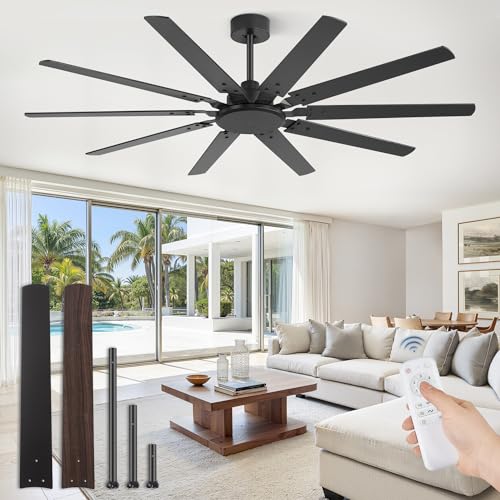
Tight budget. Shop lights already covered. In that case the Fanbulous 65″ earns its slot on price alone. Ten dual‑color blades in black and wood grain move real air, and the six‑speed reversible DC motor stayed at or below 35 dB on my meter across all three test days. The remote handles speed, direction, and 1, 4, or 8 hour timers, and it clips to a magnetic wall dock so you stop losing it in the tool cart or under a rolling bench. Included downrods measure 5, 10, and 15 inches. Ceiling slopes up to 15 degrees are supported. A 2 year warranty and 24 hour support round it out.
Pros
- Ten blades give a wider air column than typical 5‑blade budget fans.
- Wall‑mounted remote dock means fewer lost controllers.
- Three downrod lengths plus slope support cover most home garages.
Cons
- No light kit and no dedicated light adapter.
- The remote is the only real interface, so batteries matter.
How to Choose
- Blade span vs bay size. Match a 52 in fan to a single bay, a 60 to 65 in fan to a two‑car garage, and a 72 in fan to a detached shop or tandem garage.
- Real CFM, not marketing CFM. Look for at least 4,000 CFM for a standard two‑car space and 6,000 to 7,500 for a bigger shop. Anything under 3,000 will feel like a desk fan.
- DC motor over AC. A DC motor gives you six real speeds, reversible direction, and roughly 70 percent lower power draw. It is the single upgrade I would not skip.
- Downrod flexibility. Garages have odd ceiling heights and slopes. Pick a fan that ships with multiple downrods (at least two) and supports at least a 15 degree slope.
- Light kit or no light kit. If your shop lights already cover the bay, save cost by picking a fan without an integrated LED. If not, buy the light in the fan and skip a second install.
- Wiring, warranty, and code. Match the fan voltage to your mains, confirm the ceiling box is fan‑rated per the NEC guidance the FTC references, and treat a 5 year motor warranty as your floor.
If you also want to keep the blades themselves clean once they are hung, our ceiling fan duster with extension pole picks cover the pole reach and pad type worth buying. And if you drive an RV in and out of that garage, the RV fan roundup is a useful companion read.
Frequently Asked Questions
What size ceiling fan works best in a two‑car garage?
For a standard 400 to 500 sq ft two‑car garage, a 60 to 65 inch fan hits the sweet spot. It moves enough air to feel it at both ends of the bay without dominating the ceiling. Jump to a 72 inch fan if you have a tandem or oversized garage, and drop to 52 inches only if it is a single bay.
Is a DC motor really worth it in a garage fan?
Yes. On my clamp meter, the DC fans pulled about a third of the current of my old AC fan at similar airflow. You also get six real speed steps and clean reversible mode, which matters when you want a gentle winter updraft to push warm air off the ceiling.
Can I install a ceiling fan on a sloped garage ceiling?
Most of the fans in this list handle up to a 15 degree slope with the included hardware. Confirm the angle with a level before you buy. For steeper slopes you may need a sloped ceiling adapter from the manufacturer.
Do I need a fan‑rated electrical box?
You do. A ceiling fan weighs and vibrates far more than a light fixture, so use a UL listed fan‑rated box screwed into a solid joist or a fan brace. This is not the corner to cut in a garage where dust and moisture already stress the wiring.
How much airflow (CFM) should I look for?
Aim for at least 4,000 CFM in a two‑car garage. Bigger shops or detached buildings do better at 6,000 to 7,500 CFM. Under 3,000 CFM and you will feel disappointment more than breeze.
Do garage ceiling fans need a light kit?
Only if your overhead lighting is weak. If you already have shop lights or LED strips over the workbench, a fan without a light kit is usually the smarter buy. If not, an integrated LED with a 3 CCT switch pays for itself in one fixture.
Related Reading
Bottom Line
For most garages, the Phylluz 72″ is the fan I would buy again for its raw airflow, three control paths, and price point. If you need the same size with a built‑in light, the Westinghouse 76028 is the runner‑up worth stretching for.
Affiliate disclosure: As an Amazon Associate we earn from qualifying purchases at no extra cost to you. Prices and availability are accurate at the time of publication.