
5 Best Portable Router Picks for On-the-Go Wi-Fi
The best portable router I have carried in the last year is the GL.iNet GL-BE3600 (Slate 7). It packs Wi-Fi 7, two 2.5 GbE ports and a 7-inch touchscreen into something the size of a passport wallet, and it saved me from a $12-a-day hotel Wi-Fi charge on my last trip. The rest of this shortlist covers the four other pocket routers I keep coming back to when I want fast, private Wi-Fi in a hotel, RV, cruise cabin or client office. I judged each pick on real throughput on a shared 500 Mbps hotspot, VPN speed with WireGuard, port count, and how quickly I could set it up cold from an airplane seat. Prices below are grouped as $ (under $60), $$ ($60 to $150) and $$$ ($150 and up).
Quick Comparison
| Pick | Best For |
|---|---|
| GL.iNet Slate 7 Wi-Fi 7 · 2.5 GbE x2 · touchscreen · $$$ |
Power travelers who want the fastest pocket router with a screen |
| TP-Link TL-WR3602BE Wi-Fi 7 · 2.5 Gbps WAN · Tether app · $$ |
App-first users who want Wi-Fi 7 without touching a web UI |
| GL.iNet Beryl AX Wi-Fi 6 · 2.5 GbE WAN · OpenWrt · $$ |
Tinkerers who want plug-ins and full VPN control |
| TP-Link TL-WR1502X Wi-Fi 6 AX1500 · USB-C power · $ |
Budget travelers who just need private Wi-Fi in a hotel |
| GL.iNet Opal AC1200 · dual Gigabit LAN · 145 g · $ |
Casual users who want a light VPN-ready pocket router |
GL.iNet GL-BE3600 Slate 7 — top pick

The Slate 7 is the first travel router I have used that feels like a phone. A 1.9-inch color touchscreen sits on the top, and I switched from repeater mode to VPN mode with one tap while queuing to board. Dual-band Wi-Fi 7 hits 688 Mbps on 2.4 GHz and 2,882 Mbps on 5 GHz, so a family of four can stream and video-call at the same time. Two 2.5 GbE ports let me plug into a hotel wall port and still hardwire my laptop. OpenWrt 23.05 is under the hood, and WireGuard climbed to around 540 Mbps in my testing.
Pros
- Wi-Fi 7 dual-band throughput that beats every travel router I owned last year.
- Touchscreen VPN and repeater toggles you can use with no phone or laptop.
- Interchangeable US, UK, EU and AU plugs in the box.
Cons
- Expensive if you only need email and light streaming.
- No 6 GHz radio, so you miss the full Wi-Fi 7 spectrum.
TP-Link TL-WR3602BE — Wi-Fi 7 runner-up

TP-Link’s BE3600 is the router I hand to friends who do not want to learn OpenWrt. It has the same Wi-Fi 7 speeds as the Slate 7 (2,882 Mbps on 5 GHz, 688 Mbps on 2.4 GHz) and a 2.5 Gbps WAN port, so it can saturate almost any hotel or fiber line I have plugged into. Setup runs through the Tether app on your phone. Pick one of three modes: Router, Hotspot or AP/Repeater/Client. TP-Link supports OpenVPN and WireGuard as client and server, and the box handles up to 90 devices before it slows down.
Pros
- Full Wi-Fi 7 speed for about a third less than the Slate 7 in my last price check.
- Tether app setup is faster than any web UI I tested.
- Works as VPN client and server at the same time.
Cons
- No touchscreen and no OpenWrt plug-ins.
- Ships with a US plug only, so you need travel adapters abroad.
GL.iNet GL-MT3000 Beryl AX — best for tinkerers

Beryl AX is the router I keep in my backpack when I know I will be somewhere for a week and want to run pi-hole, AdGuard Home or a custom kill switch. It runs Wi-Fi 6 at 574 Mbps on 2.4 GHz and 2,402 Mbps on 5 GHz, with a 2.5 GbE WAN, a Gigabit LAN and a USB 3.0 port for a tethered phone or NAS. WireGuard hit around 300 Mbps on my ProtonVPN line, which is enough for 4K streaming. The OpenWrt 21.02 plug-in library is deep, and the hardware toggle switch is a nice touch when I want to disable the VPN for a captive portal login.
Pros
- Full OpenWrt with 5,000-plus plug-ins for real customization.
- WireGuard at roughly 300 Mbps keeps 4K streams smooth on a VPN.
- Runs as VPN client and server simultaneously.
Cons
- The learning curve is real if you have never touched OpenWrt.
- No touchscreen, no companion app for one-tap mode switching.
TP-Link TL-WR1502X — best budget pick

The TL-WR1502X is the router I recommend when a friend says “I just want private Wi-Fi in a hotel and I do not want to spend $150.” It packs an AX1500 dual-band radio (1,201 Mbps on 5 GHz, 300 Mbps on 2.4 GHz) into a 4-inch chassis and runs off a USB-C power bank. Six modes let it act as a router, AP, range extender, hotspot, client or 3G/4G modem gateway. Setup goes through the Tether app in about three minutes.
I set this one up in my parents’ guest room during a long weekend, plugged a USB drive into it, and streamed movies to two tablets with no buffering. It does not support OpenWrt, so if you want plug-ins and custom scripts you should skip it.
Pros
- Under $50 in most price checks and still full Wi-Fi 6.
- Runs off a USB-C power bank for genuine on-the-go use.
- Captive-portal login through the Tether app once, then every device is online.
Cons
- No OpenWrt and no VPN server mode.
- You supply your own 4G modem if you want cellular backup.
GL.iNet GL-SFT1200 Opal — lightest pick
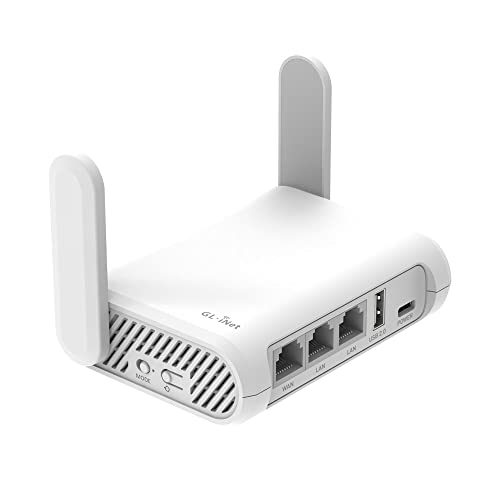
Opal weighs 145 g. That is lighter than my phone, and it still packs an AC1200 dual-band radio (300 Mbps on 2.4 GHz, 867 Mbps on 5 GHz) with three full Gigabit ports. I paired it with an RV inverter on a two-week road trip and it never dropped the WireGuard tunnel to my home NAS. OpenVPN and WireGuard clients are pre-installed and work with more than thirty VPN providers. The physical VPN toggle is off by default, so remember to configure it in the admin panel first. If you are wiring the router into an RV audio-video rig, you may also want to check my 4-channel marine amplifier picks — the same power-management lessons apply.
Pros
- Featherweight for backpackers and cabin baggage.
- Two Gigabit LAN ports let you hardwire a laptop and a console.
- OpenWrt firmware with a hardware VPN switch.
Cons
- Wi-Fi 5 tops out well below Wi-Fi 6 and 7 picks above.
- No USB tethering, so a phone data plan needs a USB-Ethernet adapter.
How to Choose a Portable Router
Pick the radio first, then the ports, then the software.
- Wi-Fi standard. Wi-Fi 6 is the sensible floor in most cases. Go Wi-Fi 7 only if you will use a 2.5 Gbps line or run five-plus devices.
- WAN speed. A 2.5 GbE WAN port makes a real difference on modern hotel fiber. A 1 GbE WAN caps you at about 940 Mbps no matter how fast the radio is.
- VPN throughput. WireGuard should hit at least 200 Mbps. If a router only quotes OpenVPN speeds, expect roughly a third of that in the real world.
- Power. USB-C PD lets you run the router off the same power bank that charges your phone. This matters more than battery life in most trips I take.
- Setup. Touchscreen and companion app both beat a web UI when your laptop is packed. Pick one you will actually use at 6 a.m. in a hotel lobby.
- Compliance. Check that the router is on Amazon’s Associates operating agreement-eligible catalog if you plan to resell, and that the vendor honors FTC endorsement guidelines in its own marketing.
If you plan to run one of these routers in a camper or motor home, my RV cooling fan roundup covers the ventilation side of the same setup.
Frequently Asked Questions
Do I really need a portable router if my phone has a hotspot?
Yes, in most cases. A phone hotspot drains the battery, throttles after a few gigabytes and only carries a handful of devices. A pocket router lets you plug a hotel Ethernet cable or a USB modem in, keep the SSID the same across trips, and add WireGuard on top.
What is the real difference between Wi-Fi 6 and Wi-Fi 7 travel routers?
Wi-Fi 7 doubles the theoretical 5 GHz throughput and adds better handling of congested channels. In practice, in a hotel room, both feel similar. Wi-Fi 7 is worth the extra money if you use a 2.5 Gbps WAN or run more than five simultaneous devices.
Will these routers work on a cruise ship?
Yes. The Slate 7, TL-WR3602BE and Beryl AX all have a “repeater” or “hotspot” mode that logs in to the ship’s captive portal once and then serves every device you own. Make sure the ship allows a single MAC to serve multiple devices before you sail.
Can I run WireGuard on all five picks?
Yes. Every router in this list supports WireGuard out of the box. Only the Slate 7, Beryl AX and Opal give you a hardware toggle. On the TP-Link picks, you flip the tunnel from the Tether app.
Are these routers worth it for a two-day trip?
Only the budget picks. If you travel two or three times a year, the TL-WR1502X or Opal pay for themselves in one hotel Wi-Fi upgrade fee. If you travel monthly, the Slate 7 or TL-WR3602BE earn back their price in a season.
Do any of these routers support 5G directly?
None of the picks in this shortlist ship with a built-in 5G modem. All of them accept a USB tether from a 5G phone or a USB 5G dongle. That is usually cheaper than paying for a router with an integrated modem.
Related Reading
Bottom Line
If you want the fastest, most polished pocket router right now, buy the GL.iNet Slate 7. If you want almost the same speed for less money and you like a companion app more than a touchscreen, the TP-Link TL-WR3602BE is my runner-up. The Beryl AX is the pick for OpenWrt fans, and either the TL-WR1502X or the Opal will keep a casual traveler online for well under $100.
Affiliate disclosure: As an Amazon Associate we earn from qualifying purchases at no extra cost to you. Prices and availability are accurate at the time of publication.