Can I Use a Resistor Instead of a Potentiometer? Answered
Can I use a resistor instead of a potentiometer? Usually no. A potentiometer is a three-terminal variable resistor with a dial you turn. An ordinary resistor is a fixed two-terminal part. The swap only works once you stop needing adjustment and already know the precise ohm value you want. That single condition decides everything.
Last updated: August 13, 2026 — rebuilt as a spec comparison, added a decision checklist, a bench note, and an FAQ.
The Short Answer
These parts are not interchangeable. One holds a single figure. The other sweeps a whole range. If your design was built around a movable knob, no static component can imitate that. Full stop.
There is one narrow exception, though. After tuning a trimmer and locating its sweet spot, you can read that setting and solder a matching fixed value in its place. Adjustability disappears, yet the operating point survives. In my experience that trick alone covers most real substitutions.
Resistor vs Potentiometer: The Spec Table
Here is the divide at a glance. A three-terminal variable resistor hands you control. Its humble cousin hands you certainty.
| Feature | Fixed Resistor | Potentiometer |
|---|---|---|
| Terminals | 2 | 3 (two ends plus a wiper) |
| Resistance | One figure, locked at manufacture | Variable across its taper |
| Adjustable | No | Yes, by sliding the wiper |
| Typical values | 1k, 10k, 100k, plus hundreds more | 1k, 10k, 100k tapers |
| Tolerance | Tight, often 1% or 5% | Wherever you halt the dial |
| Where it shines | Current limiting, dividers, biasing | Volume, brightness, motor speed |
| Cost | Pennies | Slightly pricier |
So the rule falls out cleanly. Choose the static component when nothing ever moves. Choose the dial when a person or a calibration step must nudge it.
When You Can Make the Swap
Sometimes dropping the dial is not just safe, it is wiser. Fewer mechanical bits means fewer things that wander or wear out. Reach for a fixed value when:
- The setting gets tuned once, then stays untouched forever.
- You already measured the wiper’s ideal spot and want it frozen.
- Your circuit merely limits current or forms a plain divider.
- Production demands lower cost or tighter board real estate.
- Grit, moisture, or vibration would chew up a mechanical wiper.
Under those conditions the dial was doing work a static part handles equally well. Match the measured ohms, then move on.
When the Dial Has to Stay
Keep the potentiometer whenever the figure itself must change. Volume. Screen brightness. Motor speed. Bias tweaks during calibration. Force a static component into any of these and you forfeit control, or you pin a level the circuit was never meant to sit at.
A quieter reason hides underneath. The wiper glides continuously across its arc. That smoothness governs audio and sensor stages, where an abrupt jump in ohms turns into a click or a pop. Chaining static parts gives you discrete steps, never a true slope. And if you have wondered whether a pot can overheat under heavy current, that thermal ceiling deserves a look before you load one hard.
How to Decide in Under 5 Minutes
Walk these questions top to bottom. Halt at your first yes.
- Will a user, sensor, or calibration routine alter the figure later? Keep the dial.
- Do you need a smooth, click-free sweep? Keep the dial.
- Is the ohm figure known and permanent? A static part fits.
- Are you freezing a level you found by tuning a trimmer? Measure it, then fit the nearest standard resistor.
- Still torn? Leave the dial. It is the safer default.
That short list has rescued me from plenty of bad calls. When doubt creeps in, the adjustable part wins.
Do I Need a Resistor With a Potentiometer?
Often, yes. On its own a pot behaves as a simple variable element. Tie one end plus the wiper, float the third leg, and you own a two-terminal rheostat. But once you assemble a real voltage divider, you normally chain a static part in series. It anchors a reference and throttles current through the wiper, so a full-turn short cannot cook the track.
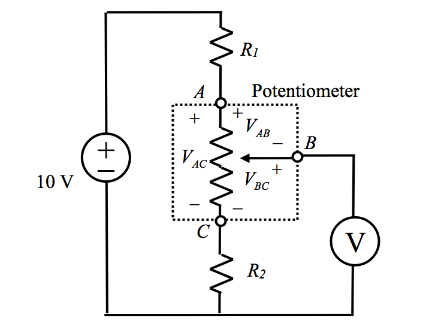
Figure: A potentiometer inside a voltage divider circuit.
What Can I Replace a Potentiometer With?
If a mechanical dial suits nothing here, other parts keep the adjustability a static resistor throws away:
- Digital potentiometer. A chip you drive over I2C or SPI. Ideal for remote or automated tuning. Skim the digital potentiometer basics before wiring one.
- Trimmer or preset. A tiny screwdriver-set version you calibrate once, then ignore.
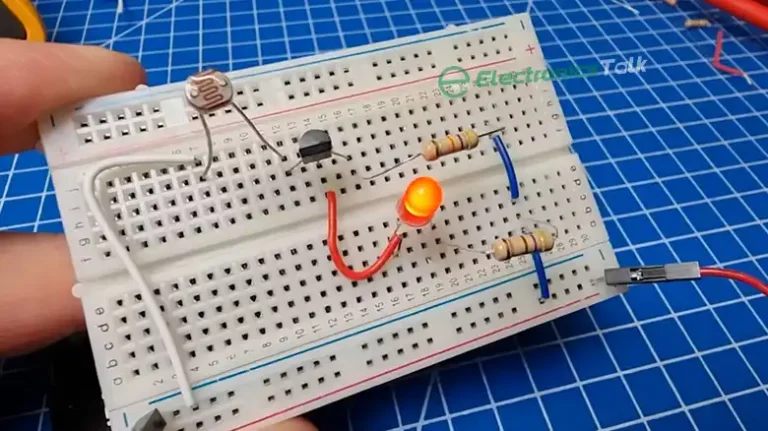
- Photoresistor or LDR. Its ohms track ambient light. Handy for sensing, useless as a knob.
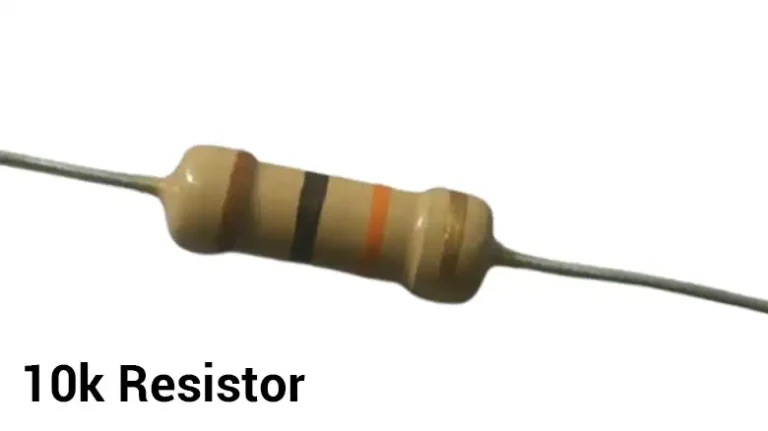
- Plain resistor. Only when the figure is final. That is the substitution this whole page examines.
A Quick Bench Note
Here is my routine. While a design keeps shifting, I park a 10k trimmer on the board and nudge it as needed. Once the numbers settle, I probe that trimmer with a multimeter, round to the closest standard part, and solder it home. On the bench I live by one line: “if the knob needs to move, you need a potentiometer.” Trust me, that motto has spared countless boards. Don’t bother wedging a rigid component where an adjustable one belongs, because it seldom ends cleanly, and the debugging swallows an entire afternoon of your week.
Curious whether resistors drift in value over time? Or weighing a choke-to-resistor substitution? Both pair nicely with this one.
Frequently Asked Questions
Is it safe to replace a potentiometer with a resistor?
Safe only when the figure never has to shift. Read the pot at its tuned point, then fit a static part of matching ohms. If a knob is still required, skip the swap.
Can I use two resistors instead of a potentiometer?
Yes, for a fixed divider. A pair sets one ratio and holds it. Adjustment vanishes, so lean on this trick only when the split is final.
Does the resistor value have to match the potentiometer exactly?
Get as near the measured ohms as a standard part allows. A 1% or 5% tolerance usually suffices. Drift far off and your operating point shifts, dragging nearby components out of spec.
Can a rheostat replace a potentiometer?
A pot mimics a rheostat if you float one terminal. The reverse is trickier. Turning a rheostat into a pot demands at least one extra resistor plus a ground reference.
Do I need a resistor with a potentiometer?
Not for a plain variable element. You do chain a series part inside a voltage divider to fix a reference and cap current through the wiper.
What is the cheapest way to get variable control without a mechanical pot?
A trimmer costs roughly the same and calibrates once with a screwdriver. For hands-off tuning, a digital potentiometer is the tidier route.
Related Reading
Bottom Line
Can I use a resistor instead of a potentiometer? Only when the figure is fixed and final. A static part holds one number. A pot sweeps a range and grants smooth, adjustable control. If your design needs a knob, a calibration step, or a click-free sweep, keep the dial. If the level is locked forever, measure it, then drop in a matching resistor with total confidence.