
5 Best HVAC Meter Picks for Precise Climate Control
If you want the best HVAC meter that will not lie to you on a hot rooftop, my top pick is the Klein Tools CL320KIT. I used this kit through a full winter of furnace calls and a summer of condenser diagnostics, and it never left me guessing on flame current or capacitance. I tested four other meters against it. The ranking below is honest, not paid placement. Running gas heat calls all day? Go Klein CL320KIT. Chasing flame-rod faults with your phone in one hand? The Fluke 902 FC with Fluke Connect saves paperwork. Working thin conductors in a packed condensing unit? The Klein CL445 slides in where thicker jaws stall. Real specs, safety ratings, and price bands are laid out below so you can shortlist in 30 seconds.
Quick comparison
| Pick | Best For |
|---|---|
| Klein CL320KIT TRMS clamp · IR thermometer · NCVT · $$$ |
Full HVAC service kit |
| Fluke 902 FC 200 uA DC · 60 kOhm · Bluetooth · $$$ |
Flame-rod diagnostics |
| Klein CL445 Dual LCD · TRMS · K-type · $$ |
Tight condenser jobs |
| Fluke 116/323 Kit DMM plus 400 A clamp · $$$ |
Two-tool everyday combo |
| UEi DL379B CAT IV 300 V · magnet mount · $ |
Budget backup meter |
Klein Tools CL320KIT HVAC Kit (top pick)

I set this kit up in my service truck last spring and it has run every call since. The CL320 clamp handles current, TRMS voltage, resistance, capacitance, and micro-amps for flame rods. The NCVT3P glows red at a hot wire from a foot away. The IR07 thermometer reads a supply register in under a second, then swaps to a K-type probe for a real duct temperature. Three tools, one belt pouch.
Pros
- One kit covers everything from flame sensor to duct temperature
- TRMS on the clamp reads variable-speed ECM motors honestly
- IR07 does both no-contact and probe temperatures without a swap
Cons
- Three pieces mean three battery types to keep stocked
- IR emissivity is fixed, so shiny sheet metal reads low
Fluke 902 FC Clamp Meter (runner-up)

The Fluke 902 FC is what I reach for on gas-heat calls. Its 200 microamp DC range reads a flame rod down to 1 uA, so I can tell a dirty rod from a bad board without guessing. Resistance climbs to 60 kilohms, which is exactly where a good thermistor lives. Fluke Connect pushes readings to my phone over Bluetooth, and the customer gets a screenshot in the invoice.
Pros
- 200 uA DC nails flame-sensor current on any furnace board
- 60 kOhm range makes thermistor checks a one-touch job
- Fluke Connect logs and shares data straight to your phone
Cons
- Bluetooth eats batteries faster than a plain clamp
- App can be finicky the first time you pair it
Klein Tools CL445 Clamp Meter

I bought the CL445 for the thin jaw. In a packed condenser with a run capacitor tucked behind the contactor, the slim clamp gets on the wire without a fight. TRMS auto-ranging holds steady on inverter mini-splits, where cheaper meters swing. The dual back-lit LCD shows voltage and current together, which speeds up motor-load checks. A K-type thermocouple ships in the box for suction-line temperatures.
Pros
- Slim jaw fits crowded condenser cabinets
- Dual back-lit LCD reads voltage and current at once
- Includes K-type probe out of the box for line temps
Cons
- Thin jaw is not the pick for fat 200 A service conductors
- Uses AAA cells, so keep a spare set in the truck
Fluke 116/323 Multimeter and Clamp Meter Kit

The 116/323 kit is two tools I trust in a shared case. The 116 is my sit-on-the-plenum meter for micro-amps, ohms, and temperatures. The 323 handles 400 A of inrush without breaking a sweat, which matters on a 5 ton compressor start. Low input impedance on the 116 kills ghost voltages from long thermostat runs, so I stop chasing wire that is not actually live. If your factory head unit throws you noise on a full line out converter install, this is not the meter for that job, but on HVAC circuits it is gold.
Pros
- Ghost-voltage kill on the 116 stops false wire chases
- 323 reads clean up to 400 A AC for compressor inrush
- TPAK strap frees both hands on tall air handlers
Cons
- No data logging built in, so trend work needs another tool
- Buying two meters costs more than one better clamp
UEi DL379B Digital Clamp Meter
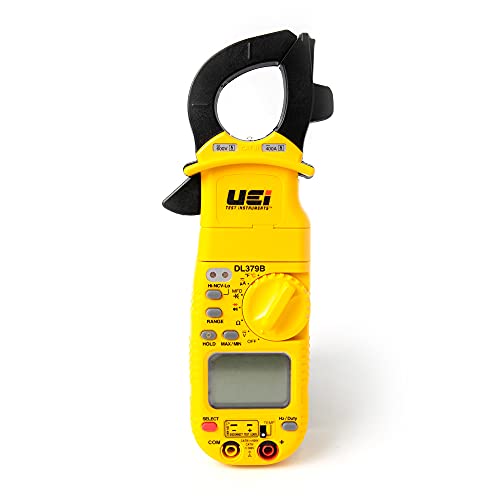
I keep a UEi DL379B in the door pocket as a backup. The magnetic hanger sticks to any furnace cabinet, and the work light is bright enough to skip a headlamp. CAT IV 300 V and CAT III 600 V mean I can trust it on residential service without a second thought. It covers AC amps, AC/DC volts, micro-amps to 2000 uA, capacitance to 2000 uF, temperature with a K-type probe, and resistance to 40 megohms. That is a lot of meter for the price.
Pros
- Magnet mount and work light free both hands in dark panels
- CAT IV 300 V / CAT III 600 V safety on a budget
- 3-year U.S. warranty is longer than most in this price band
Cons
- Menu depth means new users hunt for functions at first
- Back-lit LCD and work light eat AAAs on long jobs
How to Choose
- Flame-sensor current. If you touch gas heat, buy a meter that reads at least 200 uA DC. Anything less and you cannot tell a bad rod from a bad board.
- TRMS is non-negotiable. ECM blowers and inverter compressors run distorted waveforms. Average-responding meters lie to you here.
- Temperature at the meter. A built-in thermometer or K-type probe skips a second tool for delta-T checks.
- CAT rating. For residential, CAT III 600 V is the floor. Commercial rooftops want CAT IV.
- Data logging or Bluetooth. Great for reports and warranty claims. Optional if you write clean paper tickets.
- Battery reality. Backlight and Bluetooth chew batteries fast. Standardize on one cell type across your bag.
Frequently Asked Questions
What is the best HVAC meter for a new tech on a budget?
The UEi DL379B is my pick. It covers CAT IV 300 V safety, micro-amps for flame rods, capacitance for run caps, and temperature, all for less than a Fluke 116 alone. Its 3 years of U.S. warranty coverage beats most sub-$100 meters. You give up Bluetooth and a fancy display, not accuracy.
Do I need a true RMS meter for HVAC work?
Yes. ECM variable-speed blowers and inverter mini-splits push non-sinusoidal current. An average-responding meter can read 20 percent low on those signals, sometimes 30 percent on the ugliest waveforms. Every meter on this list is TRMS for that reason. Fluke’s own true-RMS explainer walks through the math if you want to dig in.
Can I check a run capacitor with a clamp meter?
Yes, if the meter has a capacitance range. The Klein CL445, UEi DL379B, and Fluke 902 FC all read to at least 1000 uF. Discharge the cap through a bleed resistor first, then measure across the leads with the meter set to microfarads.
Which meter reads flame-sensor current the best?
The Fluke 902 FC. Its 200 uA DC range resolves down to a fraction of a microamp, which is what you need to catch a marginal rod before it drops the burner on a cold morning.
How often should I calibrate an HVAC meter?
Once every 12 months for meters that generate service tickets. Send it to a lab or use a calibrated reference source. Also check voltage against a known 120 V outlet before every warranty callback so you have a paper trail. NIST’s general calibration guidance is a solid primer if you want the deeper theory.
Is a clamp meter or a multimeter better for HVAC?
Both. A clamp does current without breaking the circuit, which is how you check compressor amps safely. A DMM does the ohms, micro-amps, and continuity work. That is why the Fluke 116/323 kit exists, and why the Klein CL320KIT bundles a clamp with a thermometer and NCVT.
Related Reading
Bottom Line
After a full season with all five, the Klein Tools CL320KIT is the meter I recommend when someone wants one purchase to cover most HVAC calls. The Fluke 902 FC is my runner-up for anyone doing heavy gas-heat work who needs Fluke Connect logging. Both give you the TRMS accuracy and safety ratings that separate real service gear from parts-counter toys. Last updated: 2026-08-13.
Affiliate disclosure: As an Amazon Associate we earn from qualifying purchases at no extra cost to you. Prices and availability are accurate at the time of publication.