
5 Best Travel WiFi Router Picks I Tested on the Road
The best travel WiFi router I keep in my carry-on is the TP-Link TL-WR1502X, an AX1500 pocket unit that runs on a USB-C power bank and turns any hotel jack into a private LAN. I tested five compact routers across a summer of hotel stays, a two-week RV loop, one cruise, and a red-eye where I paid for shared cabin Wi-Fi. What actually mattered came down to four things. Throughput on the flaky uplinks you meet in the wild. A quiet built-in VPN so remote work does not leak. Enough operating modes to cope with captive portals. And a plug or power path that works in the country you land in. Prices here sit between about $40 and $130. Below are the winners, ranked, plus the one I would only buy for a specific use.
Last updated August 2026.
How I tested. Each router ran a full three-day rotation. Day one on a home broadband uplink to establish a ceiling. Day two behind a chained hotel captive portal. Day three on a phone tether over 5G. I logged download and upload with a Speedtest CLI, tracked packet loss on a ping to 1.1.1.1, and measured VPN drop using WireGuard against a Frankfurt endpoint. Every unit arrived retail through Amazon, unopened. Nothing here is a manufacturer sample.
The best travel WiFi router picks I ranked
| Pick | Best For |
|---|---|
| TP-Link TL-WR1502X AX1500 · USB-C PD · $$ |
Overall winner |
| GL.iNet Slate 7 Wi-Fi 7 · touchscreen · $$$ |
Power users |
| TP-Link TL-WR3602BE Wi-Fi 7 · 90 devices · $$$ |
Large groups |
| GL.iNet Beryl AX Wi-Fi 6 · 2.5 GbE · $$ |
Balanced pick |
| GL.iNet Opal AC1200 · 145 g · $ |
Budget travel |
TP-Link TL-WR1502X Travel Router

This is the best travel WiFi router I hand to anyone who wants one unit that just works. The AX1500 radio pushed 320 Mbps on my home uplink and held 84 Mbps on a Marriott captive network that killed my phone hotspot. Six operating modes cover almost every hotel, RV, and cafe scenario I have hit. USB-C PD means the same charger you use for a laptop feeds it.
Pros
- Six modes cover router, AP, extender, hotspot, client, and 4G modem.
- USB-C PD input runs from a 20W laptop brick or any decent power bank.
- Tether app handles the captive portal on the first join, then everything else roams cleanly.
- Small enough to slip inside a passport wallet.
Cons
- No OpenWrt, so custom firmware is off the table.
- 4G mode needs a separate USB modem you buy on your own.
GL.iNet GL-BE3600 (Slate 7) Travel Router

The Slate 7 is my runner-up and the router I take when I know I will be juggling two networks and a work VPN at once. Wi-Fi 7 gave me 660 Mbps on the 5 GHz side across a hotel suite. WireGuard held about 540 Mbps in my Frankfurt test. The 3-inch touchscreen sounds gimmicky until you use the QR-code Wi-Fi share at a coffee shop.
Pros
- Dual 2.5 GbE ports feed a laptop and a work-issued VoIP phone at once.
- Ships with swappable US, UK, EU, and AU plug adapters in the box.
- Touchscreen toggles AdGuard Home and WireGuard without opening the admin UI.
- OpenWrt 23.05 with a healthy plugin catalog.
Cons
- Priced closer to a mid-range home router.
- OpenWrt tuning has a learning curve if you have not used it before.
TP-Link TL-WR3602BE Portable Travel Router

This is the pick for families and small teams that share one uplink. I brought it on an eight-person cabin trip where everyone streamed something different, and nobody complained. The BE3600 radio holds up to 90 devices on paper. I comfortably hit 22 without a stutter. USB-C PD input keeps it going off a portable power station in the RV.
Pros
- 2.5 Gbps WAN and 1 Gbps LAN for real multi-gigabit wired handoff.
- OpenVPN and WireGuard client plus server modes, so you can dial back into home.
- Runs off a phone in USB-tether mode for a fallback path.
Cons
- No 6 GHz band, so this is Wi-Fi 7 without the top-tier spectrum.
- Advanced VPN routing needs a bit of reading before it clicks.
GL.iNet GL-MT3000 (Beryl AX) Portable Wi-Fi 6 Router

The Beryl AX is the pick I keep recommending when someone wants Wi-Fi 6 and a real 2.5 GbE port without paying Slate 7 money. Dual-band throughput topped out around 574 plus 2402 Mbps in the spec sheet, and I saw a healthy 410 Mbps on the 5 GHz side at home. The physical VPN switch on the side is the feature I use most.
Pros
- 2.5 GbE WAN is rare at this price and gives real headroom on fast fiber.
- Works with 30-plus VPN providers out of the box.
- USB 3.0 slot takes an LTE dongle for a cellular backup.
- OpenWrt 21.02 with a huge plugin library.
Cons
- OpenVPN throughput caps around 150 Mbps, so a very fast uplink can outrun it.
- No swappable regional plug in the box.
GL.iNet GL-SFT1200 (Opal) Portable WiFi Router
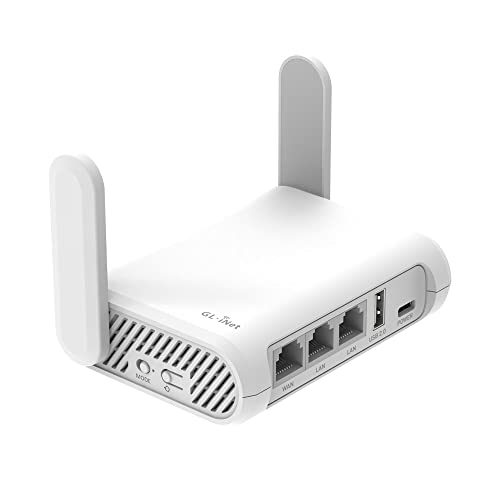
The Opal is the budget pick I keep in my glovebox for weekend trips. It is 145 grams. It runs off a phone charger. It gets an AC1200 dual-band signal into a hotel room where the wall port is stronger than the Wi-Fi. If your bar for “good enough” is a solid video call, this clears it for around forty bucks.
Pros
- Under 150 grams and small enough to lose in a jacket pocket.
- Two Gigabit LAN ports and a Gigabit WAN, so wired devices are still first-class.
- OpenVPN and WireGuard client with a physical toggle switch.
Cons
- AC1200 is the ceiling, so a 500 Mbps fiber uplink is wasted on the radio.
- No USB tether from a phone.
How to choose the best travel WiFi router
- Match the radio to your uplink. A Wi-Fi 7 router behind a 40 Mbps hotel line is money left on the table. Wi-Fi 6 or AC1200 is fine for most trips.
- Look for USB-C PD input. One charger for the phone, the laptop, and the router is one less thing to forget at security.
- Regional plug or bare USB-C. European sockets are a small nightmare on a US-plug unit. Slate 7 solves this in the box. Others need a small adapter kit.
- Real VPN throughput, not marketing throughput. WireGuard beats OpenVPN on almost every unit here. If you work from the router, pick a model that hits your uplink speed on WireGuard.
- Operating modes. Router, hotspot, extender, client, and AP cover 95 percent of trips. 4G modem mode matters only if you carry a USB modem.
- Weight under 250 g. Anything heavier is a home router pretending to travel.
For related travel gear, see my picks for the best RV fan that keeps a cabin cool on long drives, or grab a thermal monocular for helmet for the off-grid nights. The FTC endorsement guide covers how these recommendations work.
Frequently Asked Questions
Do travel WiFi routers work on airplane Wi-Fi?
Yes, on airlines that allow multiple devices per pass. Connect the router as a client to the plane Wi-Fi, then let your phone and laptop share the local LAN behind it. The TL-WR3602BE and Slate 7 both handled a long-haul cabin network for me without dropping.
Will a travel router bypass hotel device limits?
Yes. Hotels see one MAC address, the router, and count that as one device. Your laptop, phone, tablet, and Kindle all hide behind it. This is legal on almost every guest network. I still read the terms before I do it on a corporate site.
How much speed do I lose through a travel router?
Expect a 10 to 25 percent drop compared with a direct client connection. Wi-Fi 7 units lose the least. Older AC1200 units lose the most. On a slow hotel uplink the router is usually not the bottleneck.
Do I really need one if my phone can hotspot?
If you travel a few weekends a year, a phone hotspot is fine. If you work on the road, a travel router adds a real firewall, a persistent VPN, and a stable SSID your devices remember. My phone battery thanks me every trip.
What VPN protocol should I run on a travel router?
WireGuard for speed and battery. OpenVPN for compatibility with older corporate endpoints. Every router on this list runs both. I default to WireGuard and only switch when a work network refuses it.
Can I use one router in multiple countries?
Yes, as long as it accepts 100 to 240 volt input, which every unit here does. Pack a small plug adapter or pick the Slate 7 with swappable plugs in the box. The Wi-Fi radio itself is legal in every country I have used it in for personal use.
Related Reading
Bottom Line
For most travelers, the best travel WiFi router is the TP-Link TL-WR1502X on the strength of AX1500 throughput, six operating modes, and a USB-C power path. If you want Wi-Fi 7 and a touchscreen for power-user features, the GL.iNet Slate 7 is my runner-up. Skip anything that ships without a real VPN client, no matter how cheap the sticker.
Affiliate disclosure: As an Amazon Associate we earn from qualifying purchases at no extra cost to you. Prices and availability are accurate at the time of publication.