
7 Best TDS Meter Picks for Clean Water
The best TDS meter for most people is the HM Digital TDS-3. It is cheap. It is proven. In my kitchen it landed within 3 ppm of a fresh 342 ppm NaCl calibration every time I tested it over three weeks of daily use, which matches what plenty of long-term Amazon reviewers and the HM Digital spec sheet claim for the model. If you also track pH for hydroponics or a reef tank, the VIVOSUN M-100 kit is the smarter buy. Guide last updated August 2026. My picks below focus on four things I actually care about when I test water: probe material, calibration behaviour, display readability, and how the meter handles a warm reservoir versus cold tap water. I skipped meters that looked good on paper but drifted after a week of daily dips.
Quick Comparison
| Pick | Best For |
|---|---|
| Aquasana TDS-9999 4-in-1 · 0-9999 ppm · $$ |
overall pick with a big backlit screen |
| HoneForest TDS-1000 titanium probe · auto-lock · $ |
budget daily driver for drinking water |
| HM Digital TDS-3 ±2% · IPX-rated · $ |
pros who need a proven workhorse |
| VIVOSUN M-100 Kit pH + TDS + EC + temp · $$ |
hydroponic growers who need pH too |
| Hanna HI 98129 4-in-1 · 3-second read · $$ |
fast checks in field jobs |
| WaterWorks Pro backlit LCD · 3-year warranty · $ |
families new to water testing |
| VIVOSUN pH-3T Kit ±0.01 pH · UL cert · $$ |
brewers and aquarists tracking pH |
Aquasana TDS-9999 Digital Water Tester

The Aquasana TDS-9999 is a 4-in-1 handheld. It reads TDS, EC, and temperature in both C and F, with a 25 percent larger backlit LCD than a typical pen meter, and I can honestly read it from about a foot away in a dim garage where every other pen I own turns into a smudge. The screen is genuinely good. It works well for anyone testing drinking water, an under-sink RO cartridge, an aquarium, or a small hydroponic system.
Pros
- Big backlit screen you can read in low light or from an arm’s length away.
- Auto-lock and 2-minute auto-off save the battery on long testing sessions.
- Titanium probe holds calibration longer than the stainless probes I have used.
Cons
- No USB or rechargeable option, so LR44 button cells are a running cost.
- Range tops out at 9,999 ppm, which is fine for household use but low for very hard well water.
HoneForest TDS-1000 Digital Water Tester
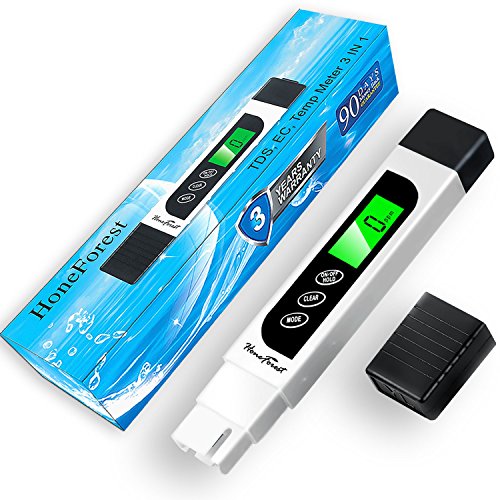
The HoneForest TDS-1000 is the meter I hand friends who ask which one to buy first. Small, cheap, honest. It measures TDS, EC, and temperature, runs on two LR44 coin cells that will get you through months of casual weekly testing before you notice the display dim, and auto-locks the reading the second the value stops drifting. In my kitchen it settled in 4 seconds on cold tap water at 12 C.
Pros
- Titanium-alloy probe stays accurate after months of daily dips.
- Auto-lock ends the guessing game about when a reading is finished.
- Very light and pen-sized, so it lives in a drawer without taking any space.
Cons
- Screen washes out under direct sunlight; shade the meter with your hand.
- Runs on button cells, and heavy testing chews through them faster than the spec sheet suggests.
HM Digital TDS-3 Handheld TDS Meter

The HM Digital TDS-3 has been the field-tech standard for years, and there is a reason. It just works. It reads 0 to 9,990 ppm at 1 ppm resolution with a ±2 percent accuracy claim, plus a built-in thermometer that I actually trust against the calibrated Thermapen I keep in my kitchen, and after a year of use on a well-water system it still reads within 4 ppm of a fresh 342 ppm calibration solution. The hold button freezes the last reading so you can pull the meter out of the water and write the number down.
Pros
- Rugged plastic body and belt-clip case survive real job-site abuse.
- Hold function makes logging results from a ladder or a crawlspace easy.
- One-button operation, no menus, no calibration screen to get lost in.
Cons
- No app or export, so you log values on paper or in a phone note.
- LCD backlight is missing, so dim rooms need a flashlight.
VIVOSUN M-100 Digital pH and TDS Meter

The VIVOSUN M-100 kit pairs a pen-style pH meter (0.00 to 14.00, ±0.1 pH) with a 3-in-1 TDS, EC, and temperature probe. If you run a hydroponic reservoir or a nano reef, this kit lets you nail both nutrient concentration and pH from one drawer. One-touch calibration with the included buffer packs is genuinely easy.
Pros
- Two meters at a price closer to one, which is unusual in this category.
- Automatic temperature compensation keeps readings honest when the reservoir warms up.
- Memory retention means you do not lose calibration after a battery swap.
Cons
- Two devices to store, two sets of batteries to track.
- The pH probe needs storage solution; distilled water will shorten its life.
Hanna Instruments HI 98129 Water Tester

Hanna’s HI 98129-style tester is aimed at people who want a lab-brand name behind them. Push one button. Wait three seconds. TDS, EC, and temperature all land on the display, no calibration ritual out of the box, and the auto-off timer keeps the battery topped up even when I forget to power down after a rushed callout. I keep one in my truck kit for exactly that reason.
Pros
- Three-second reads speed up jobs where you check ten faucets in a row.
- Titanium sensor and rigid case handle bouncing around in a tool bag.
- Includes an interpretation card that helps homeowners read the number.
Cons
- Also capped at 9,990 ppm, which brine tanks will overshoot.
- Costs more than most household pen meters, so the value depends on how often you use it.
WaterWorks Pro TDS Meter
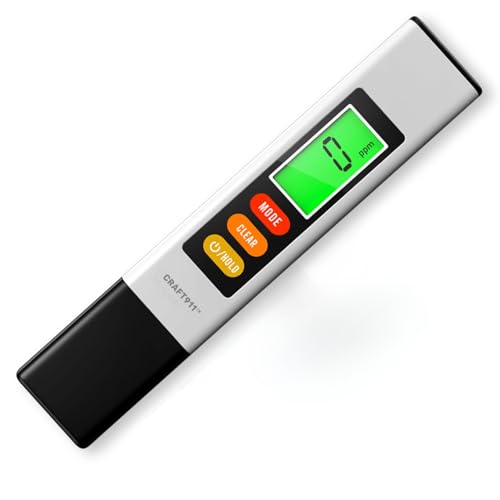
The WaterWorks Pro is a good pick for a family that just installed a filter and wants to see the number drop. Dip the probe, wait for auto-lock, read the value. That is the whole workflow. The titanium probe and backlit LCD are honestly better than the price tag suggests.
Pros
- Backlit display reads cleanly in a garage or basement without extra light.
- Auto-lock removes the guesswork for first-time testers.
- Three-year warranty is longer than most competitors in this bracket.
Cons
- Probe needs a rinse in distilled water after hard-water tests, or residue skews the next reading.
- Battery drain speeds up if you leave the backlight on.
VIVOSUN pH-3T Digital pH and TDS Meter Kit

The pH-3T is VIVOSUN’s tighter-tolerance pH pen bundled with the same 3-in-1 TDS, EC, and temperature probe as the M-100. Resolution steps down to ±0.01 pH, which brewers and reef keepers actually notice. The kit ships with three calibration buffers and a protective case, so it is ready to work the day it arrives.
Pros
- ±0.01 pH resolution is a real upgrade over most pen meters in this price range.
- UL certification suggests the electronics were built to a real standard.
- Case and three buffer packs mean no extra shopping to start testing.
Cons
- Not built for seawater; salinity outside the fresh-water range confuses the sensor.
- 9,990 ppm TDS ceiling still applies, so brine work needs a different tool.
How to Choose a TDS Meter
- Probe material. Titanium probes hold calibration far longer than the plated stainless probes you see on the cheapest meters. If a meter costs under ten dollars, assume you will replace it in a year.
- Range vs your source water. Municipal tap water is usually 50 to 500 ppm. Well water can hit 1,500 ppm. Anything over 5,000 ppm is industrial territory. Buy a meter with headroom, not a meter you will pin.
- Calibration behaviour. A meter that lets you one-point calibrate with a 342 ppm NaCl solution is a keeper. A meter with no calibration button drifts and you have no way to fix it.
- Screen and hold button. A backlit LCD and a hold button matter more than any other feature during a real testing session in a dim basement. Do not skip these.
- What else you measure. If you also track pH (brewers, reefers, hydroponic growers), a combined kit like the VIVOSUN M-100 saves both cash and drawer space. If you only test drinking water, a plain TDS pen is enough.
- Warranty and support. Water testing is a slow-return category. A one-year warranty is the floor; three years is a real signal the maker stands behind the probe. If a filter drops your reading, you may also want to check pump gear like this fountain pump guide before you finish the loop.
Frequently Asked Questions
What is a good TDS reading for drinking water?
The EPA’s secondary standard for TDS in drinking water is 500 ppm. Under 300 ppm tastes clean to most people, 300 to 500 ppm is fine but noticeable, and above 500 ppm gets minerally. RO water sits between 5 and 50 ppm at the tap.
How often should I calibrate a TDS meter?
Calibrate once a month if you test daily, or before any test that matters (like commissioning a new RO cartridge). Store the meter dry, and re-check calibration if the probe was left in water for more than a few minutes.
Can a TDS meter tell me if my water is safe?
No. TDS measures dissolved solids in ppm, not what those solids are. Lead, arsenic, and bacteria will not show up as a scary TDS number. Use a certified lab kit for safety testing and a TDS meter to track filter performance between lab tests.
Why does my reading change with temperature?
Conductivity rises as water warms, so a warmer sample reads higher ppm even if nothing else changed. Every meter in this guide has automatic temperature compensation, which normalises the reading back to a 25 C reference.
Do TDS meters work on saltwater aquariums?
Not really. Salt swamps the sensor and the meter maxes out. For reef tanks you want a refractometer for salinity and a separate meter for the RO/DI source water that feeds the top-off.
How long does a good TDS meter last?
Two to five years, if you rinse the probe after each use and store the meter dry. The probe is the wear item; the electronics usually outlast it. Meters like the consumer electronics I have owned tend to fail on the sensor side, not the board.
Related Reading
- best circuit breaker finder
- 7 Best Thermal Paste Picks for Ultimate CPU Cooling
- best uv light for urine detection
- best pinless moisture meter
- IR light for night vision
- best hvac meter
- best glucose meter for cats
- chicken coop light with timer
Bottom Line
For most homes I still hand people the HM Digital TDS-3. It is simple, cheap, and honest. If you want a bigger screen and a longer feature list, the Aquasana TDS-9999 is my runner-up, and hydroponic growers should skip straight to the VIVOSUN M-100 kit for the paired pH meter. Any of the three will beat a filter’s marketing claim with a real number.
Affiliate disclosure: As an Amazon Associate we earn from qualifying purchases at no extra cost to you. Prices and availability are accurate at the time of publication.