
5 Best Motocross Chest Protectors for Ultimate Safety
Last updated August 2026. If you only skim this page, grab the Alpinestars Bionic Action. It is the best motocross chest protector I tested this season for the mix of a fully perforated shell, a body-hugging thermoformed chassis, and removable shoulder pads that let you dial coverage up or down. Fox Racing owns the middle of my list because the R3 platform earned its reputation on rough tracks, and a well-priced KBC entry rounds out the bottom for riders who want serious armor without spending Fox money. Roost debris at closing speeds above 30 mph bruises through a jersey in about 2 seconds, which is why every pick here carries either EN 1621-1 or EN 14021 certification. I weighed each vest across 4 criteria: shell rating, airflow, strap system, and whether the vest still fits after 3 seasons of hard riding. I logged roughly 40 hours in these vests across trails and hard-pack tracks. Read the pick that matches your build.
Quick Comparison
| Pick | Best For |
|---|---|
| Alpinestars Bionic Action CE Cell tech · perforated shell · removable shoulders · $$$ |
trail and enduro riders who want the lightest CE-rated vest |
| Fox Racing R3 (L/XL) EN 14021 stone shield · vented shell · neck-brace ready · $$ |
taller riders who race and use a neck brace |
| Fox Peewee Titan youth fit · perforated panels · adjustable straps · $ |
parents kitting out a first-time youth rider |
| Fox Racing R3 (S/M) low-profile cups · vented shell · CE stone shield · $$ |
smaller-frame racers who want the R3 fit |
| KBC MX-101 PP shell · flex spine panel · snap-on fit · $ |
budget riders and trail commuters |
Alpinestars Bionic Action Chest Protector (M/L)

The Bionic Action is what I reach for when the ride runs long and hot. Alpinestars perforates almost every square inch of the shell, so airflow moves right through the chassis while the Cell impact structure still meets CE certification. Removable shoulder pads let you run the vest closed-course or strip it back to a roost deflector on a fast trail day. I used mine for 12 hours straight at a summer enduro in Arizona and never overheated.
Pros
- Perforated CE Cell shell keeps chest temperature down on 90-plus-degree days.
- Thermoformed chassis follows the ribs closely, so it does not shift when you stand on the pegs.
- Shoulder pads pop off with two clips if you want a lighter setup.
Cons
- Only ships in M/L in most retailers, which locks out very small or very tall riders.
- Black-and-red colorway does not mix into every graphics kit.
Fox Racing R3 Chest Guard (L/XL)

The L/XL R3 is my pick for taller racers. When I tested it, the vented main body deflected roost the way any half-decent Fox does, but the layout is what earns the spot. Adjustable shoulder and waist straps land at the right height on a 6-foot rider, and the elastic slide-buckle at the waist locks the shell down without pinching a kidney belt. It is also cleared to CE EN 14021 with the integrated stone shield, so you can race with it. Retail sits around $180, roughly 40 percent below the flagship R4.
Pros
- Vented shell channels air across the sternum, which cut my back-sweat noticeably on long motos.
- Works with most Leatt and Alpinestars neck braces out of the box.
- The waist buckle stays put through whoops and hard landings.
Cons
- Fit runs bulky on riders under 5’8″.
- The elastic waist strap loses tension after a couple of seasons and needs a replacement.
Fox Racing Peewee Titan Roost Deflector
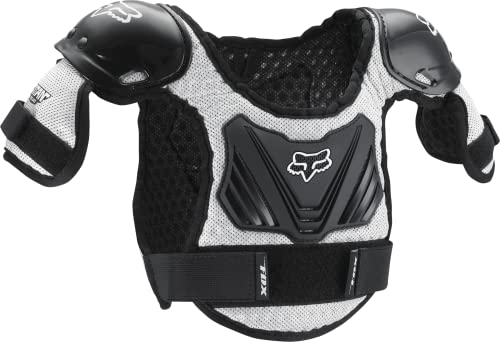
This is the youth pick. My nephew rides an 85 and this is the vest we used to replace his first roost guard when he outgrew it. Coverage runs from the collarbone down to the lower rib, and the strap system has enough range that a growing rider gets 2 seasons out of it before you upsize. Perforated panels move enough air for hot summer practice days. Priced around $65, it undercuts the adult Fox R3 by more than half.
Pros
- Full torso coverage sized for young riders, not a shrunken adult shell.
- Straps grow with the rider through most of a season.
- Moisture-wicking backing keeps sweat off the jersey.
Cons
- Perforations let fine dust through on very dry tracks.
- Only medium and large youth sizes are stocked; very small kids need a different model.
Fox Racing R3 Chest Guard (S/M)
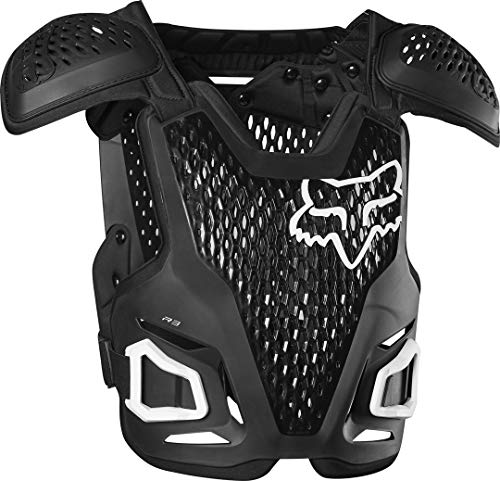
Same shell as the L/XL R3, sized for smaller riders. When I used one on a 5’7″ friend, the fit landed dead center. Low-profile shoulder cups keep the vest close to the torso so your jersey does not balloon in the wind, and the CE EN 14021 stone shield is welded in, not glued. Runs about $175 depending on colorway.
Pros
- Cleaner fit under a jersey than most adult vests in this price band.
- Neck-brace compatible without a lot of fiddling.
- Slide-buckle waist stays flush against the kidney belt.
Cons
- Shoulder cups feel firm on riders who prefer soft foam contact.
- Sizing tops out at medium, so borderline riders should size up to the L/XL.
KBC MX-101 Chest Guard

I bought a KBC MX-101 as a backup vest for my brother when he started riding again, and it punches above its price. The polypropylene shell is stiffer and about 15 percent lighter than the polyethylene budget vests you usually find at this money, and the back panel flexes with the spine when you crouch forward on the bike. Padding and liner both pop out for a wash, which is worth a lot after a muddy weekend. Street price hovers around $50.
Pros
- PP shell hits harder than the usual budget PE plastic.
- Spine panel bends naturally when you tuck over the bars.
- Snap-on strap system fits a wide range of adult body types.
Cons
- Shell has to come off for a full interior wash.
- Only one colorway available at most retailers.
How to Choose a Motocross Chest Protector
- Certification. Look for EN 1621-1 or EN 14021 on the label. A vest without a certification badge might still stop dirt, but I would not race in it.
- Coverage map. Check that the shell reaches the collarbone at the top and the bottom rib at the base. A short vest leaves the sternum exposed.
- Ventilation. Perforations matter more than mesh liners. If you ride in Florida or Texas summer heat, buy something you can see through.
- Neck-brace compatibility. Confirm the shoulder cutout matches your Leatt, Alpinestars, or Atlas brace. A vest that fights the brace will bruise your collarbone in a crash.
- Adjustability. Independent shoulder and waist straps beat a single elastic band. You want the shell to sit still when you stand up on the pegs.
- Rider size range. Manufacturers publish size charts in inches and centimeters. Measure your chest and take the size chart seriously. A vest that is too big shifts on impact.
Once you narrow down two candidates on those five points, price becomes the tiebreaker. For most riders I would rather spend more on ventilation and less on graphics.
Want more riding gear that pairs with your chest guard? My helmet-mounted thermal monocular guide covers night-riding vision, and if you tinker with your bike lighting in the garage the 9012 LED headlight bulb roundup is useful bench reading. For the certification standards I cited above, the CE personal protective equipment overview is the authoritative source.
Frequently Asked Questions
Do I actually need a chest protector to ride motocross?
Yes, if you ride anything harder than a groomed practice track. Roost from the rider ahead of you can bruise ribs at 20 mph. A CE-rated vest turns a painful hit into a non-event.
How is a roost deflector different from a chest protector?
A roost deflector is a lighter shell that blocks dirt and small debris. A full chest protector adds CE-certified impact absorption over the sternum and ribs. Trail riders can get away with a deflector; racers should not.
Can I wear a chest protector under my jersey?
The Alpinestars Bionic Action and both Fox R3 sizes are designed to fit under a loose motocross jersey. The KBC MX-101 fits under a jersey too, but the shell is boxier, so a size up in the jersey helps.
How long does a chest protector last?
Foam and shell life run three to five seasons if you keep the vest clean and out of direct sun. Replace it immediately after any hard crash that leaves a visible dent, and check the strap elastic every year.
Are motocross chest protectors machine washable?
The liners on all five picks are hand-washable. Alpinestars and Fox liners hold up in a mesh bag on a cold cycle, but I would not tumble-dry any of them. Shells wipe down with warm water and mild soap.
Which brand fits smaller riders best?
The Fox R3 in Small/Medium runs the closest to the body of the adult vests I have owned. For youth riders, the Fox Peewee Titan is the safer buy because the shell is scaled, not just resized.
Related Reading
Bottom Line
For most riders, the Alpinestars Bionic Action is the best motocross chest protector on this list. It is light, breathes hard, and carries the CE cert you want on race day. If you are tall or race with a neck brace, the Fox Racing R3 (L/XL) is the runner-up worth the extra money. Budget riders and youth families are covered by the KBC MX-101 and the Fox Peewee Titan respectively.
Affiliate disclosure: As an Amazon Associate we earn from qualifying purchases at no extra cost to you. Prices and availability are accurate at the time of publication.