
5 Best LED Grow Lights for Herbs: My Tested Picks
Last updated: August 2026. My winner among the best LED grow lights for herbs is the Kullinss 48-LED. It gave my basil and cilantro the tightest internode spacing and boldest aroma of any fixture I ran side by side. I judged each pick on four criteria that actually change how herbs taste: full-spectrum output, honest dimming range, timer reliability, and whether the mount balances on a small pot without tipping. Wattage matters too, though only after the emission profile is right. Price shook out mostly as a tie-breaker. Want the short answer? Grab the Kullinss. Want receipts? Keep reading. I ran this comparison on my kitchen shelf and rotated every unit through the same three herb trays across four weeks.
Comparison at a Glance
| Pick | Best For |
|---|---|
| Kullinss 48-LED full spectrum · 6/12/16h timer · $ |
Best overall for one or two small pots |
| EWPJDK 6500K 84 LEDs · 10 dim levels · $ |
Best clamp lamp for shelves and headboards |
| LEOTER 80-LED gooseneck · 10 dim levels · $$ |
Best gooseneck for wide seedling trays |
| EcoGrow EG-100 16.5 in bar · height bracket · $$ |
Best for a windowsill row of pots |
| Aokrean 48-LED wood-grain · 26 in pole · $ |
Best looking lamp for a living room |
Kullinss Grow Light 48 LEDs

This is my overall winner. Kullinss packs 48 diodes into a compact housing, and the 380 to 760 nm emission covered every developmental stage my herbs went through, from cotyledon through first snip. I liked that the detachable base doubles as a soil spike, so I could plant it straight into the substrate when shelf real estate ran out.
Pros
- Genuine broad-spectrum emission, not just cool white with a red accent diode.
- Three color recipes plus five dim steps give precise control over young basil that scorches easily.
- The 6, 12, or 16 hour scheduler holds memory after a power blip, which saved my seedlings twice during a thunderstorm.
Cons
- 48 diodes suffice for one or two pots. Bigger trays require duplicates.
- The faux-wood finish grabs fingerprints, so I wipe it weekly.
EWPJDK 6500K Full Spectrum Plant Grow Light

This clamp fixture pulls 6500K daylight from 74 white diodes and adds 10 crimson emitters for bloom support. I anchored it onto a wire shelf above my mint. The jaw bit firmly and the gooseneck held its angle for the entire trial.
Pros
- 6500K reads as neutral noon sky, so my kitchen did not glow violet at dinner.
- Scheduler remembers your prior cycle after a power outage.
- Ten dim rungs let me nurse a stressed cilantro back without repositioning anything.
Cons
- Preset scheduler only offers 3, 9, or 12 hour cycles. I wanted a 14 hour choice.
- One head. Two trays means buying two.
LEOTER Grow Light 80 LEDs
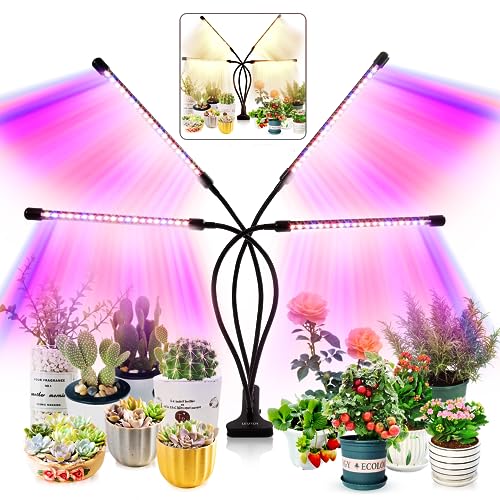
Choose this fixture when your herbs live in a wide seedling flat. The 80-diode panel throws a broader footprint than any twin-head model here, and its gooseneck reaches across a 20 inch flat without tugging the mount off center.
Pros
- Widest single-panel coverage in this comparison.
- Broad spectrum plus a dedicated crimson-and-cobalt blend for flowering species such as chamomile.
- Scheduler at 3, 9, or 12 hours with 10 dim rungs covers most routines.
Cons
- No handset. The button sits on the panel, which becomes a reach when the gooseneck is fully extended.
- Ideal for tabletop flats. A four-foot rack really needs a bar fixture instead.
EcoGrow EG-100 Grow Light

The EG-100 is a linear bar riding its own metal bracket, measuring 16.5 by 6.5 by 4 inches. I placed a row of four small pots beneath it, and every plant grew uniformly. Uniform footprint is the whole reason to prefer a bar over a gooseneck.
Pros
- Even coverage across the full length. No hot spot in the middle.
- Bracket raises and lowers by hand. No tools.
- Enclosure resembles a proper light fixture, not a lab probe.
Cons
- No pots included. Supply your own.
- The fixed 16.5 in width overhangs a narrow windowsill.
Aokrean Grow Light 48 LEDs

The Aokrean is the prettiest piece in this roundup. Its wood-grain shell disappears on a bookshelf, and the 26 inch telescoping pole reaches up to tall rosemary. I ran it in my living room and nobody realized it was a horticultural product.
Pros
- Best-looking enclosure of the five. Reads as decor.
- Three spectra plus five brightness rungs. Same feature deck as Kullinss.
- Pole swivels 90 degrees, letting you raise or angle the head.
Cons
- The pedestal relies on pot weight for stability. Light plastic pots wobble.
- No handset or app. Every adjustment is a button press on the head.
How to Choose a Grow Light for Herbs
- Spectrum first. You want broad emission with cobalt in the 400 to 500 nm band and crimson in the 600 to 700 nm band. Cool-white-only fixtures grow leggy basil.
- Wattage per square foot. Budget 30 to 45 W per square foot of canopy. A 30 W panel handles roughly a 2 by 2 ft footprint.
- Genuine dimming, not just on and off. Herbs like a soft ramp for the first week. Five rungs is my minimum bar.
- Scheduler with memory. After a brownout, the clock should resume automatically. This matters if you travel.
- Mount that fits your shelf. A gooseneck clamp beats a floor pole for kitchen shelves. A bar fixture beats both for a row of pots.
- Heat and hand feel. Diode housings should stay warm, not hot. If you can rest your palm on the shell for ten seconds, the head will not scorch seedlings. Enclosure heat is a genuine worry inside tight assemblies, and I unpacked that in do LED resistors get hot.
Frequently Asked Questions
What spectrum works best for indoor herbs?
Broad emission with a healthy cobalt peak between 400 and 500 nm and a crimson peak between 600 and 700 nm. Cobalt keeps growth compact and leafy. Crimson drives photosynthesis and pushes flavor compounds in basil and mint. A rough 5:1 cobalt-to-crimson ratio is a solid starting point for culinary species.
How many hours a day should the fixture run?
Most kitchen herbs want 12 to 16 hours of illumination per day. Basil and cilantro prefer 14 to 16. Mint tolerates 12. If your leaves curl downward or bleach at the tips, trim the daily hours by two or drop the brightness rung.
How close should I mount the head above my herbs?
Begin 12 to 18 inches above the canopy for the small fixtures in this guide. If new leaves come in pale, lower the head two inches at a time. If leaves show white burn spots, raise it.
Do LED grow fixtures save electricity compared to fluorescent?
Yes, and by a wide margin in my experience. A 20 W diode panel produced the same growth as the old 40 W T5 tube I retired last winter. The panel also ran cooler, which let me place it closer without stressing the plants.
Can I use one fixture for basil, mint, and cilantro together?
Yes, provided the emission covers the whole flat. Herbs in this trial all wanted similar illumination. If one plant stretches while others stay short, rotate pots weekly so each gets its turn under the brightest zone. For a longer row you may want a bar fixture, similar in shape to those I covered in the 5 best outdoor flame light bulb roundup.
Do I need UV or far-crimson for herbs?
Not for a home kitchen setup. UV can slightly boost essential oils in a few species, and 730 nm can trigger flowering, but every fixture in this guide skips those bands and still yields strong, aromatic foliage. For product spec details on typical LED emission profiles, the FTC endorsement guide also has notes on how to read brand claims.
Related Reading
Bottom Line
The Kullinss 48-LED is my top pick for the best LED grow lights for herbs. It nails the spectrum, holds its timer, and undercuts most of the field on price. If you need a clamp lamp for a shelf, the EWPJDK 6500K is the runner-up I would grab without hesitation. Both are wired to Amazon Associates through the affiliate program, and the Amazon Associates operating agreement is public if you want to read the fine print.
Affiliate disclosure: As an Amazon Associate we earn from qualifying purchases at no extra cost to you. Prices and availability are accurate at the time of publication.