
5 Best 2×4 Grow Light Picks for Indoor Gardens
The best 2×4 grow light I have used is the Spider Farmer G4500. It threw an even 2.85 µmol/J across my 2×4 tent, ran cool, and let me dial brightness from an app while I was at work. I picked this list by leaning on three things that actually matter when you buy: real PPF per watt (not marketing lumens), how flat the light hits the canopy corners, and heat behavior in a sealed tent. Price bands and warranty rounded it out. Below you get five lights I would actually put over a tomato or leafy crop, plus a plain buying guide and answers to the questions I got most from friends starting hydroponic setups.
Quick Comparison
| Pick | Best For |
|---|---|
| Spider Farmer G4500 320W bar · app control · $$$ |
Growers who want app scheduling and even canopy light |
| Spider Farmer SF2000 200W · Samsung LM301H · $$ |
Serious hobbyists chasing efficiency in a compact tent |
| VIPARSPECTRA P2000 250W · dimmable · $$ |
Budget builds that still need a real full spectrum |
| MARS HYDRO TSL2000 300W · daisy chain 50 · $$ |
Multi-tent setups that need scaling later |
| Spider Farmer SF600 72W · seedlings · $ |
Closet gardens, seed trays, cheap first light |
Spider Farmer G4500 LED Grow Light

I set this up in my 2×4 tent last spring and it became my daily driver. The 320W bar layout pushes light to the tent corners the way a panel simply cannot, and the app lets you preload sunrise, veg, and flower schedules from your phone. It fits growers who plan to expand later, because up to 50 fixtures can dim together on one signal.
Pros
- Even PPF at the tent walls, not just the center.
- App control with sunrise and sunset simulation.
- Five-year warranty with US service.
Cons
- Bar profile needs extra vertical clearance in short tents.
- App and daisy-chain setup takes an hour the first time.
Spider Farmer SF2000, 200W LED Grow Light
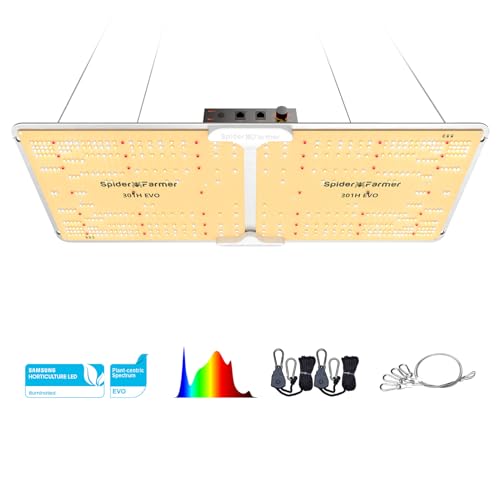
The SF2000 is what I hand people who want serious efficiency without spending G4500 money. Samsung LM301H EVO diodes hit 3.14 µmol/J on the label, and the fanless build keeps my grow closet quiet enough to sleep next to. It suits a single 2×4 tent from seedling to a proper flower cycle.
Pros
- Best-in-class diode efficiency at this price.
- Silent, no fan whine at night.
- Warm plus cool plus 660 nm plus IR spectrum.
Cons
- Weaker IR punch than dedicated bloom lights.
- Costs more than budget panels up front.
VIPARSPECTRA P2000 LED Grow Light

I used the P2000 over a 4×2 veg tent for one round of lettuce and basil, and the dimmer knob made it easy to walk seedlings up without burning them. The 3000K plus 5000K plus 660 nm blend lands close to natural daylight, and the fanless aluminum sink kept temps flat under a T-shirt canopy. It fits growers who want a straightforward panel with no app to configure.
Pros
- Simple analog dimmer, no phone required.
- Daisy chain up to 20 units for wider rooms.
- Silent fanless heat sink.
Cons
- No app scheduling if you like remote control.
- One plug per panel, so many chains want a dedicated circuit.
MARS HYDRO TSL2000 LED Grow Light
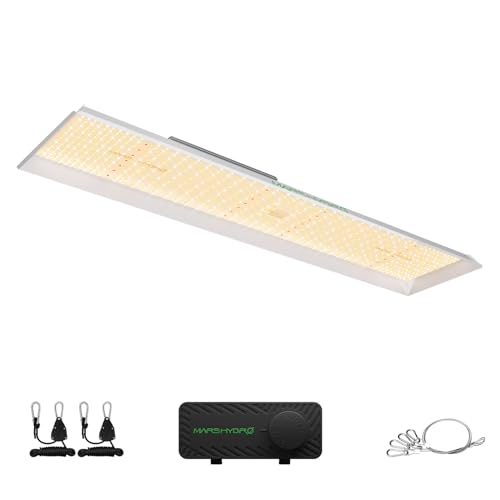
The TSL2000 packs 704 SMD diodes in a center-dense pattern that pushed a very flat PPFD map across my 4×2 tent. Its external driver has a real dimming button and the wall-plug autosenses 120V, 240V, or 277V, so I moved it between two houses without cable swaps. It works for the grower who is one tent today and three tents next year.
Pros
- Even center-to-edge PPFD from the diode layout.
- Daisy chains up to 50 lights for big rooms.
- External driver runs cooler than integrated ones.
Cons
- Peak output needs added ventilation in sealed tents.
- No app control, just the physical dimmer.
Spider Farmer SF600 LED Grow Light

The SF600 is a cheap first light. I used it over a small seed tray in a bookshelf closet and it did the job for germination and early veg. At 72W it will not flower a full 2×4 tent alone, but as a seedling starter or a supplement bar next to a stronger light, it earns its price.
Pros
- Cheapest entry into full-spectrum LED growing.
- Slim, plug and play, no ballast to mount.
- 50,000 hour rated life.
Cons
- Too weak to flower a full 2×4 canopy on its own.
- No dimming, one brightness only.
How to Choose
- PPF over lumens. Ignore the lumens number. Ask for PPF in µmol/s and efficacy in µmol/J. Aim for 2.5 µmol/J or higher.
- Canopy coverage. A bar layout hits the corners of a 2×4 tent better than a square panel of the same wattage.
- Dimming. A real dimmer lets you walk seedlings up without shock. Analog knob is fine; app control is nicer.
- Heat. Fanless sinks are quieter but need a little airflow around the driver. Sealed tents want the driver off the fixture body.
- Warranty. Three years is the floor. Five years is the mark of a brand that stands behind its diodes.
- Related reads. For the wiring side see my notes on the best landscape lighting transformer if you want to match voltage to fixtures, or check do LED resistors get hot for heat behavior of driver components.
Frequently Asked Questions
What size grow light do I need for a 2×4 tent?
For veg, 200W to 250W of a modern LED is plenty. For heavy flowering, plan on 300W to 400W of a high-efficacy LED to hit 800 to 1000 µmol m2 s. Going bigger than 400W in a 2×4 tent gives diminishing returns and adds heat.
How high should a 2×4 grow light hang above the canopy?
Start at 24 inches above seedlings, drop to 12 to 18 inches during veg, then 8 to 12 inches during flower. A PAR meter is the honest way to set height; the manufacturer chart is only a starting point.
Are bar-style lights better than panels for a 2×4 tent?
Yes, in my experience. Bars push light to the tent walls where a panel of the same wattage leaves shadows. The Spider Farmer G4500 was the clearest example in this list.
Do I need separate veg and bloom lights?
No. A full-spectrum LED with 3000K and 5000K plus 660 nm red and IR handles a full seed-to-harvest cycle. Older two-spectrum switches are a legacy design.
How much power will a 2×4 grow light use per month?
At 300W running 18 hours a day, expect about 162 kWh per month. At an average US rate near 16 cents per kWh, that is roughly 26 dollars monthly. Efficient LEDs drop that number.
Are grow lights safe for a home closet?
Yes, if you leave a small air gap around the fixture and use a timer. Keep the driver off carpet and check the tent seams for heat pockets during the first day of a new run.
Related Reading
Bottom Line
The Spider Farmer G4500 is my top 2×4 grow light because it lights the canopy corners evenly and pairs a five-year warranty with real app control. If you want the same brand for less money in a smaller build, the Spider Farmer SF2000 is the runner-up that gets you most of the yield without the bar footprint. Both stay evergreen picks in this category.
Affiliate disclosure: As an Amazon Associate we earn from qualifying purchases at no extra cost to you. Prices and availability are accurate at the time of publication.