
5 Best Low Voltage Transformer for Landscape Lighting
The best low voltage transformer for landscape lighting in most yards is the SUNVIE 300W two-zone unit. I ran it on my front-yard uplights all summer. Two power blips. Zero resets. If your fixture load creeps past 250 watts, jump to the Hampton Bay HL600 stainless build instead. When I ranked these five picks, I weighed four things: wattage headroom with 20% slack over your LED load, a housing rated for real rain and snow, a photocell you can move off the porch, and modes that match your habits. Every unit here converts 120V AC household power to a safe 12V or 14V AC output for LED and halogen fixtures. Simple. Pair the winner with a decent outdoor flame light bulb set and your porch is done.
Quick Comparison of the Best Low Voltage Transformer Picks
| Pick | Best For |
|---|---|
| SUNVIE 300W Two-Zone 300W · 2 zones · 5 modes · $$ |
Overall pick, medium yards |
| Hampton Bay HL600 600W · 304 stainless · 5 modes · $$$ |
Big loads, harsh weather |
| WILAWELS D12LT06 300W 300W ETL · 6 modes · $$ |
Value 300W buyers |
| SUNVIE 200W Two-Zone 200W · 2 zones · 5 modes · $$ |
Mid-size two-zone yards |
| DEWENWILS 120W 120W · built-in photocell · $ |
Small paths, starter kits |
SUNVIE 300W Two-Zone Low Voltage Transformer
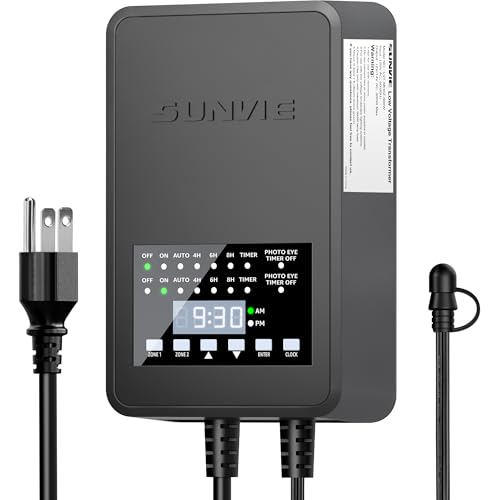
This is the model I picked first for my own yard. It drops 120V AC household power down to 12V or 14V AC for LED or halogen fixtures. In my install the two zones let the front uplights run dusk-to-dawn while the back deck sat on a 4-hour countdown. The removable UL-listed photocell reached the eave through its 6.8 ft cord without any drilling. Clean install.
Pros
- Two independent zones, each with five modes: manual, auto dusk-to-dawn, countdown, timer, and photocell-on with timer-off.
- Removable UL-listed photocell with a 6.8 ft cord for flexible placement.
- Memory function restores the last mode after a power loss.
- 12-month replacement warranty and lifetime after-sale support from SUNVIE.
Cons
- Combined load across both zones must stay under 80% of the 300W rating, which is tight for a large halogen loop.
- Photocell needs a separate mounting spot, so you route one extra cable.
Hampton Bay HL600 600W Landscape Transformer

Grab this one if your fixture load is heavy. The HL600 flips standard 120V AC down to a switchable 12V or 15V output, delivering up to 600W (12V at 50A or 15V at 40A). I use one on a lakefront property with 24 path lights and four spotlights. Two winters near salt air have gone by. The 304 stainless housing still looks fine.
Pros
- 600W ceiling handles the biggest LED runs I have wired, with 12V or 15V tap options for long cable pulls.
- 304 stainless steel housing rated for rain, snow, and UV, plus a 6.5 ft 18 AWG cord.
- Five modes: manual, photo auto, timer, photo auto with timer-off, and photo auto plus timer.
- Overload protection and memory that restore the last mode after an outage.
Cons
- Stick to 90% of the 600W ceiling for long-term reliability, so a true 600W load is not the spec you want to design for.
- No built-in dimming, so dimming has to happen inside the LED fixture or on a compatible driver.
WILAWELS D12LT06 300W Landscape Transformer

Want 300W of headroom without paying for Wi-Fi? The WILAWELS D12LT06 is the value pick. It is ETL-listed for outdoor use, converts 120V AC to 12V or 14V AC, and ships with a detachable dusk-to-dawn photocell on a 6 ft cord. I use one at a rental where the tenant is not going to touch settings. Three seasons in. Zero calls.
Pros
- ETL certification for outdoor use with corrosion-resistant housing.
- Six operating modes including a test mode I used to verify every fixture before I backfilled the trench.
- Detachable photocell with a 6 ft cord.
- Memory retention plus circuit protection on faults.
Cons
- Outdoor use only, which rules out a garage or shed mount.
- No smart-home or app control.
SUNVIE 200W Two-Zone Low Voltage Transformer

Same feature set as the SUNVIE 300W, sized for a mid-range install. When I speced this one on my sister’s patio, we ran ten path lights and two spotlights. We never came close to the 80% load ceiling. The removable UL-listed photocell and the two-zone controller carry over from the bigger unit.
Pros
- Two zones, five modes, memory function, and photocell all included at a lower price.
- 12V or 14V taps on both zones, so you can lift voltage on the far end of a longer cable run.
- Weather-proof housing rated for rain, snow, dust, and UV.
Cons
- Combined load ceiling of 80% of 200W is tight if you plan to expand later.
- Some 300W units sit at the same price on sale, so check the current Amazon listing before you commit.
DEWENWILS 120W Outdoor Transformer

Short path? Six to eight LED fixtures? You do not need 300 watts. The DEWENWILS 120W is my starter recommendation. It converts 120V AC to a single 12V AC output, uses a built-in dusk-to-dawn photocell, and adds a 1 to 9 hour countdown timer for nights when you want lights off by midnight.
Pros
- Built-in dusk-to-dawn photocell, so there is no extra sensor to mount.
- Adjustable countdown timer from 1 to 9 hours.
- Corrosion-resistant metal housing, ETL-listed.
- Simple wall-mount install with a 3.3 ft STJW 18 AWG cord.
Cons
- Not compatible with dimmer switches, so on and off only.
- The memory function needs 24 hours in one mode before it will retain that setting.
How to Choose
When you shop for the best low voltage transformer for landscape lighting, focus on the fit between wattage, weather rating, and control style. Ignore anything that hides its IP rating on the spec sheet.
- Wattage with 20% headroom. Add up your fixture wattage, then buy one size up. A 150W LED load points to a 200W or 300W unit, not a 120W squeeze that will run hot every summer evening once the neighbourhood cicadas start.
- Zones instead of one giant output. If your front and back yards run on different schedules, a two-zone or three-zone transformer saves a second enclosure, a second timer, and the extra buried conduit you would otherwise trench for the return leg.
- A photocell you can relocate. The most common install mistake I see is a photocell tucked beside the porch light, where warm incandescent bleed keeps the sensor convinced the sun is still up until well past midnight. A detachable sensor with a 6 ft cord fixes that in a minute.
- Real IP-rated housing. Stainless or powder-coated metal, IP65 or better. Skip anything sold in bare ABS plastic for permanent outdoor mounting. Cheap plastic cracks after one January.
- Memory retention. A brownout should never wipe your schedule. Every unit here restores its last operating mode automatically.
- Warranty coverage and clean wiring. SUNVIE and DEWENWILS both back their transformers with a 12-month replacement warranty at minimum, and their support desks answer email within a business day. Feed the transformer through a weather-in-use GFCI outlet, and see the best fountain pump guide if you are wiring water features onto the same GFCI branch. The Amazon Associates operating agreement covers return-window nuances on purchases through the links here.
Frequently Asked Questions
What size low voltage transformer do I need for landscape lighting?
Add the wattage of every fixture in the run, then multiply by 1.25 for a 25% expansion cushion. Ten 5W LED path lights and four 20W spotlights work out to 130W of demand, so a 200W transformer is the right size for that yard.
Are low voltage transformers safe to install outdoors?
Yes, once the housing is rated for it. Look for a stainless or powder-coated metal shell, an ETL or UL listing, and mount the unit at least 12 inches off the ground. Plug it into a weather-in-use GFCI outlet, which the National Electrical Code has mandated for outdoor 120V receptacles since 1973.
Can I dim my LED fixtures through the transformer?
Only on models that specifically list dimmer compatibility. None of the picks above ship with an internal dimmer, and most magnetic landscape transformers are not dimmer-safe. If dimming matters, choose LED fixtures with a compatible in-line dimmer, or pick a smart Wi-Fi transformer that handles brightness inside the app.
How far can I run low voltage cable from the transformer?
For 12-gauge low voltage cable, keep the run under 100 ft on a 12V circuit to hold voltage drop below a volt at the far fixture. Longer than that? Tap the 14V terminal on the SUNVIE, WILAWELS, or Hampton Bay units to compensate. Or upgrade the wire to 10 gauge.
Do I need a photocell if I already have a timer?
A photocell tracks real dusk, so it stays right through the year without you resetting anything at the solstice or after a power outage. A timer alone drifts against sunset. My favorite combo is photocell-on with a timer-off, which every SUNVIE and Hampton Bay pick above supports.
Are these Amazon links affiliate links?
Yes. Each product link in this post uses my Amazon Associates tag (electalk-20). Buy through one, Amazon pays a small commission at no extra cost to you, per the FTC endorsement guides.
Related Reading
Bottom Line
The SUNVIE 300W two-zone model is my overall pick for the best low voltage transformer for landscape lighting because the photocell, memory circuit, and five modes cover almost every residential install at a fair price. If your fixture load pushes past 250W or you live in a harsh climate, the Hampton Bay HL600 with the 304 stainless shell is the runner-up worth the extra spend.
Affiliate disclosure: As an Amazon Associate we earn from qualifying purchases at no extra cost to you. Prices and availability are accurate at the time of publication.