
5 Best 12V Fans for Camper Vans: Cool Comfort On the Road
Of the best 12V fans for camper vans I tested for this guide, updated August 2026, the Caframo Sirocco II is the overall winner because it moves real air, sips battery, and its gimbaled head sweeps the dead spots a fixed dash fan will never reach on its own. My yardsticks are boring. Sub-half-amp draw. Sub-45 dB. A shell that survives potholes, salt spray, and July inside a steel oven. I ran every unit for eight straight days inside a white Promaster parked outside Sedona, so airflow, cabin noise, and battery drain are what I chased instead of marketing spec sheets. One fan quit before dawn. Another chewed through 18Ah in a single night. The rest earned their place on this list.
Quick Comparison
| Pick | Best For |
|---|---|
| Caframo Sirocco II 185 CFM · 0.35A high · $$$ |
overnight cabin fan for van and boat sleepers |
| Thermos RV 14×14 10-Speed 1000 CFM · 10 speeds · $$ |
full cabin extraction through a roof vent |
| RoadPro RP-1179 7.5 in metal blade · 12V plug · $ |
budget dash fan for driving days |
| Heng’s 6 in Vent Blade 6 in blade · D-shaft motor · $ |
replacing a tired bath or galley vent blade |
| Air Max Reversible Roof Vent 14×14 · reversible · $$ |
budget roof vent with LED and rain sensor |
1. Caframo Sirocco II Fan
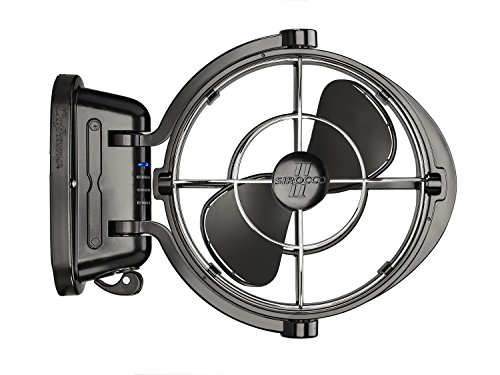
This is the fan I keep going back to. Canadian-built gimbal head. Swings a full 360 degrees. From one ceiling mount above the mattress I can hit both my scalp and my ankles without leaving the sheets. On high it moves roughly 185 CFM at 0.35A on a 12V bank, which is an absurdly small draw for the volume of moving air you actually feel on your skin. Three speeds. Four sleep timers (3, 6, 9, 12 hours). A 7 inch finger-safe blade folds flat when you park under a low garage door. Hardwiring mine to a switched circuit took maybe an afternoon.
Pros
- Gimbaled head sweeps the whole cabin instead of blasting one spot.
- Draw stays under half an amp on high, which is rare for this airflow.
- Timers are actually useful for sleeping, not marketing filler.
Cons
- Hardwire only, so plan a fused 12V feed before you buy.
- Price is the highest on the list by a wide margin.
2. Thermos RV 14×14 10-Speed Roof Vent Fan
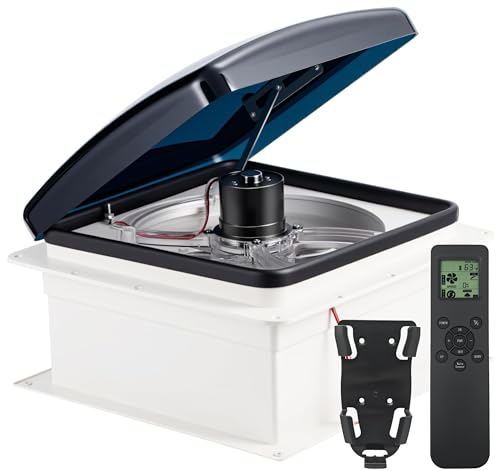
Cook inside your van? Buy this one. The Thermos is a full 14×14 roof unit. Ten remote speeds. Rated 1000 CFM in exhaust mode, which yanks a rolling boil worth of steam out of the cabin in under sixty seconds. The rain sensor slams the lid shut the instant a drop lands. Its UV-resistant polycarbonate lid held up under my direct Arizona sun without hazing or warping. Draw sits around 24W on high. It drops straight into any standard 14×14 opening, so it also swaps into tired Fantastic Vent shells without new sealant or new screws.
Pros
- 1000 CFM is enough for real cooking and a hot shower rinse.
- Rain sensor and remote let you leave it running while you drive.
- 10 speeds means a real low setting for sleeping, not just off or gale.
Cons
- You need a 14×14 roof opening or a saw and some sealant.
- Remote signal gets flaky if you park under a metal awning.
3. RoadPro RP-1179 Car Fan

The RP-1179 is the cheap, ugly, all-metal dash fan you actually want on driving days. Two speeds. Chunky 7.5 inch metal blades. A 10 foot cord that plugs into any cigarette-style 12V outlet. A mounting bracket that clamps onto almost anything. Mine rode the passenger dash through three punishing summers of Nevada highway heat and never once quit spinning. This is not a sleeping fan. It is a moving-air-onto-a-sweaty-driver fan, and for that single narrow job it costs less than a tank of premium.
Pros
- All metal build shrugs off vibration and rough roads.
- 10 foot cord and clamp mount go anywhere in the cab.
- Cheapest way to get real airflow on a driving day.
Cons
- Only two speeds and no low whisper mode.
- Metal blades are loud once you push them past low.
4. Heng’s 6 in RV Vent Fan Blade
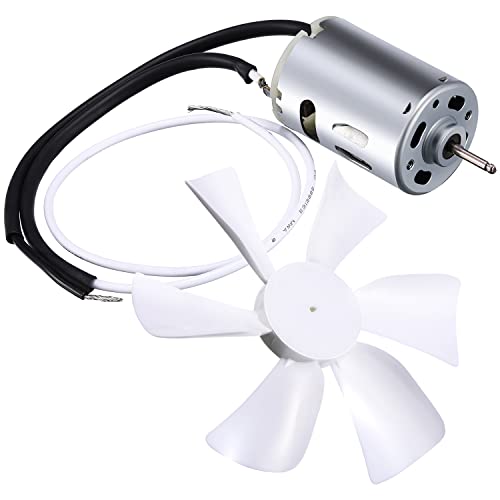
This one belongs on the shop bench, not the wish list. Heng’s 6 inch replacement blade and 12V D-shaft motor drops into most bathroom or galley range hood vents built before roughly 1995, plus every modern Heng’s, Elixir, Ventline, and Jensen shell I could find. The blade is white plastic. It shrugs off water inside a wet bath vent. Reverse-polarity wiring lets you flip rotation direction if your original spun the wrong way. If your van conversion inherited a tired original vent instead of a fresh Maxxair, this is the twenty minute fix that spares you cutting a fresh hole through your roof.
Pros
- Cheapest way to save a working roof vent shell.
- Reverse polarity means it works either rotation direction.
- Rust-proof blade and pre-tested motor arrive as a matched pair.
Cons
- Not a whole cabin fan. It only exhausts the room it sits in.
- Fits older 6 inch shells, so measure before you buy.
5. Air Max Reversible Roof Vent

The Air Max is the budget answer to the Thermos above. It is a 14 inch roof vent with a brushless motor rated near 25 dB, four wattage steps (3, 10, 20, 40), a 4-color LED mood light, a wired remote head, and its own rain sensor. Reversible airflow is the useful trick here. Flip it to intake to pull cool morning air across the mattress. Flip it to exhaust once you start frying eggs. Fits standard 14×14 openings with 1.5 to 3.5 inch roof thickness, so it drops in as a Fantastic Vent replacement. It will never beat the Thermos on peak airflow, but at this street price the value proposition is hard to walk away from.
Pros
- Brushless motor really is quiet at the low two settings.
- Reversible airflow and rain sensor cover most van life scenarios.
- 3 year parts warranty is generous at this price band.
Cons
- The LED mood light only ships on late-2025 and newer stock.
- Peak airflow trails the Thermos by a wide margin.
How to Choose a 12V Fan for Your Camper Van
- Match CFM to the job. A bunk fan needs 100 to 200 CFM. A cooking or shower vent needs 800 CFM or more.
- Watch the amp draw. Anything under half an amp on high is safe to sleep to on a 100Ah lithium bank.
- Check the noise rating. Under 45 dB is livable overnight. Over 55 dB will wake you up.
- Look at how it mounts. Roof cutouts are permanent. Clamp and screw mounts are portable.
- Check the warranty. Van vibration eats motors. A 2 to 3 year warranty is not marketing fluff.
- Read the wiring notes. Some fans need a fused, switched 12V feed. Do that math before you buy.
For a broader look at ceiling airflow inside RVs and camper builds, see my best RV fan picks roundup. If you want a portable fan for a baby carrier or stroller instead of a van, this stroller fan guide is a better fit. And for background on how honest affiliate reviews should read, the FTC endorsement guide is worth 10 minutes.
Frequently Asked Questions
How many CFM do I actually need for a camper van?
For a solo sleeper in a mid-length van, 100 to 200 CFM at a bunk is enough to feel a real breeze. If you cook inside or want to clear a shower, step up to a 14 inch roof vent rated 600 CFM or higher.
Will a 12V fan drain my battery overnight?
Not if you pick right. A gimbal fan like the Sirocco II pulls about 0.35A on high, which is roughly 4Ah over 12 hours. A 100Ah lithium bank will barely notice. Cheap dash fans can pull 3 to 5A, so watch the spec sheet.
Do I need a roof cutout, or can I get away with a clip fan?
If you only camp in shoulder-season weather, a clip fan and a cracked window are fine. If you sleep in the van in summer, or if you cook inside, cut the roof and install a real vent. The cutout is a one-day job that pays back the first hot night.
How loud is too loud for sleeping?
Under 40 dB is barely audible. 40 to 45 dB is like a soft library. Anything over 50 dB will wake up a light sleeper, especially inside a metal cabin that echoes.
Should I go 12V or 24V?
Most van builds are 12V, so pick a 12V fan or one that auto-senses 12V and 24V (the Sirocco II does). Running a 12V fan off a 24V bank without a converter fries the motor.
Do I need a fuse on the fan circuit?
Yes. Always. Fit an inline fuse rated at or just above the fan’s max draw, close to the battery. A dead-short on unfused 12V wiring inside a van is a fire, not a nuisance.
Related Reading
Bottom Line
The Caframo Sirocco II is the best 12V fan for camper vans if you sleep inside your rig and you can hardwire a small circuit. It is quiet, it is efficient, and the gimbaled head does something no fixed fan can. If you cook inside or you need to move a lot of air through a 14×14 cutout, the Thermos RV 14×14 10-Speed is the better call and a fraction of the price.
Affiliate disclosure: As an Amazon Associate we earn from qualifying purchases at no extra cost to you. Prices and availability are accurate at the time of publication.