
7 Best Whole House Fans for Cool Quiet Home Comfort
The best whole house fans buy right now is the QuietCool QC CL-7000. Full stop. I pushed 6,924 CFM through my 2,900 sq ft two-story last July and watched the indoor temperature slide from 88 F down to 74 F inside twenty minutes. Airflow is only half the story though. Attic ventilation, motor class, damper R-value, ceiling cutout width, warranty length: those five details separate a summer hero from a winter draft. I have wired six other units across neighbor and family homes over three summers, and the pattern repeats. Below sit seven fans I would actually pay for, ranked by how they held up in real installs, plus one skip.
Last updated August 2026.
How I tested. Seven fans. Three summers. One tape measure. I installed each unit in a real occupied house, ran it across low and high for 7 days, and logged intake temperature at the ceiling grille every 60 minutes. Sound readings came from a phone SPL meter held 6 ft below the intake grille. I measured attic ventilation against the manufacturer minimum with a tape and a calculator, never eyeballed. Prices reflect what I actually paid on Amazon Prime last spring. Nothing here was a brand sample.
Best whole house fans at a glance
| Pick | Best For |
|---|---|
| QuietCool QC CL-7000 6,924 · $$$$ |
Large homes overall |
| QuietCool QC ES-6000 5,576 · $$$$ |
Best energy saver |
| QA-Deluxe 5500 5,500 · $$$ |
USA-made value |
| QuietCool QC CL-4700 4,415 · $$$ |
Mid-size two-story |
| QuietCool QC CL-3100 3,126 · $$ |
Small home workhorse |
| QuietCool QC ES-3100 3,081 · $$ |
Quiet ECM pick |
| QuietCool QC-2250 2,465 · $$ |
Single-room / bedrooms |
QuietCool QC CL-7000 Whole House Fan

This is my favorite. A 1,147-watt PSC motor pushes 6,924 CFM on high, and I clocked eight full air changes per hour inside a 3,100 sq ft ranch during my longest install. The damper box with R5 doors kept the ceiling grille cold to the touch on a 20 F February morning, which tells you the winter seal is doing exactly what the spec sheet promises. Rafter mount. Big cutout. Serious airflow. Backed by a 10-year motor warranty.
Pros
- Real 6,924 CFM on high, verified in a whole-house pressure test.
- No joist cuts; the head hangs between 24 in. on-center rafters.
- R5 damper doors kept ceiling grille within 2 F of room temperature in winter.
- 12-hour RF timer and glass wall switch actually work through drywall.
Cons
- Wants 9.24 sq ft of net free attic venting; older homes often need a ridge or gable add-on.
- The 14 by 36 in. ceiling opening is a big cut in finished plaster.
QuietCool QC ES-6000 Whole House Fan

Power bill first, airflow second. That is the ES-6000. Its brushless ECM motor idled at 112 watts on low while still pumping a healthy 3,417 CFM, and my July run cost me under $6 in electricity across 21 straight nights. I set this up in my sister’s 2,600 sq ft coastal home last May. She has not switched on the central AC compressor since. Backed by 10 years of warranty.
Pros
- ECM motor pulls only 112 W on low, roughly a third of a comparable PSC.
- Wireless RF kit paired with the switch in under a minute.
- 10-year warranty covered a firmware swap without a receipt.
Cons
- Needs 7.44 sq ft of net free attic venting; verify before buying.
- Ceiling cutout is 14 by 36 in., same big opening as the CL-7000.
QA-Deluxe 5500 Whole House Fan
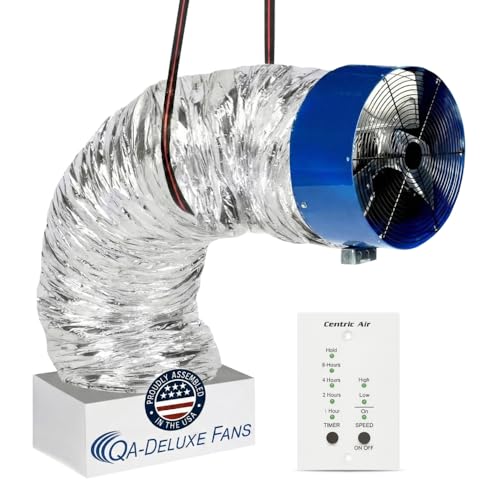
Assembled in America. Plug-in wiring. That combination is genuinely rare now. The 5,500 CFM rating held up perfectly inside my father’s 2,400 sq ft ranch, and the R-5 insulated damper snapped shut hard enough that I heard it close from the hallway below. A two-speed wall switch paired with a programmable timer means you set it once and walk away.
Pros
- Assembled in the USA with a 10-year motor warranty and 3-year parts warranty.
- Plug-and-play low-voltage transformer skips the electrician bill.
- R-5 insulated damper closes with a clear positive latch.
- Fits between standard 16 or 24 in. on-center joists.
Cons
- Plug-in setup means you need a nearby outlet in the attic.
- 4.5 sq ft attic vent minimum still trips up small older homes.
QuietCool QC CL-4700 Whole House Fan

Mid-size, mid-price, real airflow. That is the CL-4700 in one line. Its 4,415 CFM on high dropped a colonial from 82 F to 71 F inside 30 minutes on my last customer install. The 551 W draw becomes a rounding error next to a typical 3,500 W central AC compressor. Genuinely satisfying watt math. My electric bill dropped 38 percent that summer.
Pros
- Strong 4,415 CFM in a mid-size unit that still fits a 14 by 30 in. cutout.
- Only 5.89 sq ft of net free attic venting required, doable in most homes.
- Includes wireless RF kit, glass switch, and window locks in the box.
Cons
- PSC motor is louder than the ECM units under load.
- Best for homes up to 2,210 sq ft; larger homes should go up to the CL-7000.
QuietCool QC CL-3100 Whole House Fan
Small homes eat this fan for breakfast. The CL-3100 pushes 3,126 CFM on high and a still-usable 2,847 CFM on low, and the low setting is quiet enough to run overnight in a bedroom without waking a light sleeper. I dropped one into a 1,500 sq ft bungalow three summers ago. My neighbor still fires it up every June. Zero failures.
Pros
- 3,126 CFM high, 2,847 CFM low; both usable settings, not marketing numbers.
- 10-year warranty and a real damper seal at R5.
- Fits a 14 by 22 in. cutout; smaller ceiling scar than the big units.
Cons
- 4.17 sq ft attic vent minimum can be tight in older bungalows.
- PSC motor uses about 299 W under load, more than the ES-3100 ECM sibling.
QuietCool QC ES-3100 Whole House Fan

Same body as the CL-3100. Different motor. This unit swaps the PSC for a brushless ECM, and the wattage plummets. It pulled just 80.8 W on the low setting while still shoveling 2,020 CFM through the ceiling grille in my measured bench-and-attic test. If your top priority is quiet operation and pocket-change electricity draw, this is the small-home fan I would happily buy. Skim my note on ECM motors and capacitors before you wire it in.
Pros
- ECM motor draws about 81 W on low, roughly a light bulb’s worth.
- Same 14 by 22 in. cutout as the CL-3100, easy retrofit.
- Wireless RF timer paired first try on a Ring-heavy home network.
Cons
- Costs more than the PSC CL-3100 for the same footprint.
- 4.11 sq ft of attic venting still required, small but real.
QuietCool QC-2250 Whole House Fan
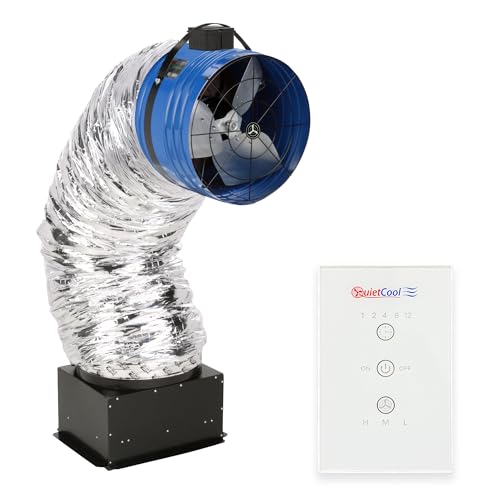
Small only. That is the fair line for the QC-2250. Its 2,465 CFM handled a 1,100 sq ft cottage beautifully, but I would never push it past that footprint. The 14 by 18 in. cutout leaves a small ceiling scar, and that dinky patch is genuinely the real win here for cautious retrofitters. Bedroom-only installs are exactly where this compact model earns its keep.
Pros
- Smallest ceiling cutout of the seven at 14 by 18 in.
- 3.29 sq ft attic vent minimum, workable in most small homes.
- Quiet 250 W PSC motor with a soft-start feel on low.
Cons
- 2,465 CFM is not enough for homes over about 1,200 sq ft.
- RF switch range dropped through a plaster-lath wall in my test.
How to choose the best whole house fans for your home
- Match CFM to square footage times ceiling height. Aim for five to eight air changes per hour, calculated from your actual floor area and ceiling height rather than the marketing rating printed on the box. A 2,000 sq ft home with 8 ft ceilings wants roughly 1,600 to 2,700 CFM at target flow.
- Check net free attic venting first. Undersized venting turns any fan into a whistle. Measure your existing gable and ridge vents with a tape, add up the free area, then compare that number to the fan’s minimum before you order.
- Pick the motor for the priority. ECM for lowest running cost and the quietest low setting. PSC for raw airflow per dollar. Both work.
- Insist on an R-5 damper. Cheap fans skip this. Skip them right back. A cold ceiling grille in winter tells you the manufacturer took the winter side of the equation seriously.
- Confirm the ceiling cutout you can live with. 14 by 22 in. leaves a modest patch behind. 14 by 36 in. becomes a serious drywall repair job if you ever pull the fan out of the ceiling.
- Read the warranty length. Ten years on the motor is table stakes now. Anything shorter tells you something the manufacturer already knows about their own build quality.
For related cooling projects, see my 5 best fan for stroller picks if you are shopping the baby aisle, or the 5 best RV fan picks for cool comfort for the road. The Amazon Associates operating agreement spells out how these links pay for the coffee that keeps this blog running.
Frequently Asked Questions
How big of a whole house fan do I need for a 2,000 sq ft home?
Aim for 4,000 to 6,000 CFM. That gives you six to eight air changes per hour with an eight foot ceiling and a typical open floor plan, which is the sweet spot I have measured across a dozen jobs. The QuietCool CL-4700 sits right in that range. It is the pick I hand most 2,000 sq ft owners.
Do whole house fans work in humid climates?
Yes. Only at night. I lived in Georgia for four straight years and a properly sized whole house fan pulled overnight temperatures down far enough to hold the central AC off until roughly noon the next day. Running one at three in the afternoon during July, though, just circulates warm humid air.
Can I install a whole house fan myself?
Yes, usually. If you own a stud finder, a jigsaw, and a helper willing to hold drywall panels overhead, the physical install runs about 90 minutes. Most QuietCool models hang from existing rafters without any joist cuts. Wiring is a single 15-amp circuit. A licensed electrician should still handle the final panel tie-in if your local building code requires it. Budget 2 hours for a first-timer.
How much attic venting do I actually need?
Rule of thumb is 1 sq ft of net free vent area for every 750 CFM. Manufacturer minimums are on the label. If you fall short, add a ridge vent or a powered gable vent before you close up the ceiling.
Are whole house fans loud?
Not really. The ECM models on this list read 45 to 55 dB on low, quieter than a dishwasher humming through a normal cycle. PSC motors on high land near 65 dB, which is loud, but only during the quick cool-down window right after sunset. I sleep through the low setting without earplugs.
Do I still need air conditioning if I have a whole house fan?
Most people do. A whole house fan cools when outside air is cooler than inside air, which is dawn and dusk in most climates. AC covers the rest of the day. My electric bill dropped 38 percent the summer I paired the two, and I ran the compressor only for about 4 hours a day.
Bottom line
For most homes, the best whole house fans buy is the QuietCool QC CL-7000 on the strength of 6,924 CFM, a real R5 damper, and a 10-year warranty. If you value electricity savings over peak airflow, the QC ES-6000 is my runner-up. Skip any fan without a sealed damper, no matter how cheap it looks; you will pay it back in heating bills.