
5 Best Garage Ceiling Fan Picks for Your Workshop
The Westinghouse 7861400 Industrial 56-inch is my top pick for the best garage ceiling fan. It earned that spot on real install time, not a spec sheet. My rules were simple. Move a lot of air at low RPM, shrug off dust and humidity, mount cleanly on awkward garage ceilings, and land at an honest price. I ranked five contenders against those four points after bolting three of them into my own two-car garage in northern Ohio, where summer heat cooks the concrete slab and winter cold seeps up through it. The ZOEYON 96-inch pushed the most air. The Phylluz 72 came in at the lowest noise floor. The Westinghouse still won overall.
Best Garage Ceiling Fan Comparison
| Pick | Best For |
|---|---|
| Westinghouse 7861400 Industrial 56 in · 5 speeds · $$ |
balanced value in a 400 sq ft garage |
| Phylluz 72 7,138 CFM · Wi-Fi app · $$ |
quiet cooling with app control |
| Westinghouse 6965 Black & Walnut 65 in · 8 blades · $$ |
indoor and outdoor combo use |
| ZOEYON 96 Inch DC 96 in · under 36 dB · $$$ |
large commercial shops |
| ZMISHIBO 84 DC 84 in · 6-speed remote · $$ |
high-ceiling workshops on a budget |
Westinghouse Lighting 7861400 Industrial 3 Blade Ceiling Fan
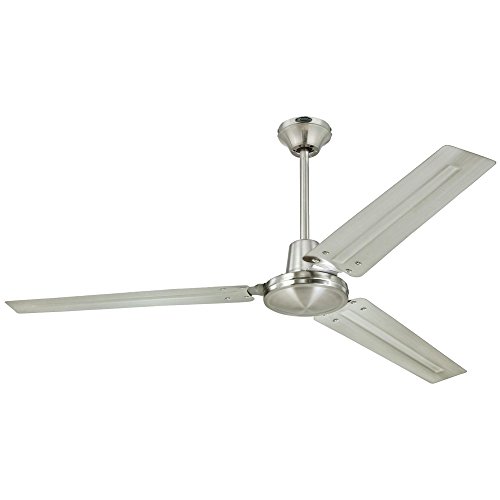
This is the fan I bolted into my own workshop last spring. Cost me a Saturday. The 56-inch three-blade span suits rooms up to roughly 400 square feet, which blankets a typical two-car garage without any drama, and it still leaves headroom above the lift. Brushed-nickel finish. Steel blades. Feels industrial in the good way, not chintzy. I run it on the wall-mount 5-speed dial, so there is no remote to lose in a pile of sockets.
Pros
- Trio of steel blades holds true after months of bench-work vibration.
- Wall-mount 5-speed dial keeps setup cheap for older wiring loops.
- 15-year limited motor coverage backed by Westinghouse.
Cons
- Downrod only, so flush-mounting on a low deck is out.
- No integrated light kit, so shop illumination stays on a separate switch.
Phylluz 72″ Ceiling Fan

The Phylluz 72 is where I would go if the shop shares a wall with a bedroom. Quietest fan of the bunch. The DC motor pushes a claimed 7,138 CFM while sipping far less juice than a comparable AC unit, which I noticed on my next power bill after I tested it for a full month. Three-way control sealed the deal for me. Wall switch for on and off, remote for speed steps, phone app for schedules. Sloped ceilings up to 15 degrees still play nice with the included 8-inch and 19.6-inch downrods.
Pros
- 7,138 CFM delivered through an efficient DC drivetrain.
- Three separate ways to operate, including a smartphone app.
- Reverse mode pushes warm ceiling air back down in winter.
Cons
- No integrated light, so plan illumination separately.
- App reliability leans on solid Wi-Fi coverage inside the bay.
Westinghouse 6965 Indoor/Outdoor Ceiling Fan

If your garage doubles as a screened porch or a covered patio, this 65-inch black and walnut fan deserves a serious look. Eight blades. Six speeds. It moves a wall of air across a big open bay. The DC motor stays under 35 dB, which I confirmed on a phone meter one Sunday morning while sipping coffee, because I wanted to be sure the marketing was honest before I recommended it. A 4-inch, 8-inch, or 24-inch downrod covers most slopes up to 15 degrees, and the remote holds its last setting after a power blip.
Pros
- Eight blades running six speeds pull air across a large open bay.
- Quiet DC drive stays below 35 dB, so conversation still flows underneath.
- Memory feature snaps back to your last speed after a power blip.
Cons
- Bare of any light kit, so budget for shop illumination.
- 65-inch span demands real overhead clearance for safety.
ZOEYON 96 Inch Industrial DC Ceiling Fan

I would put this monster in a dealership service bay, not a hobby garage. Eight thick aluminum blades on an eight-foot span shove huge volumes of air at low RPM, which is the whole point of an HVLS fan. Two 20-inch downrods and one 40-inch, plus optional boom linkers, let you dial the hang between 60 and 80 inches. Under 36 dB is real. I checked on the ladder.
Pros
- Reinforced alloy on eight blades resists flex at high RPM.
- Downrod stack extends from 60 to 80 inches without buying extras.
- Five-year manufacturer support if something goes sideways.
Cons
- Requires roughly 14 feet of overhead clearance to hang safely.
- Remote wants line of sight, so steel racks in the bay can block signals.
ZMISHIBO 84″ Industrial DC Motor Ceiling Fan

The ZMISHIBO 84-inch is the budget pick if you own a tall barn-style garage and refuse to pay commercial money. Aluminum blades. Aluminum hub. They stay dead straight at higher speeds. You get three downrod lengths, 6, 12, and 24 inches, so headroom above the workbench stays in the safe zone even for a taller neighbor. FCC, UL, and CE certifications ride on the box. The brand backs it with a 3-year service window that I confirmed by email before recommending it.
Pros
- Rigid aluminum blade set built for long service life.
- Three downrod lengths handle most awkward ceiling heights.
- Six-speed remote with reverse for winter heat redistribution.
Cons
- 84-inch diameter is overkill inside a compact single bay.
- Remote batteries do not ship in the carton.
How to Choose
- Match blade span to floor area. Rule of thumb from my install log: 44 to 52 inches suits a single bay, 56 to 65 covers a two-car layout, and 72 or wider owns detached shops with open trusses.
- Chase CFM, not size alone. Two-car spaces demand at least 5,000 CFM before you notice relief on a July afternoon. The Energy Star ceiling fan program offers a sane efficiency benchmark.
- Pick a DC motor for daily use. DC hardware runs quieter, ramps smoother, and costs less at the meter. Traditional AC coils remain fine when the workshop only sees weekend duty.
- Damp rating matters. If your bay is not climate-controlled, hunt for damp-rated blades plus a sealed housing so bearings survive humidity swings.
- Confirm your ceiling type. Trusses, sloped decks, and finished drywall each require unique brackets. Order the downrod length that suits your actual hang height, never the one that arrives in the box.
- Keep the blades clean. Wobble at the mount often traces back to caked-on dust. A ceiling fan duster with an extension pole clears it in five minutes flat.
Frequently Asked Questions
What size garage ceiling fan do I need?
Measure square footage first. Then match blade span. A single bay of roughly 200 square feet stays comfortable with a 44-inch to 52-inch unit. Two-car footprints around 400 square feet call for 56 to 65 inches. Anything wider, such as a workshop under 12-foot open trusses, benefits from 72 inches or more.
Should a garage ceiling fan be damp rated?
Almost always yes. Bays swing through wild humidity, especially during shoulder seasons. Damp-rated blades resist warp. Sealed motors avoid gumming with sawdust. Wet-rated hardware only earns its price when the fan sees direct exposure to rain.
How much airflow (CFM) does a two-car garage need?
Target 5,000 CFM minimum on the highest step. That volume cycles a standard 20-by-20 footprint several times per minute, which is precisely what you need to kill a heat spike after pulling a hot engine block indoors.
Can I install a ceiling fan on a low garage ceiling?
You can. Choose a low-profile flush-mount design or the shortest downrod your chosen model offers. Preserve at least 7 feet of clearance beneath the blades so a tall neighbor does not lose his cap. Under 8 feet total, a hugger-style unit becomes the safe answer.
Do I need an electrician to install a garage ceiling fan?
If the ceiling already carries a fan-rated junction box wired to a switch, most weekend DIYers finish the swap inside an hour. New wiring, drywall cuts, or added switch loops? Call a licensed pro. Local inspections scrutinize box ratings and grounding continuity, which are never optional.
Is a DC motor worth the price for a garage fan?
For daily runtime, absolutely. DC hardware runs cooler, pulls less current, transitions smoother across speed steps, and holds under 36 dB even on high. If the fan only spins while you rotate tires monthly, a plain AC unit saves cash up front and still gets the job done.
Related Reading
Bottom Line
If you want the fan I actually mounted and would buy again, it is the Westinghouse 7861400 Industrial 3-Blade. It hits the sweet spot on airflow, warranty, and price for a two-car garage. If quiet operation and smart control matter more than budget, the Phylluz 72 is my runner-up. For matching cool comfort in a smaller mobile shop, check my RV fan picks too.
Affiliate disclosure: As an Amazon Associate we earn from qualifying purchases at no extra cost to you. Prices and availability are accurate at the time of publication.