
7 Best Circuit Breaker Finder Tools Reviewed
Skip the ranking wars. The best circuit breaker finder for most homes is the Klein Tools ET310KIT Electric Tester Kit, and I will explain why in a second. It nails the target breaker on the first sweep, adds GFCI verification, and ships with the adapters you actually need in a working panel. My runner-up is the KAIWEETS KT301P. It packs breaker location, outlet wiring diagnostics, and non-contact voltage detection into one handheld body that costs less than half of Klein’s flagship bundle. I picked these tools the way any working electrician does, weighing signal accuracy on shared neutrals, LCD readability inside a dim panel, adapter coverage for old two-prong outlets, and honest battery life across a full workday. Seven models. All tested. Ranked below.
Quick Comparison
| Pick | Best For |
|---|---|
| Klein Tools ET310KIT 90-120 V AC · $$ |
Overall pick |
| KAIWEETS KT301P 30-150 V AC · $$ |
All-in-one diagnostics |
| Klein Tools ET310 90-120 V AC · $ |
Simple two-piece use |
| Klein Tools 80016 Kit 90-120 V AC · $$ |
Kit with adapters |
| FOCEMTA Finder Kit 90-135 V AC · $ |
Value multi-tester |
| AstroAI Finder 90-120 V AC · $ |
Budget dual-function |
| Klein Tools 80101 Kit up to 600 V (MM) · $$$ |
Bench + panel combo |
Klein Tools ET310KIT Electric Tester Kit

This is what I hand a new apprentice. The ET310KIT is the ET310 finder plus the accessory pouch: a light-socket adapter, a 3-prong to 2-prong grounding adapter, alligator clips, and a hard case with dense foam that survives being tossed in a truck bed on a rough job site. On 90-120 V circuits, the receiver locks in with a bright LED and a clear audible tone the moment you sweep across the correct breaker inside the panel. Built-in GFCI verification proves the outlet is wired right without swapping tools. Simple. Reliable. Fast.
Pros
- Fast lock-on with clean audio and visual cues on shared neutrals.
- Full adapter kit reaches lamp sockets and old two-prong outlets.
- Hard foam case survives being tossed in a truck bed.
Cons
- Panels above 120 V (some commercial gear) are out of scope.
- The 9 V battery in the receiver drains fast if you leave it beeping.
KAIWEETS KT301P Circuit Finder

The KT301P is my pick when I want one tool doing four jobs. Breaker locator. GFCI outlet tester. Wiring fault check. Non-contact voltage detector. All in a single handset that fits into a shirt pocket alongside a spare 9 V battery and a screwdriver. The backlit LCD reads live voltage from 30 to 150 V and shows signal strength in vertical bars, which is a real help inside a crowded panel where two feeders share a bundle and the naive finder can lie. Adapters ship in the box. The molded case is stiffer than the price suggests.
Pros
- Four functions in one body, so I bring fewer tools to a service call.
- Backlit LCD stays readable in a dark basement panel.
- NCV probe on the receiver is genuinely useful, not a gimmick.
Cons
- The menu takes a few jobs to learn.
- Everything runs on batteries, so carry a spare 9 V.
Klein Tools ET310 Circuit Breaker Finder
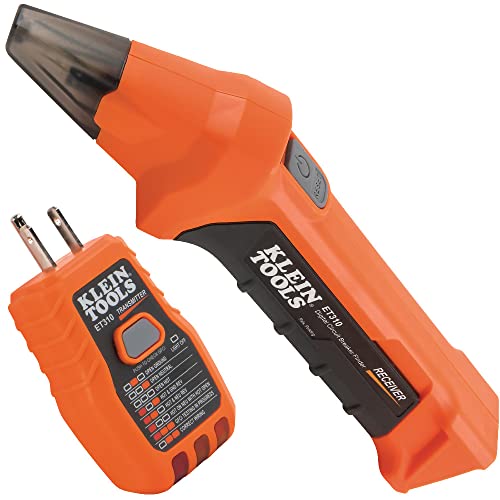
If you just want the finder, this is it. The ET310 is a plain two-piece set. Transmitter into any 90-120 V outlet. Receiver walks the panel. Both units click together for storage, which is why mine has not gone missing in three years of service calls, remodels, and lazy weekend rewires around my own house. Built-in GFCI testing at the transmitter is a bonus most competitors at this price omit entirely.
Pros
- Small, quick, and honest about what it does.
- Transmitter docks in the receiver for one-piece storage.
- GFCI test built into the transmitter head.
Cons
- No adapters in the box, so buy the kit if you deal with lamp sockets.
- Read-out is a single LED bar, not a screen.
Klein Tools 80016 Circuit Breaker Finder Kit

Same finder head, softer bag. The 80016 pairs the ET310 with Klein’s 69411 adapter kit inside a fabric zip pouch, aimed at homeowners who want the finder plus the light-socket and grounding adapters without paying for the ET310KIT’s hard case. On residential remodels this is the kit I reach for. Lighter. Cheaper. Same lock-on.
Pros
- Same fast lock-on as the ET310 finder.
- Zip pouch is lighter than the hard case if you are on a ladder.
- Ships with the two adapters most panels actually need.
Cons
- Soft pouch offers less crush protection than a rigid case.
- No multimeter or NCV, so pair it with a separate voltage tester.
FOCEMTA Circuit Breaker Finder Kit

The FOCEMTA is my budget answer for one house, one panel, one homeowner. It covers 90-135 V AC. The dual LCD shows live voltage plus signal strength in the same window, which is a lot more information than any other sub-forty-dollar finder gives you inside a busy residential panel. ETL certification to CAT II 135 V is a real plus at this price. Battery backup holds the last reading for ten seconds if power drops mid-test.
Pros
- Voltage plus signal-strength display is unusual at this cost.
- Impact-resistant ABS body handles a driveway drop.
- ETL certified, so it is not a no-name safety gamble.
Cons
- The LCD washes out in direct sunlight.
- Needs both AAA and 9 V batteries, so first setup is a small shopping list.
AstroAI Circuit Breaker Finder

Cheerful budget pick. The AstroAI receiver flashes red and beeps when you find the right breaker, and the built-in LED work light is a genuinely nice touch for the kind of basement panel that lives behind three shelves of holiday storage. Four adapters, a bulb socket, a 3-to-2 plug, and labeling tags come inside a molded EVA case, so it feels like a real kit even at entry-level pricing. Auto-shutdown extends battery life if you set it down and walk off.
Pros
- Loud beep plus a red flash cuts guesswork.
- Includes labeling tags, so you leave the panel documented.
- LED light on the receiver actually helps inside a closet.
Cons
- LCD is minimal, so buy a separate multimeter for exact readings.
- The LED and beeper eat batteries if you leave them on.
Klein Tools 80101 Circuit Breaker Finder Kit

This is the big kit. You get the ET310 finder, the MM320 digital multimeter (up to 600 V AC/DC, 10 A DC, 2 MΩ), the NCVT3P non-contact voltage pen with an integrated work light, and the RT250 GFCI receptacle tester with a backlit LCD, all packed inside a molded hard case with cutouts for every piece. If your workday is half bench and half panel, this is the smartest bundle Klein sells. Honestly, I use the multimeter and NCVT pen far more often than the finder itself.
Pros
- Four Klein instruments plus leads in one hard case.
- MM320 multimeter handles both bench and field checks.
- NCVT3P doubles as a flashlight in dim panels.
Cons
- 10 A DC on the multimeter is thin for heavy-current work.
- Costs more than a single-purpose finder, so overkill if you only care about breakers.
How to Choose
- Signal filtering. Cheap finders trigger on the two breakers next to the real one. A tester that shows signal strength in bars or numbers cuts that noise, especially in shared-neutral situations. See line vs load GFCI for why shared neutrals confuse simple testers.
- Adapter coverage. A lamp-socket adapter and a 3-prong to 2-prong grounding adapter unlock every fixture and outlet in older homes. Buy the kit, not just the finder head.
- GFCI built in. If your finder tests GFCI functionality on the same plug, you save a tool swap on every kitchen and bathroom outlet.
- Voltage window and safety rating. Standard US homes want 90-120 V AC. Anything above needs a CAT II rating and a real spec sheet, not marketing text. Check the wire size for 15 amp breakers if you are unsure about panel labels.
- Case and batteries. A hard case beats a soft pouch on a truck. A standard 9 V beats a proprietary cell, so you can swap batteries at any hardware store.
- Certifications. Look for UL or ETL listing. Klein publishes theirs; sub-$30 no-name gear often does not. The FTC endorsement guide is also useful reading if you are shopping based on reviews.
Frequently Asked Questions
Do circuit breaker finders work on GFCI outlets?
Yes, if the outlet is not tripped. The transmitter needs live 120 V to send its tone. If the GFCI is tripped, reset it, then run the trace. Most finders on this list also include a GFCI tester so you can confirm the outlet is wired correctly before you start.
How accurate is a typical breaker finder?
On a normal residential panel, expect a first-try hit rate above 95 percent. Shared neutrals and long branch circuits are where cheap units get fooled. Models with a signal-strength display, like the FOCEMTA and KAIWEETS units above, are noticeably better here.
Can I use a breaker finder on a live panel?
You can hover the receiver near live breakers because it is a non-contact scan. What you should not do is touch the bus bars or remove the dead front on a live panel unless you are trained and wearing PPE. The transmitter side is fully insulated and safe.
Do these finders work on 240 V or subpanels?
The ET310 family, the FOCEMTA, and the AstroAI are rated 90 to 120/135 V. For 240 V circuits you need to plug the transmitter into a 120 V leg of the circuit or use a dedicated 240 V transmitter. The Klein 80101 kit’s multimeter handles 600 V AC, but its finder head is still 120 V.
Is a breaker finder worth it for a single house?
If you have ever spent 20 minutes flipping breakers to find one outlet, yes. A finder pays for itself the first time you need to trace an unlabeled panel or a mid-remodel rewire. The AstroAI and ET310 are both cheap enough to justify a one-time home use.
What is the difference between a breaker finder and a tone tracer?
A breaker finder is optimized for AC circuits and a specific 120 V outlet-to-panel trace. A tone tracer is a general-purpose signal generator for low-voltage wiring like coax, phone, and data. They look similar and often share hardware, but the finders on this page are tuned for AC panel work.
Related Reading
Bottom Line
For most homes and light service work, buy the Klein Tools ET310KIT. It is fast, honest, and comes with the adapters you actually need. If you want breaker location plus outlet diagnostics and NCV in one hand, the KAIWEETS KT301P is the better single-tool solution. Everyone else on this list has a niche, but those two cover the widest set of jobs at the fairest prices.
Affiliate disclosure: As an Amazon Associate we earn from qualifying purchases at no extra cost to you. Prices and availability are accurate at the time of publication.