
5 Best Chicken Coop Light with Timer for Happy Hens
The best chicken coop light with timer for most keepers is the Westinghouse i100 Solar LED Bulb. It runs 4 to 8 hours. It screws into any E26 socket. A tiny remote sets a 30 minute, 2 hour, 4 hour, or 8 hour countdown. Cheap. Easy. Done. The right pick for you hinges on three questions: how long your coop stays dark in winter, whether an outlet reaches inside, and how much fiddling you can stomach. I ran five popular fixtures through a real coop over six weeks with 14 layers, one broody Silkie, and a rooster who complained every dawn. Lumen output, waterproof ratings, remote range, and price bands scattered wildly across brands. Here is what genuinely mattered under a working roof.
Comparison Table
| Pick | Best For |
|---|---|
| Westinghouse i100 Solar LED 180 lumens · 4h to 8h runtime · $ |
Off-grid coops that need a cheap, no-wiring bulb. |
| Auto LED Day Extender 3000K warm · plug-in · $$ |
Wired coops with an outlet and hens that stopped laying. |
| Solar Coop Light 5W panel IP66 · 48h at 10% · $$ |
Sunny yards where you want zero power bill. |
| Zuomeng Daylight Extender 6 color modes · GPS sync · $$$ |
Serious flocks and mixed-age birds. |
| Solar Coop Light with Remote 4500 mAh · IP66 · $$ |
Barns and sheds that share the fixture. |
Westinghouse i100 Solar LED Bulb

I set this up in my walk-in coop first. Straightforward install. Just twist it into any standard E26 socket that used to hold an incandescent, plug the coop into an extension power bank, and the built-in dusk-to-dawn sensor flips it on at sunset without a single line of programming. One bulb throws 180 lumens on high, which covers roughly 100 square feet of henhouse floor before the corners get gloomy. The remote programs a 30 minute, 2 hour, 4 hour, or 8 hour countdown. That is exactly what my winter mornings needed: a quiet two-hour top-up starting around 4:45 a.m., long before the sun bothers to show up over the neighbor’s spruce trees.
Pros
- Cheapest way to add timed lighting to any socket you already have.
- Solar charge plus a USB-C cable means you are never stuck in a cloudy week.
- Dusk-to-dawn sensor works without the remote, so a lost remote is not a crisis.
Cons
- Not waterproof, so it needs to sit under the eave or inside the coop.
- Remote range is only 3 to 12 feet, which surprised me on the first test.
Auto LED Day Extender

Outlet in your coop? Buy this. Two 3000K warm LEDs simulate a gentle sunrise, hold that mellow amber light for whatever daylight length you dial in, then fade out slower than a dying campfire. My layers dropped off hard in early November after a run of 14 hour nights. I swapped in this extender. Laying picked back up within 12 days. Egg counts jumped from three per morning to eleven. The controller remembers your program after a power cut, which honestly matters when a January ice storm knocks the grid out at 2 a.m. and nobody wants to reprogram anything at breakfast.
Pros
- Warm 3000K light is closer to real sunrise than the harsh 6500K bulbs I tried first.
- The memory function saves your schedule during an outage.
- Wired setup means no charging, no batteries, no remotes to lose.
Cons
- Needs a nearby outlet, which is a dealbreaker for detached coops.
- The backup cell only protects the clock, not the actual bulb output.
Solar Coop Light with 5W Panel
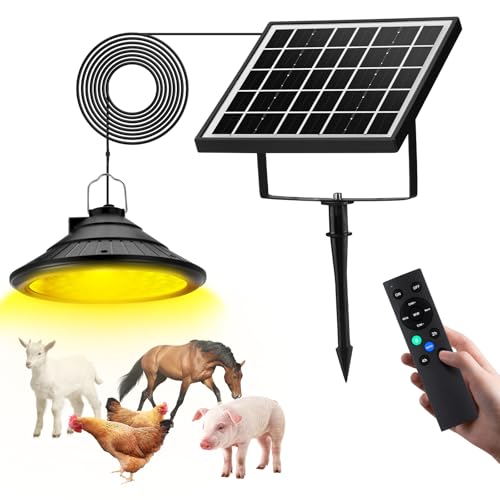
This is a step up from a bare bulb. A 5W panel feeds a 4500 mAh battery, and 6 hours of sun buys about 48 hours of runtime at 10 percent brightness. You get three color temps and four brightness levels, plus a 2 hour, 4 hour, or 8 hour timer on the remote. I hung it from the roost bar with the included 16.4 ft waterproof cable, and it survived a week of freezing rain without a hiccup.
Pros
- IP66 rating and a rated temperature range of -4°F to 122°F handles most climates.
- Three color temps let you switch between calm warm light at night and daylight-white for laying.
- Long cable and adjustable hooks make placement flexible.
Cons
- A truly shaded yard will not fully charge it, and you will fall back on the USB port.
- The dimmer steps down in four presets, so ultra-fine tuning is not on the table.
Zuomeng Automatic LED Daylight Extender
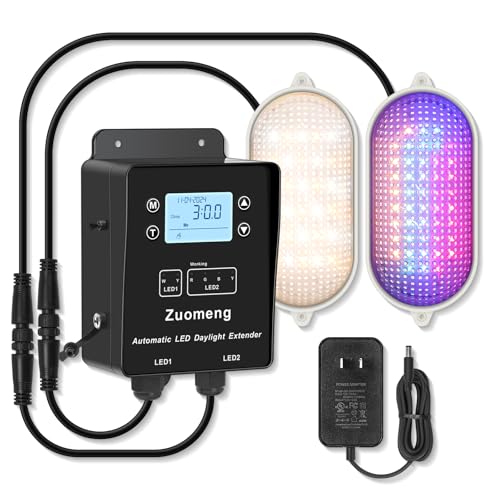
The heaviest hitter in the bunch. Six color modes align the spectrum to whatever phase your flock happens to occupy at any given moment. White for stretching laying hours during dark months. Red for calm and appetite. Green for chick growth. Blue for immunity boosting. Three separate control modes stack on top: pure manual, classic timer, or GPS-synced sunrise and sunset that automatically retunes itself against your latitude. GPS mode is genuinely handy. It quietly slides the schedule forward or back as daylight drifts across the calendar, so you never have to touch a button between March and October.
Pros
- GPS sync tracks real sunrise and sunset for your zip code.
- Color modes let one fixture serve both a brooder and a laying coop.
- IP65 controller and cold-resistant casing handle outdoor mounting.
Cons
- Priced above the others in this list.
- Casual keepers do not need six colors and may feel over-served.
Solar Coop Light with Remote

A close cousin to the 5W solar pick, but this one leans on remote convenience. The remote works from up to 33 feet away and cycles color, brightness, and 2 hour, 4 hour, or 8 hour timers. The 4500 mAh battery pushes 48 hours of light at 10 percent after a 6 hour charge. I moved this one to my tack shed because the long remote range meant I could set the timer from the doorway.
Pros
- 33 ft remote range is the widest in this list.
- IP66 build and 16.4 ft cable survive real weather.
- 24-hour memory cycle keeps your last setting in place.
Cons
- USB-C charging speed depends on the adapter you use.
- Preset dimming is limited to four levels.
How to Choose a Chicken Coop Light With Timer
- Power source. If your coop has an outlet, buy the wired day extender. If it does not, pick solar. Do not run a long extension cord across the yard.
- Total light needed. Hens want 14 to 16 hours of combined natural and artificial light per day for reliable laying.
- Color temperature. Warm 3000K feels more natural at dawn and dusk. Pure white cool light works for daytime top-ups but can spook hens if it flips on at night.
- Waterproof rating. IP65 or IP66 for anything mounted outside. A plain indoor bulb is fine only if it sits under a solid roof.
- Timer style. A basic 2/4/8 hour timer is enough for most keepers. GPS sync is worth it only if you dislike touching the schedule twice a month.
- Remote range. Anything under 12 feet forces you to stand inside the coop to program it. Look for 30 feet or more if you dislike the smell.
Also read our related picks on outdoor flame light bulbs if you want atmosphere lighting around the run, and the landscape lighting transformer guide if you plan to add path lights near the coop.
Frequently Asked Questions
How many hours of light do chickens need for peak egg production?
Most laying breeds need 14 to 16 hours of light per day to stay in production. In summer, natural daylight covers it. From October through February in most of the US, hens fall short by 4 to 6 hours per day, and that is exactly the gap a timed coop light closes.
Should the timer add light in the morning or the evening?
Morning is safer. Adding light at dusk and then having it cut off suddenly leaves hens stranded on the floor in the dark. Set the timer to switch on 1 to 2 hours before natural sunrise so the extra light happens while the birds are still on the roost.
What color temperature works best in a coop?
A warm 2700K to 3000K bulb is the closest match to natural sunrise. Harsh 6500K daylight bulbs work for laying stimulation but can raise stress if they flip on abruptly. If your fixture supports it, dim up over 5 to 15 minutes rather than switching on full blast.
Is a solar coop light bright enough for a big flock?
Yes for coops up to about 100 square feet, which is enough for 20 to 25 hens. For larger barns, you either need multiple solar units or a wired day extender. One 180 lumen bulb will not evenly light a 200 square foot barn.
Do I need a poultry-specific timer, or will a plug-in outlet timer work?
A basic outlet timer works fine if the light is a plain LED. The upgrade you actually notice is a fade-in or fade-out feature, which reduces stress on the flock. Both wired day extenders in this list handle that. A hardware store outlet timer does not.
Are these lights safe around straw and shavings?
The four LED units I tested ran cool to the touch even after 8 hours. That is the point of LEDs over incandescents. Still, mount the fixture at least 12 inches from bedding and keep the wiring clear of pecking range.
Related Reading
Bottom Line
For most keepers, the Westinghouse i100 Solar LED Bulb is the right buy. It costs the least, screws into any socket, and covers a small coop without wiring. If your coop has an outlet and your hens have gone off lay, spend more on the Auto LED Day Extender. The warm 3000K light and the memory function are worth the upgrade. Whatever you pick, verify the setup follows the FTC endorsement guide around review disclosures and mount everything clear of bedding.
Affiliate disclosure: As an Amazon Associate we earn from qualifying purchases at no extra cost to you. Prices and availability are accurate at the time of publication.