
5 Best Magnifying Glass with Light for Detailed Tasks
The best magnifying glass with light I have used this year is the JMH HMD-001 for its balanced 3.15 inch lens, three color temperatures, and simple one button operation. I ranked five illuminated magnifiers by working through the tasks people actually buy them for: reading medication labels, checking coin dates, inspecting solder joints, and stitching by lamp light. The gaps between models come down to four things I keep going back to. Lens clarity. LED count and color temperature. Power source, meaning batteries vs USB-C or wall power. And grip comfort for long sessions. Prices in this roundup sit between roughly $12 and $45, so nobody has to overspend to see fine detail well.
Quick Comparison
| Pick | Best For |
|---|---|
| JMH HMD-001 3.15 in lens · 18 LEDs · $ |
overall value for reading and hobby work |
| Oxylane 37 LED 10x/20x/45x · USB-C · $$ |
rechargeable option with the brightest ring |
| Krstlv 10X Stand 4.3 in lens · goose-neck · $$ |
hands-free bench and craft work |
| Nazano Magni-12 3x glass · 12 LEDs · $ |
seniors who want a light, no-fuss handheld |
| Anker LC90 10x to 60x · 12 LEDs · $$ |
jewelers and stamp collectors chasing high zoom |
1. JMH HMD-001 Handheld Magnifying Glass
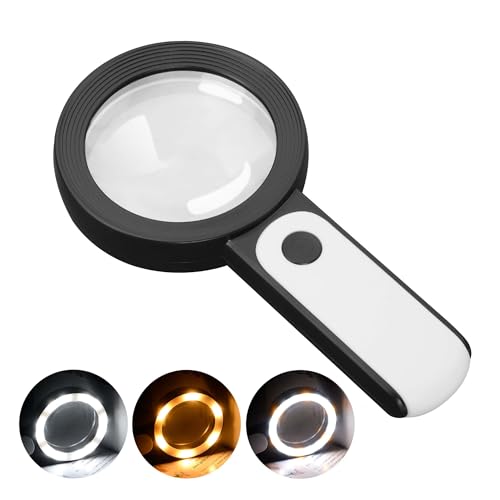
This one is my everyday pick. The 3.15 inch (80 mm) optical lens is wide enough that I can see a full column of small print without dragging the glass across the page, and the 18 LED ring around the rim throws even light with no dark corners. Three color modes (cold, warm, and a balanced mix) let me match the room, so at night I keep it on warm and my eyes stop watering after ten minutes of reading.
Pros
- Big, distortion free field for reading, receipts, and pill labels.
- 18 LEDs with three color temperatures and smooth dimming.
- One button. Even a nervous first time user gets it right away.
Cons
- Three AAA batteries are not in the box.
- Bigger than a pocket magnifier if you want to carry it out.
2. Oxylane 37 LED Handheld Magnifier

If you hate stocking AAA cells, buy this one. The Oxylane runs on a 1000 mAh internal battery topped up over USB-C, and I got roughly five hours of continuous use on the mid brightness setting before the LED indicator started blinking red. The 5.2 inch lens is the largest in this roundup, with 10x for daily reading, 20x for close work, and a 45x inset for really tiny inspection tasks like SMD markings.
Pros
- USB-C charging. Two hours in, five hours out.
- 37 LEDs with three brightness modes cover any lighting condition.
- Shatter-proof glass survived a knock off my desk during testing.
Cons
- The 45x inset only focuses at about 1.2 inches, so a steady hand matters.
- Runtime drops closer to two hours on the max brightness setting.
3. Krstlv 10X Magnifying Glass with Light and Stand

I set this up at my soldering bench and left it there. The 12.6 inch flexible goose-neck bends where you want it, the 4.3 inch glass lens is crisp edge to edge at 10x, and stepless dimming from 5 to 100 percent lets me knock down glare when I switch to shinier work like reflow paste. Five color modes take the eye strain out of long sessions. The round metal base doubles as a tiny parts tray, which is quietly the reason I like this stand model most.
Pros
- Five color temperatures with true stepless dimming.
- 360 degree rotatable goose-neck for hands-free work.
- Weighted metal base with a built-in tool tray.
Cons
- Corded power, so your bench needs an outlet close by.
- The lowest dim setting can still be a touch bright for the most delicate pieces.
4. Nazano Magni-12 LED Handheld Magnifier

I bought this for my mother, and it lives on the arm of her chair. The double-layered optical glass lens is 3.15 inches wide and gives a clean 3x view without the wavy edges you get on cheap acrylic. Twelve LEDs light the page with no shadow, and the handle is shaped so a hand with mild arthritis can hold it steady. It is not the flashiest pick in this list, and that is exactly the point.
Pros
- Real glass lens with a true 3x, distortion-free view.
- 12 LEDs give even illumination even in a dark room.
- Comfortable handle for weak or arthritic grip.
Cons
- Batteries sold separately.
- 3x may not be enough if you inspect jewelry or SMD parts.
5. Anker LC90 5 in Page Magnifier

This is the one for people who need real reach. The five inch acrylic lens carries four labelled zones (10x, 25x, 45x, and 60x) at fixed working distances, which sounds fussy but pays off when you compare a mint mark under 25x vs 45x. I used it to grade a small coin lot and did not need a jeweler’s loupe once. Twelve LEDs with three color modes and variable brightness keep glare off the shinier surfaces.
Pros
- Four fixed magnification zones from 10x all the way to 60x.
- Cool, neutral, and warm LED modes for different surfaces.
- Long handle that keeps my wrist neutral over long sessions.
Cons
- Runs on three AAA cells (not included).
- Lowest brightness step can still be strong on very fine work.
How to Choose
- Lens material. Real optical glass beats acrylic for edge sharpness and scratch resistance, but acrylic is lighter for handheld use.
- Magnification range. 2x to 5x covers reading and general hobby work. Go to 10x or higher only for coins, stamps, jewelry, or SMD inspection.
- LED color temperature. Around 5000 K reads as neutral daylight. Warm modes help at night when a cool ring feels harsh on your eyes.
- Power source. USB-C rechargeable is the least hassle. AAA is cheaper up front and easier on the road. Corded stand models trade portability for constant brightness.
- Grip and ergonomics. For anyone with weak hands, weight and handle shape matter more than magnification numbers. Try the grip empty in your hand for a full minute.
- Compliance and trust. Buy through Amazon Associates approved listings and check the FTC endorsement guidance so you know how disclosures on review sites like this one work. See the FTC Endorsement Guides.
For related lighting picks on the site, I like the outdoor flame light bulb roundup and the guide to a low voltage landscape lighting transformer when you want to tie the whole workshop lighting story together.
Frequently Asked Questions
What magnification is best for reading small print?
For newspapers, medication labels, and receipts, 2x to 3x is usually plenty. Anything higher shrinks the field of view so much that you spend more time sliding the lens than actually reading. Start low.
Should I choose a glass or acrylic lens?
Glass is sharper at the edges and does not scratch as easily. Acrylic is lighter, cheaper, and safer if you drop the magnifier. If you plan to hold it for an hour at a time, acrylic wins on comfort. For bench work, buy glass.
Are USB rechargeable models worth the extra cost over AAA?
I think so. Two hours of charging usually delivers four to six hours of run time, and you never scramble for spare cells at 11 pm. The one exception is a bug-out or travel kit, where a magnifier that runs on standard AAA cells is easier to keep alive.
What LED color temperature should I look for?
Around 5000 K (daylight) shows true colors, which matters if you inspect coins, gemstones, or paint colors. For long reading sessions, a warm 3000 K mode is easier on tired eyes. Models with switchable color temperature give you both.
Can a magnifying glass with light help with macular degeneration or low vision?
Illuminated magnifiers do not treat any eye disease, but many low-vision users find that a bright, even LED ring plus the right power lens makes daily reading much less tiring. Ask your eye doctor which magnification level fits your prescription before buying a high-power model.
Do these work for soldering or SMD inspection?
Yes, but pick the right shape. A stand model like the Krstlv frees both hands for the iron and the part, while a handheld unit is better for the after-the-fact inspection pass. For SMD marking codes, you want at least 10x.
Related Reading
Bottom Line
My top pick is the JMH HMD-001 because the mix of 3.15 inch lens, 18 LEDs, and three color temperatures covers most people at a fair price. If you would rather never buy AAA cells again, the Oxylane 37 LED with USB-C charging is the runner-up I would grab instead, and the Krstlv stand is what I keep on my soldering bench for hands-free work.
Affiliate disclosure: As an Amazon Associate we earn from qualifying purchases at no extra cost to you. Prices and availability are accurate at the time of publication.