
7 Best Planted Aquarium Lights for Healthy Tank Growth
I set up seven contenders for the best planted aquarium light across a 20-gallon Iwagumi and a 55-gallon Dutch tank, and the AQUANEAT LED Aquarium Light landed on top for most beginner freshwater builds. It is cheap, wide-spectrum, and forgiving about rim thickness. The rest of my picks split by tank size and how much control you actually want at the switch. My buying yardsticks are simple. Enough PAR at substrate. Full-spectrum LEDs, not a bare cool-white strip. A day-night programmer, so you are not toggling a wall switch at 10 pm. And a housing that shrugs off splash and salt creep. Price matters. A $30 light that fries in six months costs more than a $90 unit that runs three years.
Quick comparison
| Pick | Best For |
|---|---|
| AQUANEAT LED Light 42 LEDs · 18-24 in · $ |
Beginner freshwater tanks on a budget |
| hygger Clip-On 24/7 68 LEDs · 12-20 in · $$ |
Rimless nano tanks that want a sunrise cycle |
| hygger 18W 24/7 98 LEDs · 18-24 in · $$ |
Mid-size planted tanks with real programming |
| hygger 26W 24/7 130 LEDs · 30-36 in · $$ |
Larger planted tanks that need punch |
| hygger AQ-48 2815 lm · 48-54 in · $$$ |
Big Dutch or Amano 55-75 gal builds |
| SEAOURA 12-18 in DIY modes · CRI 89 · $$ |
Aquascapers who want colour tuning |
| SEAOURA Clip-On IP68 · 7-12 in · $ |
Tiny betta or shrimp bowls |
AQUANEAT LED Aquarium Light (top pick)
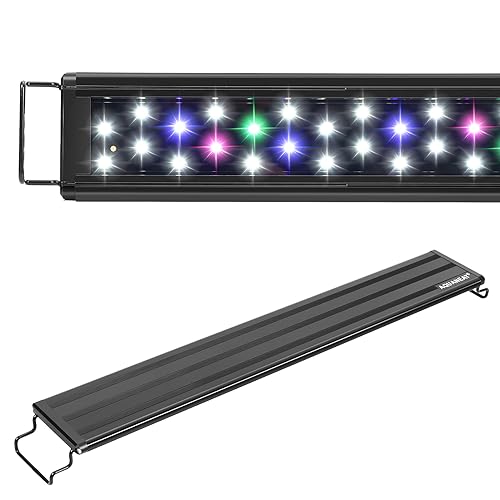
This is the light I recommend to anyone starting their first planted tank. Its 42 LEDs (30 white 6500 K plus blue, pink, and green accents) drive Anubias, Java fern, and moss without any fuss, and the sliding brackets fit anything from an 18-inch 10-gallon up to a 24-inch 20-long. I have run one over a shrimp tank for two years without a flicker. Just remember it is not waterproof, so hood clearance matters.
Pros
- Fits most 18-24 in tanks regardless of rim thickness.
- Full-spectrum mix punches above its price for low- and medium-light plants.
- Very low power draw and near-silent operation.
Cons
- No dimmer, no timer, no fade. On or off.
- Housing is not waterproof, so keep it above splash line.
hygger Clip-On 24/7 Aquarium LED Light
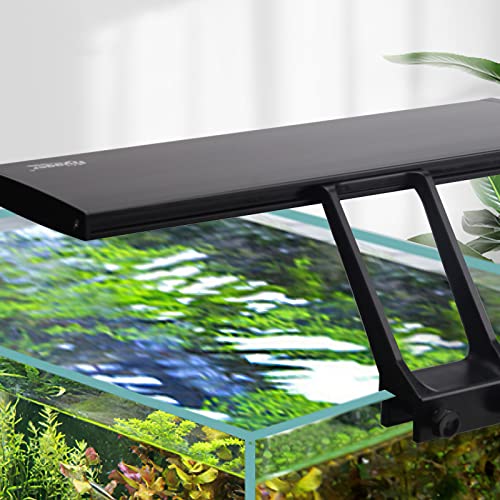
I set this one on a 15-gallon rimless cube and it earned its keep on day one. The clamp grabs glass up to 0.9 inches thick, and you can flip it horizontal or vertical depending on your scape. Default 24/7 mode ramps orange sunrise (6-8 am), pushes crisp daylight (8 am-10 pm), and dims to blue moonlight (10-10:50 pm). DIY mode gives you three timer lengths, five brightness steps, and eight colours.
Pros
- 24/7 ramping cycle runs on its own once set.
- Clip mount works on thin rimless glass and can be reoriented.
- Modular power adapter, so a snagged cable does not brick the unit.
Cons
- Fits 12-20 in tanks only; wider builds need two units.
- No brightness control while Cycle Colour is active.
hygger 18W 24/7 Aquarium LED Light
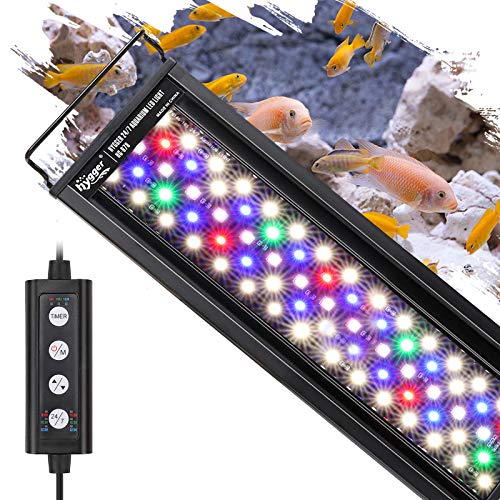
For a 20 to 29-gallon planted tank you want programming without paying flagship prices. That is where this unit slots in. 98 LEDs (2835 + 5050) push 1,075 lumens across an extendable aluminium bracket that spans 18-24 inches. Sunrise, daylight, and moonlight transitions ramp over 15 minutes so my rummy-nose tetras never darted at the change.
Pros
- Real 24/7 cycle with shiftable start time.
- Eight colour presets plus five brightness steps in DIY mode.
- Separable adapter and a proper thick aluminium heat sink.
Cons
- Only three fixed timer options: 6, 10, or 12 hours.
- No custom RGB mixing outside the preset cycle.
hygger 26W 24/7 Aquarium LED Light

I used this one over a 40-gallon breeder and the extra wattage told. 130 LEDs, 85 CRI, and the same 24/7 ramping logic as the 18W but with more punch at substrate for medium-light stem plants like Ludwigia and Rotala. The bendable bracket extends 30-36 inches and heat management is easily the best of the hygger line I tested. If you have LED strips that run scorching, here is why LED heat is not always benign.
Pros
- Enough PAR for medium-light stems on a 30-36 in tank.
- Same detachable adapter as the smaller hygger units.
- 15-minute fade in and out keeps fish calm at transitions.
Cons
- No Wi-Fi or app control; buttons only.
- 85 CRI is fine, not gallery-grade.
hygger AQ-48 LED Aquarium Light
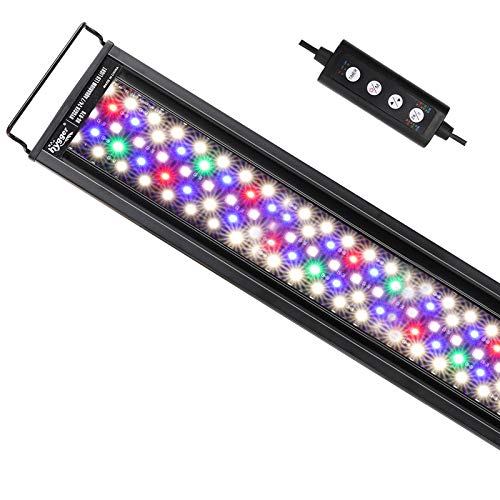
If you are running a 55-75 gallon Dutch or Amano-style build, this is what I would put over it. 2,815 lumens from 106 white, 43 blue, 15 red, 8 green, and 43 RGB LEDs give you honest colour pop without turning the tank into a nightclub. Default cycle turns on at 6 am and off at 10:50 pm. DIY mode still gives you seven colours, five intensities, and three timer presets.
Pros
- Wide LED mix covers full-spectrum with an RGB kicker.
- Realistic 24/7 rhythm sets and forgets itself.
- Sliding brackets clamp firmly on standard rim widths.
Cons
- Auto on/off times are fixed unless you go into DIY mode.
- Sized for 48-54 in tanks only.
SEAOURA LED Aquarium Light (12-18 Inch)

This one is for aquascapers who care about how their plants look, not just whether they grow. The SMD2835 LEDs (6500 K plus red, pink, green, blue) hit 89 CRI, which is the highest number in this roundup. Three colour modes: white only, full colour, or blue only. Ten brightness steps, three timer lengths. Ramp fade is 15 minutes each way.
Pros
- 89 CRI renders reds and yellows convincingly.
- Extendable metal bracket suits lidded and rimless 12-18 in tanks.
- Memory recall after a power outage.
Cons
- Only three colour presets; advanced hobbyists may want more.
- No remote; all changes happen on the fixture.
SEAOURA Clip-On Aquarium Light

I have this one on a shrimp bowl and a betta cube. Small tank, small light, IP68 housing so a splash during water changes does not kill it. Full-spectrum 5054 + 2835 chips deliver seven single colours plus a sunrise-to-moonlight Cycle mode. 10 intensity levels in every mode except Cycle, which runs at a fixed level. The bracket slides and adjusts height, so it will sit on rimmed or rimless 7-12 in tanks. Rated 30,000 hours.
Pros
- IP68 rated, so it takes real splash.
- Sixteen programmable timer points and five presets.
- Remembers your settings after a power cut.
Cons
- Cycle mode locks intensity at a fixed level.
- Designed for low- to medium-light plants, not carpeting species.
How to choose a planted aquarium light
- PAR at substrate, not lumens at the fixture. Manufacturers love publishing lumen totals. What matters is Photosynthetically Active Radiation reaching your plants twelve inches below the light. If a spec sheet does not list PAR at depth, treat it as a low-light unit.
- Full-spectrum LEDs beat cool-white strips. A mix of 6500 K white with red (620-660 nm) and blue (440-470 nm) drives real photosynthesis. Pure blue-white “aquarium moonlight” strips look good and grow nothing.
- Programmable timer or 24/7 mode. Set it once and forget it. Ten to twelve hours a day is the sweet spot for most planted tanks. Longer means algae. Shorter means stunted growth.
- Rise and fade transitions. A sudden on-off startles fish and stresses shrimp. Fifteen-minute ramps solve it.
- Waterproof or above-splash rating. IP68 lets you clean glass without panic. If the housing is not rated, keep it well above the water line.
- Serviceable parts. A detachable adapter or replaceable bracket means a snag does not scrap the whole unit. This is worth the extra $10.
For the electrical side of your setup (drivers, low-voltage transformers), the same rules apply to any low-voltage LED transformer you might use in-line for outdoor kits.
Frequently Asked Questions
What spectrum does a planted aquarium light need?
Aim for a full-spectrum LED that covers 400 to 700 nm, with real red (620-660 nm) for stem plants and blue (440-470 nm) for leaf growth. Any fixture labeled “plant” or “aquarium plant” from a reputable brand meets this. Pure cool-white daylight strips will keep plants alive but colours will look washed out.
How many watts per gallon do I need?
For modern LEDs, 0.5 to 1.0 watts per gallon covers most low- to medium-light plants. A 20-gallon tank runs happy on a 10-20 W LED. High-light species like dwarf hairgrass or Rotala macrandra will want closer to 1.5 W/gal plus CO2.
How long should I run the light each day?
Ten to twelve hours a day, on a timer, for most planted tanks. Longer than that and algae wins. If you are seeing green fuzz on glass, cut the photoperiod by an hour before you dose anything.
Do I need CO2 to run these lights?
For low- to medium-light setups with Anubias, Java fern, moss, and Cryptocoryne, no. Once you push into medium-high light or high-CRI aquascaping fixtures at full brightness, you probably do. CO2 lets plants use the extra light instead of leaving it for algae.
Is a clip-on light strong enough for a planted tank?
For nano tanks (5 to 20 gallons) and low- to medium-light plants, yes. The hygger and SEAOURA clip-ons I picked here are honest fixtures. For anything above 20 gallons or if you want carpeting plants, buy a bar fixture instead.
Can I leave a moonlight setting on overnight?
You can, but plants and fish both need real dark to rest. If you run a blue moonlight, keep it under two hours and only for viewing. The 24/7 cycles on the hygger units cap moonlight at 50 minutes, which is about right.
Bottom line
For most freshwater planted tanks between 18 and 24 inches, the AQUANEAT LED Aquarium Light is the honest starting point. It is cheap, it does not fail, and it fits. If you want a 24/7 sunrise-to-moonlight cycle without programming yourself into a corner, step up to the hygger Clip-On 24/7 for nano tanks or the hygger 18W 24/7 for anything bigger.