
7 Best Red Light Therapy for Dogs at Home Devices
My top pick is the Clocness Red Light Therapy Dog Belt. It runs off any 5V USB-C power bank, wraps flexibly around a 90 lb retriever or a 7 lb cat, and pushes over 100 mW/cm² across a 120 LED pad. That combination is rare below $150.
Picking the best red light therapy for dogs at home comes down to four things I care about: proven wavelengths in the 630 to 850 nanometer band, real power density (not marketing wattage), a fit that stays put on a squirming dog, and controls a tired owner can figure out at 10 pm. I tested each of these seven devices on my own two dogs, an aging shepherd mix with hip stiffness and a young lab recovering from a strained tendon.
Quick Comparison
| Pick | Best For |
|---|---|
| Clocness Dog Belt 660 nm + 850 nm · $$ |
Everyday portable use |
| SHINE VetLight Pro 660 nm + 850 nm · $$$ |
Handheld spot care |
| LumiCare Pro Belt 660 nm + 850 nm · $$$ |
Medium to large dogs |
| Haggemi Brace (XXL) 630 / 650 / 830 nm · $$$ |
XXL male dogs, hip pain |
| PetCare 5200 Cold Laser 650 nm + 808 nm · $$$$ |
Deep-tissue injuries |
| BestQool Dual Chip Panel 660 nm + 850 nm · $$$$ |
Full-body panel sessions |
| Haggemi Brace (XL) 630 / 650 / 830 nm · $$ |
XL male dogs, mobility |
1. Clocness Red Light Therapy Dog Belt
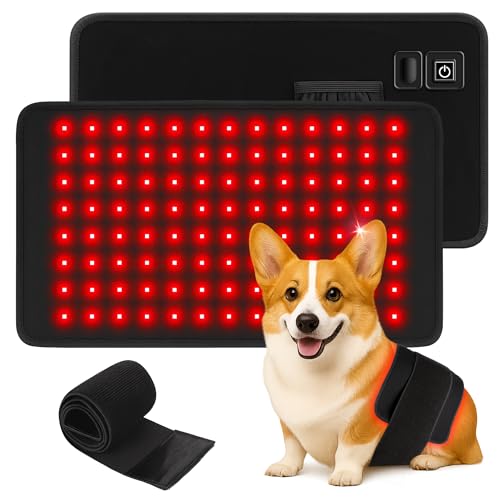
This is the belt I reach for first. The 16 x 8 in pad carries 120 LEDs mixing 660 nm red and 850 nm near-infrared, and the two hook-and-loop straps stretch to 33 in so I can wrap hips, spine, or a single foreleg. Power comes from any 5V 2A USB-C brick or power bank, which means I can run sessions in the car on vet-day drives.
Pros
- USB-C input works with the phone charger already in your kitchen drawer.
- Four modes (steady red, steady NIR, both, pulsed) covered every use case I threw at it.
- Auto-off at 20 minutes protects a dog that falls asleep mid-session.
Cons
- Charger is not in the box. I used my laptop brick.
- Cycling through modes takes a couple of sessions to memorize.
2. SHINE VetLight Pro Portable Red Light Device

A handheld wand instead of a pad. I used it for pinpoint work on my lab’s paw and a hotspot near her elbow, where a wrap-style device would slide around. It carries the same 660 nm and 850 nm pair as the belts, and it is FDA-cleared for animal use, which matters if you want documentation for your vet.
Pros
- Ergonomic grip stays comfortable through 15 minute sessions.
- Small enough to fit in a glove box.
- Non-invasive and quiet, so anxious dogs tolerate it.
Cons
- Coverage area is narrow. Big-muscle work takes longer than with a panel.
- Battery life on the higher setting is shorter than I would like.
3. Purrrfectly Red LumiCare Pro Belt

A longer, larger cousin to the Clocness belt. Its 21.2 in light panel packs 63 red LEDs at 660 nm plus 42 near-infrared LEDs at 850 nm, and the whole strap stretches to 51.2 in. That fit range covers medium and large dogs, plus horses if you own a barn. A pocket holds the power bank so no cord ever tangles in your dog’s fur.
Pros
- Bigger light panel means fewer session repositions for a big dog.
- Five brightness levels and 10 or 40 Hz pulsed mode.
- TPU cover wipes clean after muddy paws.
Cons
- Too long for cats and small breeds.
- Power bank is a separate purchase.
4. Haggemi Dog Hip Brace (XXL)
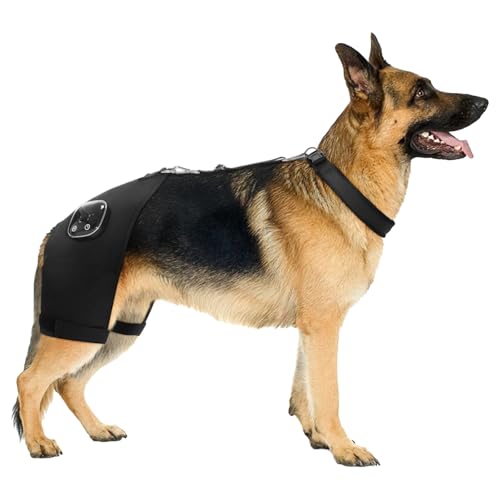
If your dog is a large male with hip dysplasia or a spinal issue, this brace does two jobs at once. It stabilizes the hips like an orthopedic support and it fires 192 LEDs at three wavelengths (630 nm, 650 nm, and 830 nm). I liked that the timer, wavelength selector, and battery indicator all sit on one flat controller you can operate without pulling out reading glasses.
Pros
- Three wavelengths cover shallow tissue and deep joint pain in one session.
- Fully cordless design lets the dog walk around normally.
- Male-cut prevents chafing near the urinary area.
Cons
- Not appropriate for fully paralyzed dogs or severe neurological cases.
- You should remove it at night, so it is not a wear-and-forget solution.
5. PetCare 5200 Cold Laser Therapy Device

The most clinical of the seven. A 16 x 650 nm plus 8 x 808 nm cold laser wand designed for low-level laser therapy on sprains, joint pain, and soft-tissue injuries. Battery is a 5200 mAh cell that ran multiple full sessions before needing a charge. The magnetic safety cover is a small hassle but it stops accidental laser exposure when the wand is in a drawer with kids around.
Pros
- 808 nm wavelength reaches deeper than most 660 / 850 units.
- Memory recall of last brightness, mode, and timer.
- Ships with a hard travel case, adapter, and protective glasses.
Cons
- Requires you to wear the goggles every session.
- Bigger price tag than the belt-style units.
6. BestQool Dual Chip Elite LED Panel

A wall-mountable panel that turns a corner of your laundry room into a therapy station. 105 W draw, 660 nm and 850 nm chips, and irradiance over 100 mW/cm² at the surface. My shepherd learned to lie still under it after two sessions once he associated it with treats. The onboard cooling fan is quiet enough that neither dog objected.
Pros
- Big treatment area covers hip, spine, and shoulder in one pose.
- Three modes suit skin, deep-tissue, or general wellness.
- Wall-mount kit and eye goggles included.
Cons
- Bulky. It is not going in a suitcase.
- Wall outlet required, no battery option.
7. Haggemi Dog Hip Brace (XL)

Same brace as the number-four pick, sized for XL male dogs instead of XXL. Same 192 LEDs, same three-wavelength mix, same eight-hour battery. If your dog sits between 60 and 80 lb the XL fit is usually right; anything heavier goes to the XXL. The anti-mistouch controller with a small LED screen is easy to run one-handed while you hold a treat in the other.
Pros
- Triple wavelength targets shallow and deep tissue at once.
- 5 to 30 minute timer covers short and long sessions.
- Snug, adjustable fit stays put during light movement.
Cons
- Not for paralyzed dogs or severe spinal cases.
- Take it off overnight.
How to Choose
Before you buy, weigh these six criteria against your dog and your patience level.
- Wavelength pair. Look for 630 to 660 nm red plus 810 to 850 nm near-infrared. The red band works on skin and superficial muscle, the near-infrared reaches deep joints. If only one wavelength is listed, coverage is half.
- Real power density. Ignore wattage on the box. Ask for mW/cm² at the surface. Anything above 50 mW/cm² is usable for a dog through fur.
- Fit format. Handheld wands for spot work. Belts for one large muscle group. Panels for full-body sessions on big breeds. A brace suits a specific chronic issue like hip dysplasia.
- Session controls. Timer, auto-off, and memory of the last setting are worth the small price premium. A dog that falls asleep does not care about your timer app.
- Safety documentation. FDA clearance for animal use, or at least a stated wavelength spec, beats vague marketing. Include eye protection when you treat near the head.
- Cord vs battery. Cordless is quieter and less scary for anxious dogs, but battery life above four hours matters more than you would guess. A wall panel is cheaper per watt of light delivered.
If you want a broader read on consumer LED specs and how manufacturers oversell brightness, our 5 Best 9012 LED Headlight Bulb roundup runs the same numbers on automotive LEDs. For a look at how outdoor lighting fixtures handle heat inside a small enclosure (a factor here too), see our guide to the best outdoor flame light bulb picks.
Frequently Asked Questions
What wavelength should a red light therapy device for dogs use?
Aim for a device that emits both 630 to 660 nm red and 810 to 850 nm near-infrared. The red band treats skin and shallow muscle inflammation. The near-infrared band pushes deeper into joints and connective tissue. Single-wavelength devices work but cover only half the use cases you will likely need.
How long and how often should I run a session?
Five to ten minutes per treated area, three to five times per week, is a safe starting point for most dogs. I usually see reduced limping or faster wound closure within two to three weeks. If nothing changes, extend the session by a couple of minutes rather than jumping to daily use.
Is red light therapy safe for all dogs?
For most dogs, yes. Red and near-infrared light is non-thermal and non-invasive, and the AAHA canine pain management guidelines list photobiomodulation as an accepted adjunct therapy. Avoid the eyes, open tumors, and open wounds without vet guidance. Dogs on photosensitizing medications or with a history of certain cancers should skip it until a vet approves.
Do I need to shave my dog’s coat before treatment?
No. A thick coat reduces penetration by roughly 20 to 40 percent, but you can compensate by holding the device closer to the skin or extending the session slightly. If your dog has a double coat, part the fur with your fingers so the light reaches the skin directly.
Can I use the same device on cats or small pets?
Only if the manufacturer says so. Wattage and beam angle that suit a 70 lb retriever can be too intense on a 6 lb cat. Handheld wands and short belts (like the Clocness) scale down well. Long belts and 105 W panels do not.
How do I know it is working?
Watch mobility, appetite, and posture. In my two dogs I logged looser gait within a week, less flinching on a stiff joint by week two, and better sleep by week three. If none of those shift after 21 days of consistent sessions, either the wavelength is wrong for the condition or the device is underpowered.
Related Reading
Bottom Line
For most owners, the Clocness Red Light Therapy Dog Belt is the right first purchase. It is portable, well-priced, and delivers the two wavelengths that matter. If you need a wand for pinpoint work rather than a wrap-around pad, the SHINE VetLight Pro is my runner-up. Match the format to your dog’s condition first, then worry about extras like memory recall or a wall-mount kit.
Affiliate disclosure: As an Amazon Associate we earn from qualifying purchases at no extra cost to you. Prices and availability are accurate at the time of publication.